Is Dove 0% Aluminum Deodorant Cucumber & Green Tea Safe During Pregnancy? (Updated 2026 Guide)
Updated September 9, 2026
Dove 0% Aluminum Deodorant Cucumber & Green Tea
Dove
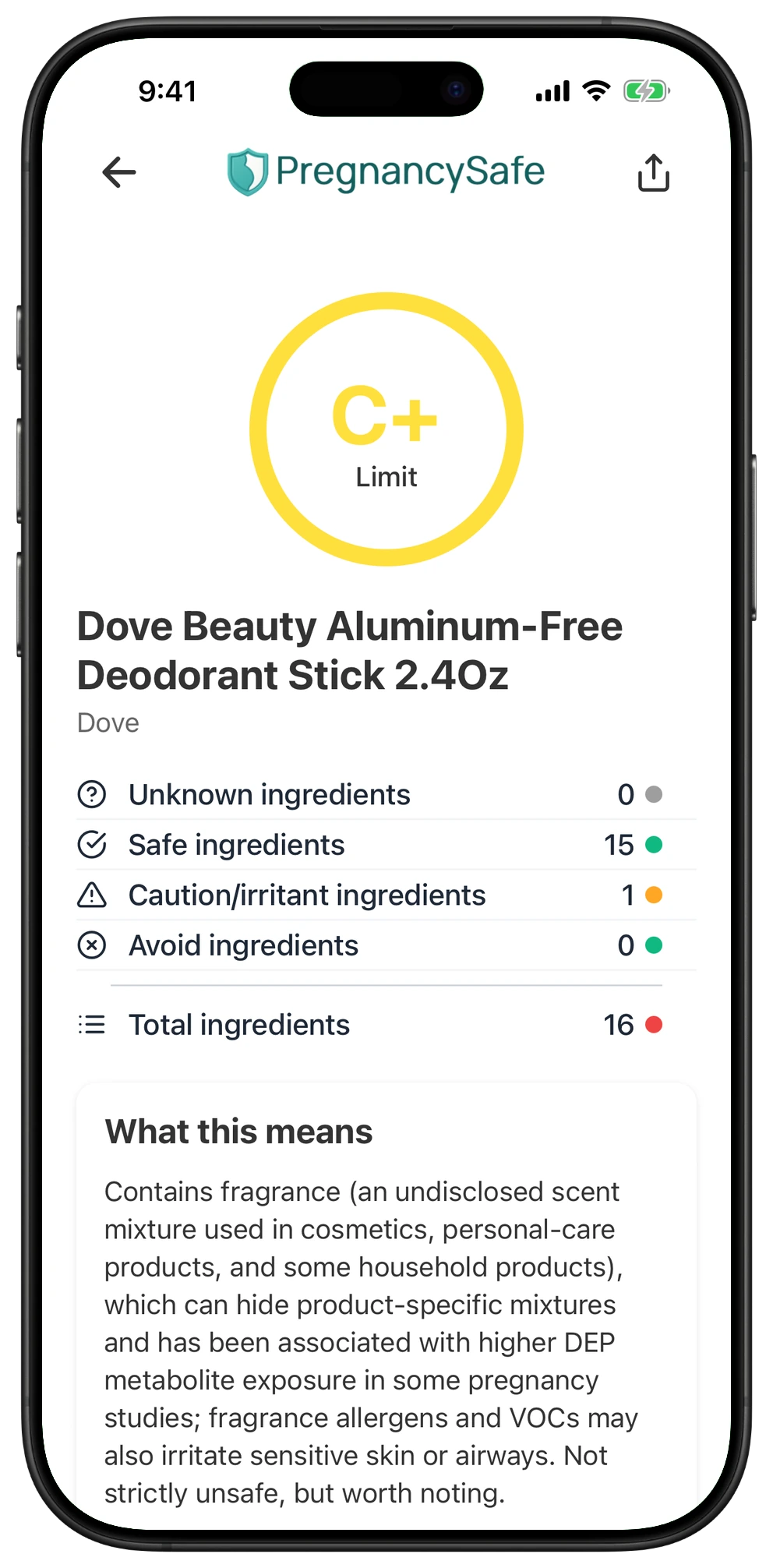
Dove Cucumber & Green Tea Aluminum Free Deodorant receives a C+ grade, making it a use with caution choice during pregnancy rather than an unrestricted recommendation. Fragrance is the main caution because its mixture is not fully disclosed and can cause irritation; this does not establish that ordinary underarm use harms your baby. A fragrance free deodorant is a reasonable way to reduce that uncertainty.
You can use this, but maybe don't make it your everyday go to. Not the end of the world if you've used it. Consult your OBGYN or midwife if you have concerns.
Pregnancy Safe is 100% independent and research driven. No companies pay to promote or sponsor products.
Stress Less This Pregnancy
Check your deodorant in the app

What Ingredients Are in Dove 0% Aluminum Deodorant Cucumber & Green Tea?
Dove 0% Aluminum Deodorant Cucumber & Green Tea has 19 ingredients. We flagged 1 ingredient to use with caution.
fragrance
CAUTION
A fragrant substance used to add a pleasant aroma to products or environments. Fragrance warrants caution for normal topical use because of mixture uncertainty and possible irritation, but indirect pregnancy exposure studies do not prove harm from this deodorant.
linalool
LIKELY SAFE
Linalool is a naturally occurring aromatic alcohol found in many flowers and spices, known for its floral, lavender like scent and calming properties. Linalool is rated likely safe at diluted topical amounts, although the supporting lavender evidence is indirect and does not establish this deodorant's pregnancy safety.
propylene glycol
LIKELY SAFE
Propylene glycol is a colorless, odorless, and tasteless synthetic liquid commonly used as a solvent, humectant, and carrier in food, pharmaceuticals, and cosmetic products. Propylene glycol is low concern at normal cosmetic amounts on intact skin during pregnancy; high dose oral or intravenous medication concerns do not describe ordinary underarm use.
glycerin
SAFE
Glycerin is a colorless, odorless, and sweet tasting humectant commonly used in skincare products to attract and retain moisture in the skin. Glycerin is compatible with pregnancy at normal cosmetic amounts, with low exposure expected from topical underarm use.
water
SAFE
Water is a clear, tasteless, and essential liquid that sustains all known forms of life. Water used as a topical product base is not a pregnancy concern during normal underarm use, though the finished formula and microbial quality still matter.
alpha isomethyl ionone
SAFE
Alpha isomethyl ionone is a synthetic fragrance compound commonly used for its floral, violet like scent in perfumes and cosmetic products. This fragrance ingredient is unflagged in the topical assessment, but that does not establish pregnancy safety at the amount used in this deodorant.
benzyl alcohol
SAFE
Benzyl alcohol is a colorless, aromatic alcohol commonly used as a preservative and solvent in cosmetics and pharmaceuticals. This preservative and solvent is unflagged here, without a pregnancy specific assessment of its topical dose in this deodorant.
benzyl benzoate
SAFE
Benzyl benzoate is an aromatic ester commonly used as a medication to treat scabies and lice, as well as an industrial solvent and fragrance ingredient. This fragrance ingredient is unflagged here, and its medicinal uses do not establish pregnancy safety at this deodorant's topical dose.
citronellol
SAFE
Citronellol is a naturally occurring floral and citrus scented alcohol commonly used in perfumes and fragrances. This scent ingredient is unflagged in the topical assessment, rather than specifically established as safe for deodorant use during pregnancy.
coumarin
SAFE
Coumarin is a naturally occurring aromatic compound known for its sweet, vanilla like scent and often used in flavorings and fragrances. Coumarin is unflagged here, but its use as a fragrance does not establish pregnancy safety at this deodorant's topical dose.
dipropylene glycol
SAFE
Dipropylene glycol is a clear, colorless, and odorless solvent commonly used in cosmetics, fragrances, and industrial applications for its excellent solvency and low toxicity. This cosmetic solvent is unflagged here, with no pregnancy specific evidence establishing safety at the topical amount in this formula.
disodium edta
SAFE
Disodium EDTA is a chelating agent commonly used in cosmetics and food products to bind metal ions and improve stability. This formula stabilizing ingredient is unflagged here, rather than individually confirmed safe at this deodorant's topical dose during pregnancy.
geraniol
SAFE
Geraniol is a naturally occurring, sweetly floral and rose like aromatic alcohol commonly used in perfumes and flavorings. This fragrance ingredient is unflagged here, but its natural origin does not establish pregnancy safety for topical deodorant use.
hexyl cinnamal
SAFE
Hexyl cinnamal is a synthetic aromatic compound commonly used as a fragrance ingredient to impart a sweet, floral, and jasmine like scent. This fragrance ingredient is unflagged here, without a pregnancy specific assessment of the topical amount in this deodorant.
limonene
SAFE
Limonene is a naturally occurring citrus scented compound commonly used for its aromatic properties and potential health benefits. This citrus scented ingredient is unflagged here, rather than specifically established as safe at this deodorant's topical dose during pregnancy.
poloxamine 1307
SAFE
Poloxamine 1307 is a synthetic amphiphilic copolymer used as an excipient in pharmaceutical and cosmetic formulations to enhance drug delivery and stability. This formulation ingredient is unflagged here, but pregnancy specific safety at the amount applied in this deodorant has not been established.
simethicone
SAFE
Simethicone is an anti foaming agent used to relieve bloating, discomfort, and gas by breaking up gas bubbles in the digestive tract. Simethicone is unflagged here, and its digestive medicine role does not establish pregnancy safety for its topical use in this deodorant.
sodium stearate
SAFE
Sodium stearate is a white, waxy, crystalline compound commonly used as a soap base and thickening agent in personal care and cleaning products. This thickening ingredient is unflagged here, rather than individually confirmed safe for topical deodorant exposure during pregnancy.
stearic acid
SAFE
Stearic acid is a naturally occurring saturated fatty acid commonly used as an emulsifier and thickening agent in cosmetics and skincare products. This cosmetic thickener is unflagged here, without a pregnancy specific assessment of its topical dose in this formula.
Answering Your Questions
How much Dove 0% Aluminum Deodorant Cucumber & Green Tea is safe during pregnancy?
Apply a thin layer to intact underarm skin, following the package directions rather than adding extra layers. No pregnancy specific amount has been established for this formula, so avoid treating a particular number of swipes as a proven safety limit.
Can you use Dove 0% Aluminum Deodorant Cucumber & Green Tea daily while pregnant?
Follow the label and reapply only as needed rather than repeatedly layering it throughout the day. Stop using it if you develop irritation or find that the scent triggers symptoms, and consider a fragrance free option.
Why does this Dove deodorant receive a C+ grade?
The C+ comes from ingredient based scoring, not a clinical test of pregnancy outcomes. Fragrance carries a caution rating, while linalool and propylene glycol are rated likely safe for normal topical exposure. Many other ingredients are unflagged rather than individually confirmed safe in pregnancy.
Can I use this deodorant while breastfeeding?
The pregnancy grade does not establish breastfeeding safety, and a product specific breastfeeding assessment is not available here. If you use it, keep application to your underarms, not your breast or nipple, and avoid direct contact between treated skin and your baby's mouth. A fragrance free option can reduce fragrance exposure and irritation concerns.
What alternative should I look for during pregnancy?
Look for a fragrance free deodorant with a clearly listed formula, especially if scents or fragranced products bother you. Check the complete ingredient list rather than relying on aluminum free or natural claims; neither guarantees a better pregnancy assessment.
Should I use aluminum free deodorant when pregnant?
An aluminum free label alone does not determine pregnancy suitability. This formula is aluminum free but still receives a C+ because of its ingredient profile, particularly fragrance, so consider the whole formula rather than that single claim.
Are all Dove deodorants rated the same for pregnancy?
No single assessment should be applied to every Dove deodorant. This C+ applies to the Cucumber & Green Tea aluminum free stick formula reviewed here, not automatically to other scents, sprays, or antiperspirants.
Does the fragrance mean this deodorant contains phthalates?
Not necessarily: fragrance does not prove that this particular formula contains phthalates. Some pregnancy studies associate fragranced product use with higher exposure to a metabolite of DEP, but those findings do not establish the contents of this stick or harm from ordinary underarm application.
Should I worry if I already used this deodorant during pregnancy?
Ordinary occasional underarm use is not an emergency on the basis of this assessment. The caution reflects fragrance related uncertainty and possible irritation, not proof that your use harmed your pregnancy. You can choose a fragrance free product going forward if you prefer to reduce exposure.
What Are Pregnancy Safe Alternatives to Dove 0% Aluminum Deodorant Cucumber & Green Tea?
Here are some solid alternatives. Everything below has an A or B grade, meaning no flagged ingredients in our database.
| Grade | Product | Brand | Type |
|---|---|---|---|
| A | Sweet Coconut Aluminum Free Deodorant | Hello Bello | deodorant |
| A | Sweet Coconut Aluminum Free Deodorant 2.6 Oz | Hello Bello | deodorant |
| A | Fresh Cream Deodorant - Sensitive & Fragrance-Free 60Ml | Moogoo | deodorant |
| A | Vegan & Sensitive Skin Formula Solid Deodorant | Humble Brands | deodorant |
Are Other Dove Products Safe During Pregnancy?
We looked at 10 other Dove products. 0 are pregnancy safe (A or B grade), while 10 need a closer look.
| Grade | Product | Type |
|---|---|---|
| C | Advanced Care Caring Coconut Antiperspirant Deodorant Stick | antiperspirant |
| C- | Advanced Care Dry Spray Antiperspirant Deodorant Original Clean | antiperspirant |
| C- | Advanced Care Invisible Cucumber & Cactus Water Antiperspirant | antiperspirant |
| C- | Advanced Care Original Clean 72H Antiperspirant Deodorant Stick | antiperspirant |
How Does Dove 0% Aluminum Deodorant Cucumber & Green Tea Compare to Other Deodorants?
We graded 1,100 Deodorants for pregnancy safety. Here's how they stack up:
Dove 0% Aluminum Deodorant Cucumber & Green Tea earns a C+ grade, placing it among the majority of Deodorants. Only 3% of products in this category get an A grade, so it pays to choose carefully.
How Do We Score Products for Pregnancy Safety?
We analyze each product's ingredients and category to flag known risks and provide cautionary notices for general category safety concerns.
A - Safe
Excellent choice! All ingredients are considered safe during pregnancy.
What to do: Use with confidence.
B - Likely Safe
Pretty much safe with very minimal risk. Some ingredients may have limited pregnancy studies, but no significant safety concerns have been identified.
What to do: Use with confidence.
C - Limit
Contains ingredients with some pregnancy considerations. Research shows these ingredients may have limited safety data, potential for minor hormonal effects, or require caution based on animal studies.
What to do: Use sparingly and consider safer alternatives when available.
D - Caution
Similar to C grade but contains multiple cautionary ingredients. The combination increases overall concern.
What to do: Try to avoid if that makes you feel better. If you've already used it, no need to panic.
F - Avoid
Contains an ingredient Pregnancy Safe recommends avoiding during pregnancy. This may reflect an established risk or a precaution based on limited evidence; check the ingredient guidance and exposure context.
What to do: Do not use during pregnancy. If you've already used it, don't worry - contact your OBGYN if concerned.
People Also Checked
References
- https://www.fda.gov/cosmetics/cosmetic-ingredients/fragrances-cosmetics
- https://www.fda.gov/cosmetics/cosmetic-ingredients/phthalates-cosmetics
- https://www.fda.gov/cosmetics/cosmetic-ingredients/allergens-cosmetics
- https://pmc.ncbi.nlm.nih.gov/articles/PMC3110684/
- https://pmc.ncbi.nlm.nih.gov/articles/PMC4016195/
- https://pmc.ncbi.nlm.nih.gov/articles/PMC4097177/
- https://pmc.ncbi.nlm.nih.gov/articles/PMC8453372/
- https://pmc.ncbi.nlm.nih.gov/articles/PMC10999525/
- https://www.epa.gov/indoor-air-quality-iaq/volatile-organic-compounds-impact-indoor-air-quality
- https://pmc.ncbi.nlm.nih.gov/articles/PMC11641599/
- https://www.nccih.nih.gov/health/lavender
- https://mothertobaby.org/baby-blog/slippery-topic-essential-oils-pregnancy/
- https://www.mayoclinichealthsystem.org/hometown-health/speaking-of-health/essential-oils-and-pregnancy
- https://pmc.ncbi.nlm.nih.gov/articles/PMC7956842/
- https://www.ecfr.gov/current/title-21/part-184/section-184.1666
- https://pmc.ncbi.nlm.nih.gov/articles/PMC7009459/
- https://pubmed.ncbi.nlm.nih.gov/15995735/
- https://pubmed.ncbi.nlm.nih.gov/23064775/
- https://www.ema.europa.eu/en/documents/scientific-guideline/questions-and-answers-propylene-glycol-used-excipient-medicinal-products-human-use_en.pdf
- https://pmc.ncbi.nlm.nih.gov/articles/PMC11867916/
- https://pubmed.ncbi.nlm.nih.gov/29281181/
- https://pubmed.ncbi.nlm.nih.gov/40234020/
- https://www.hfpappexternal.fda.gov/scripts/fdcc/index.cfm?id=GLYCERIN&set=FoodSubstances
- https://pubmed.ncbi.nlm.nih.gov/31840548/
- https://pmc.ncbi.nlm.nih.gov/articles/PMC7009851/
- https://www.medicinesinpregnancy.org/leaflets-a-z/glycerin-suppositories/
- https://mothertobaby.org/pregnancy-breastfeeding-exposures/cosmetics/
- https://www.personalcarecouncil.org/wp-content/uploads/2022/03/INCINomenclatureConventionsReferenceInformation2022_v1.pdf
- https://www.seslhd.health.nsw.gov.au/sites/default/files/groups/Royal_Hospital_for_Women/Mothersafe/documents/skinhaircareandcosmetictreatmentsapril2021.pdf
- https://www.nhs.uk/pregnancy/complications/itching-and-intrahepatic-cholestasis/
- https://www.fda.gov/cosmetics/resources-consumers-cosmetics/cosmetics-pregnancy
- https://www.fda.gov/cosmetics/cosmetics-guidance-documents/good-manufacturing-practice-gmp-guidelinesinspection-checklist-cosmetics
- https://www.fda.gov/cosmetics/potential-contaminants-cosmetics/microbiological-safety-and-cosmetics
- https://pubmed.ncbi.nlm.nih.gov/25153208/