Best Pregnancy Safe Deodorant (Updated 2026 Guide)
Updated September 9, 2026
The Answer
For pregnancy, choose a deodorant your skin tolerates and use it as directed; fragrance free is a practical option, while aluminum free is not an established pregnancy requirement. Our catalog contains mostly C range grades, but these ingredient scores do not establish whether normal underarm use is clinically safe or unsafe.
Deodorants control odor, while antiperspirants reduce sweating, so choose according to what you need. Fragrance mixtures can cause irritation and introduce uncertainty about individual scent ingredients; aluminum chlorohydrate has very low systemic absorption from intact skin, although direct pregnancy outcome evidence is limited. Use labeled amounts on intact skin, avoid inhaling sprays, and seek individualized advice about treatment products or kidney disease.
Pregnancy Safe is 100% independent and research driven. No companies pay to promote or sponsor products.
Stress Less This Pregnancy
Check your exact deodorant in the app

✓ What's Safe
- • Choose fragrance free formulas if you want to reduce scent mixture exposure or your skin reacts to scented products.
- • Check whether the label promises odor control, sweat reduction, or both; an aluminum free deodorant may not keep your underarms dry.
- • Read the complete ingredient list for the exact scent, format, and version you are buying rather than relying on the brand name.
- • Consider a stick, gel, or roll on if you want to avoid breathing spray mist or loose powder.
- • Read antiperspirant active ingredient concentrations, application directions, and health warnings before use.
- • Match a listed product to its exact version and read its qualifications; its grade is not a pregnancy safety guarantee.
✗ What to Avoid
- • Avoid fragrance, parfum, or natural fragrance if scents irritate your skin or airways; these are related scent mixture labels, not proof that a product contains phthalates.
- • Avoid benzyl salicylate if you have a known allergy to it; its presence at cosmetic concentrations does not establish pregnancy harm.
- • Avoid chamomilla recutita flower extract if you have reacted to chamomile, and be cautious with it if you have ragweed or daisy family allergies.
- • Avoid breathing loose talc powder or deodorant spray; talc contamination and airborne exposure are different concerns from use in a solid formula.
- • Avoid applying deodorant or antiperspirant to broken or irritated skin, or continuing a formula that causes a reaction.
- • Avoid treating aluminum free, natural, or crystal claims as pregnancy safety certifications; crystal alum still contains aluminum.
Most Common Ingredients in Deodorant Products
We analyzed 1,100 deodorant products. Here are the most common ingredients, ranked by how often they appear:
Ingredients to Watch Out For in Deodorant
These are the most common flagged ingredients across 1,100 deodorant products we analyzed.
fragrance
Caution
A fragrant substance used to add a pleasant aroma to products or environments.
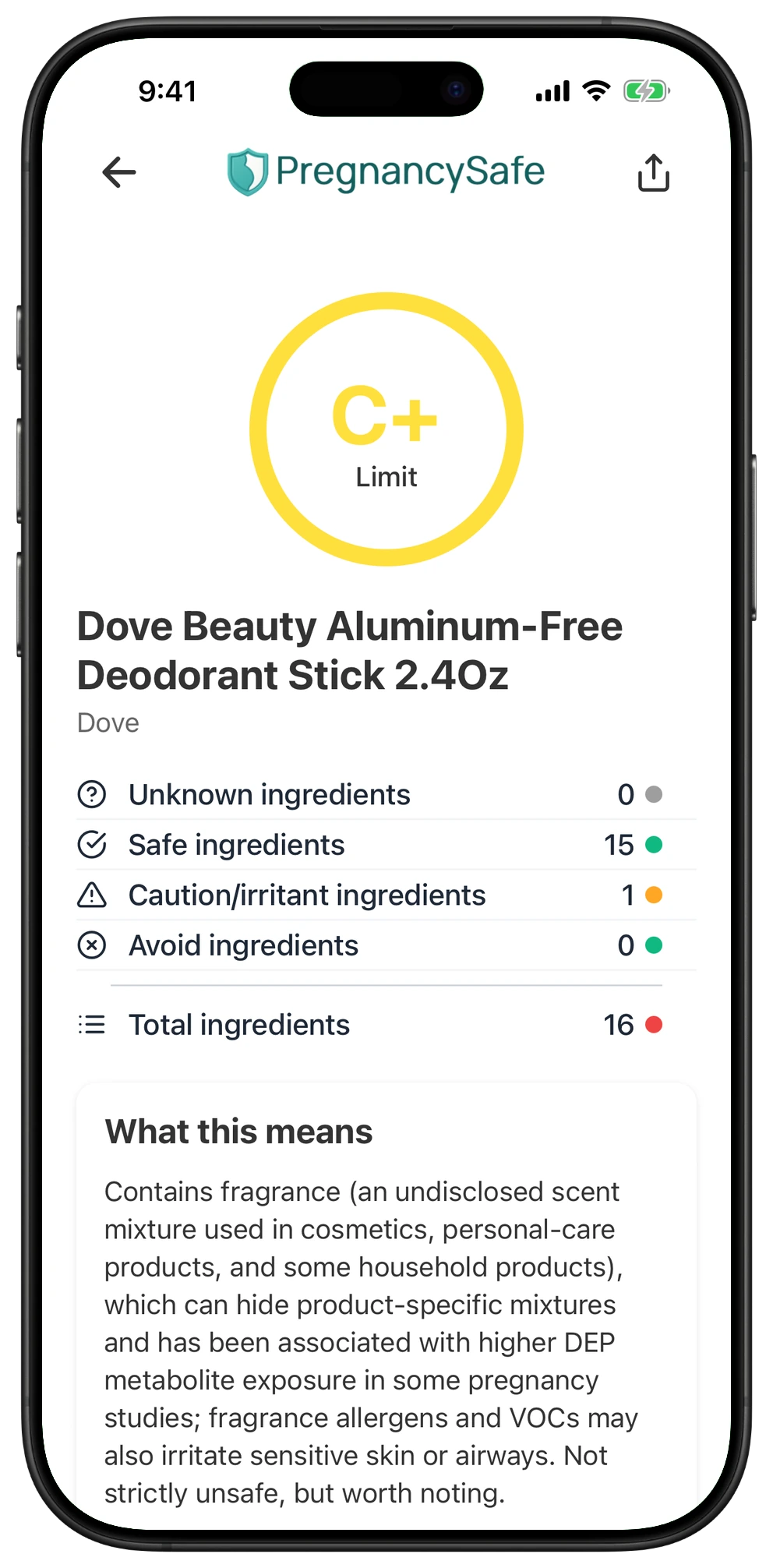
Can hide product specific mixtures and has been associated with higher DEP metabolite exposure in some pregnancy studies; fragrance allergens and VOCs may also irritate sensitive skin or airways.
In deodorant, fragrance denotes a scent mixture whose individual components may not be disclosed. It can cause skin or airway reactions; pregnancy exposure associations do not prove that every mixture contains phthalates or that routine underarm use causes harm. Fragrance free is an optional way to reduce this uncertainty.
Flagged in 585 of 1,100 products (53%)
parfum
Caution
Parfum is a fragrant mixture of essential oils, aroma compounds, and solvents used to impart a pleasant scent.
Can hide product specific mixtures and has been associated with higher DEP metabolite exposure in some pregnancy studies; fragrance allergens and VOCs may also irritate sensitive skin or airways.
Parfum is another label term for fragrance, not a separate class of pregnancy toxicant. In a leave on deodorant, the practical concerns are undisclosed mixture components and possible irritation or allergy. The term alone does not establish phthalate content or harmful exposure.
Flagged in 152 of 1,100 products (14%)
benzyl salicylate
Caution
Benzyl salicylate is a fragrant compound commonly used as a UV filter and scent ingredient in perfumes and cosmetics.
Has limited pregnancy specific human data and weak endocrine mode signals, but regulated low dose cosmetic use has wide safety margins compared with high dose oral salicylates.
Benzyl salicylate adds scent and can act as a light stabilizer in deodorant. Direct human pregnancy evidence is limited, and fragrance allergy is a practical concern. Assessed low dose cosmetic exposure is not equivalent to medication like oral salicylate exposure.
Flagged in 79 of 1,100 products (7%)
bht
Caution
BHT (butylated hydroxytoluene) is a synthetic antioxidant commonly used as a preservative to prevent the oxidation of fats and oils in food products.
Has limited human pregnancy data, with low concern at reviewed cosmetic levels but reproductive and thyroid related findings in high dose oral animal studies.
BHT, or butylated hydroxytoluene, helps prevent oxidation in deodorant formulas. Reviewed cosmetic concentrations are considered low concern, although direct pregnancy data are limited. Reproductive findings from high dose oral animal studies do not establish harm from ordinary topical deodorant use.
Flagged in 70 of 1,100 products (6%)
aluminum chlorohydrate
Caution
Aluminum chlorohydrate is a common antiperspirant agent that helps reduce sweating by blocking sweat glands.
Has very low systemic absorption from intact skin antiperspirants but lacks direct pregnancy outcome data, with OTC labels advising health professional input during pregnancy or breastfeeding.
Aluminum chlorohydrate is an antiperspirant active that reduces underarm sweating. Systemic absorption from normal use on intact skin is very low, but direct pregnancy outcome data are limited. Follow the product’s concentration specific directions and warnings, particularly if you have kidney disease.
Flagged in 59 of 1,100 products (5%)
Caution
Phenoxyethanol is a preservative commonly used in cosmetics and skincare products to prevent microbial growth and extend shelf life.
Has limited direct pregnancy data and possible infant oral exposure concerns from nipple area products, while regulated cosmetic concentrations are generally considered low systemic risk.
Phenoxyethanol preserves deodorant against microbial growth and may also serve as a fragrance solvent. Cosmetic assessments support use at allowed concentrations, including up to 1% as a preservative in the EU, while direct pregnancy data remain limited. Infant ingestion concerns involving nipple products should not be treated as evidence of harm from underarm application.
Flagged in 46 of 1,100 products (4%)
chamomilla recutita flower extract
Caution
Chamomilla recutita flower extract is a soothing botanical ingredient known for its calming and anti inflammatory properties.
Warrants caution because pregnancy specific topical evidence is inadequate; assessed cosmetic concentrations appear to pose low systemic concern, but irritation or allergy is possible and concentrated or medicinal preparations are not well studied.
Chamomilla recutita flower extract is German chamomile flower extract used as a skin conditioning botanical in deodorant. Pregnancy specific topical evidence is inadequate; irritation or allergy is the clearest practical concern, especially with daisy family sensitivity. A formulated extract is not equivalent to oral chamomile or concentrated essential oil.
Flagged in 42 of 1,100 products (4%)
aluminum sesquichlorohydrate
Caution
Aluminum sesquichlorohydrate is a common antiperspirant agent used to reduce sweating by temporarily blocking sweat glands.
Has developmental concern at higher chronic exposures, but regulated vaccine adjuvants and occasional clinician directed antacid use should be considered separately.
Aluminum sesquichlorohydrate is an aluminum salt used to reduce sweating in antiperspirants. Broader aluminum findings from high dose or non topical exposures do not establish harm from this ingredient in routine underarm use. Its assessment depends on formulation, concentration, and exposure; follow the label and seek advice for kidney disease or treatment use.
Flagged in 40 of 1,100 products (4%)
How Do Deodorant Products Stack Up?
Our catalog contains ratings for 1,100 deodorant products. These are database grades, not independent safety certifications.
These scores mix deodorants and antiperspirants and do not establish exposure doses. Aluminum-free is not a pregnancy-safety certification, and crystal alum still contains aluminum.
Best Pregnancy Safe Deodorant
Popular options from our catalog, prioritizing A and B ingredient grades, with C grade options used to fill remaining places. Within each group, products are ordered by searches in Pregnancy Safe, not retail sales. Read the cautions and guidance above; grades do not verify a complete current label or guarantee pregnancy safety.
| Grade | Product | Brand |
|---|---|---|
| B+ | Native Unscented Deodorant Stick | Native |
| B+ | Lume Whole Body Women'S Deodorant - Smooth Solid Stick - Aluminum Free - Unscented Contains caffeine; the ingredient grade does not establish the amount. | Lume |
| B+ | Tom'S Of Maine Deodorant Aluminum Free Unscented | Tom'S Of Maine |
| A | Fresh Cream Deodorant - Sensitive & Fragrance-Free | Moogoo |
| B+ | Aluminum-Free Serum Deodorant Stick - Golden Coconut | Juus |
Your Questions Answered
Which deodorant is good during pregnancy?
Start with a formula that meets your odor control needs without irritating your skin. A fragrance free option can reduce exposure to undisclosed scent mixtures, but aluminum free is an optional preference rather than an established pregnancy requirement. Check the exact version’s ingredients and directions. The popular product list can help you compare formulas, but popularity and grades are not guarantees of pregnancy safety.
How to prevent smelly armpits during pregnancy?
Choose a deodorant for odor control and apply it according to its directions on intact, non irritated underarm skin. If wetness is also a problem, remember that an antiperspirant reduces sweating whereas an odor only deodorant does not. Avoid adding extra applications beyond label directions or layering scented products that irritate you. Ask your clinician about treatment options if ordinary products are not meeting your needs.
Do I need to avoid aluminum antiperspirants while pregnant?
A blanket switch to aluminum free products is not established as necessary by the available evidence. Human studies of aluminum chlorohydrate antiperspirants show very low systemic absorption through intact skin, but direct pregnancy outcome data remain limited. Cosmetic safety assessments apply to particular concentrations and exposures, not every product or pattern of use. Follow the label and seek individualized advice if you have kidney disease or use treatment strength products.
Are natural or crystal deodorants safer during pregnancy?
Natural does not establish pregnancy safety or freedom from allergens. Botanical extracts and natural fragrance can still irritate sensitive skin, and their pregnancy specific evidence may be limited. Crystal alum contains aluminum, so a crystal deodorant is not automatically aluminum free. Compare the actual ingredients and intended use rather than relying on these claims.
Should I worry if I have already used scented deodorant?
Typical scented deodorant use is not established as harmful to pregnancy and is not, by itself, an emergency. Some studies associate fragranced personal care use with higher exposure to a phthalate metabolite, but they do not show that every fragrance contains phthalates or that your deodorant caused harm. Fragrance free is a reasonable exposure reduction choice if you prefer it. Stop a product that causes irritation or airway symptoms.
What do the deodorant grades tell me?
Our catalog contains 1,100 products, including 38 with an A grade, and combines deodorants with antiperspirants. Grades summarize ingredient flags, not measured exposure doses or clinical pregnancy outcomes. An A grade is not proof of independently verified safety, and a D or F grade does not by itself establish that a product is contraindicated. Incomplete records are not evidence of harm; use the exact label, intended use, and qualifications when comparing options.
How to Interpret These Ratings
Our ingredient and category rules generate letter grades from the information recorded in the catalog. Missing ingredients and broad category assignments can affect the result. These grades do not measure your dose, confirm a complete current label, or test a product for contamination.
A high grade is not a guarantee of pregnancy safety. A low grade is not, by itself, proof of harm from every use. Follow the product-specific guidance above, check the actual package, and ask your prenatal clinician about supplements, treatment decisions or uncertain exposures.
People Also Checked
References
- https://www.fda.gov/cosmetics/resources-consumers-cosmetics/cosmetics-pregnancy
- https://health.ec.europa.eu/publications/safety-aluminium-cosmetic-products-submission-iv_en
- https://www.vanicream.com/product/vanicream-aluminum-free-deodorant
- https://www.fda.gov/cosmetics/cosmetic-ingredients/fragrances-cosmetics
- https://www.fda.gov/cosmetics/cosmetic-ingredients/phthalates-cosmetics
- https://www.fda.gov/cosmetics/cosmetic-ingredients/allergens-cosmetics
- https://pmc.ncbi.nlm.nih.gov/articles/PMC3110684/
- https://pmc.ncbi.nlm.nih.gov/articles/PMC4016195/
- https://pmc.ncbi.nlm.nih.gov/articles/PMC4097177/
- https://pmc.ncbi.nlm.nih.gov/articles/PMC8453372/
- https://pmc.ncbi.nlm.nih.gov/articles/PMC10999525/
- https://www.epa.gov/indoor-air-quality-iaq/volatile-organic-compounds-impact-indoor-air-quality
- https://health.ec.europa.eu/system/files/2023-11/sccs_o_277.pdf
- https://eur-lex.europa.eu/legal-content/EN/TXT/HTML/?uri=OJ%3AL_202600909
- https://pmc.ncbi.nlm.nih.gov/articles/PMC10955127/
- https://pubmed.ncbi.nlm.nih.gov/29410076/
- https://www.cir-safety.org/sites/default/files/bensal042019FR.pdf
- https://health.ec.europa.eu/system/files/2023-06/sccs_o_268.pdf
- https://health.ec.europa.eu/system/files/2022-08/sccs_o_257.pdf
- https://pubmed.ncbi.nlm.nih.gov/37751543/
- https://pubmed.ncbi.nlm.nih.gov/12396675/
- https://pmc.ncbi.nlm.nih.gov/articles/PMC13151845/
- https://www.ecfr.gov/current/title-21/chapter-I/subchapter-B/part-172/subpart-B/section-172.115
- https://www.ecfr.gov/current/title-21/chapter-I/subchapter-B/part-182/subpart-D/section-182.3173
- https://www.fda.gov/news-events/press-announcements/fda-finalizes-food-chemical-safety-post-market-assessment-program-launches-reassessment-bht-ada
- https://www.ecfr.gov/current/title-21/chapter-I/subchapter-D/part-350
- https://dailymed.nlm.nih.gov/dailymed/drugInfo.cfm?setid=59a3c8d3-64cf-439a-b290-7a7016ce7d0d
- https://www.industrialchemicals.gov.au/sites/default/files/2022-12/EVA00100%20-%20Evaluation%20statement%20-%2022%20December%202022.pdf
- https://pubmed.ncbi.nlm.nih.gov/30052317/
- https://pubmed.ncbi.nlm.nih.gov/31553995/
- https://pubmed.ncbi.nlm.nih.gov/33861633/
- https://pubmed.ncbi.nlm.nih.gov/32869713/
- https://www.ncbi.nlm.nih.gov/books/NBK597305/
- https://health.ec.europa.eu/system/files/2021-08/sccs_o_195_0.pdf
- https://ec.europa.eu/growth/tools-databases/cosing/details/28157
- https://journals.sagepub.com/doi/10.3109/10915819009078737
- https://link.springer.com/article/10.1007/s00204-024-03938-5
- https://www.sfda.gov.sa/en/warnings/1156
- https://www.industrialchemicals.gov.au/sites/default/files/Ethanol%2C%202-phenoxy-_Human%20health%20tier%20II%20assessment.pdf
- https://hero.epa.gov/reference/2857875
- https://books.publisso.de/sites/default/files/documents/series/mak/dam/Vol2019/Iss1/Alt006/mb12299kske6319_w.pdf
- https://www.nccih.nih.gov/health/chamomile
- https://www.ema.europa.eu/en/documents/herbal-monograph/final-european-union-herbal-monograph-matricaria-recutita-l-flos-first-version_en.pdf
- https://www.ema.europa.eu/en/documents/herbal-monograph/final-community-herbal-monograph-chamaemelum-nobile-l-all-flos_en.pdf
- https://journals.sagepub.com/doi/10.1177/1091581818801814
- https://journals.sagepub.com/doi/10.1177/1091581817705620
- https://pubmed.ncbi.nlm.nih.gov/40314057/
- https://pubmed.ncbi.nlm.nih.gov/40374153/
- https://wwwn.cdc.gov/TSP/ToxProfiles/ToxProfiles.aspx?id=191&tid=34
- https://pmc.ncbi.nlm.nih.gov/articles/PMC9681673/
- https://pmc.ncbi.nlm.nih.gov/articles/PMC10809980/
- https://www.cdc.gov/vaccine-safety/about/adjuvants.html
- https://www.fda.gov/vaccines-blood-biologics/safety-availability-biologics/common-ingredients-fda-approved-vaccines
- https://www.acog.org/womens-health/infographics/vaccines-during-pregnancy
- https://www.fda.gov/cosmetics/cosmetic-ingredients/talc
- https://www.fda.gov/cosmetics/cosmetics-news-events/fda-releases-data-agencys-2023-testing-talc-containing-cosmetic-products-asbestos
- https://www.federalregister.gov/documents/2025/11/28/2025-21407/testing-methods-for-detecting-and-identifying-asbestos-in-talc-containing-cosmetic-products
- https://publications.iarc.who.int/Book-And-Report-Series/Iarc-Monographs-On-The-Identification-Of-Carcinogenic-Hazards-To-Humans/Talc-And-Acrylonitrile-2025
- https://www.cancer.org/cancer/risk-prevention/chemicals/talcum-powder-and-cancer.html
- https://www.cdc.gov/niosh/npg/npgd0584.html
- https://pmc.ncbi.nlm.nih.gov/articles/PMC6310682/
- https://recalls-rappels.canada.ca/en/alert-recall/talc-health-risks-associated-inhalation-and-exposure-female-genital-area