Is Steak Safe During Pregnancy? (Updated 2026 Guide)
Updated September 9, 2026
The Answer
Yes, you can eat steak during pregnancy, but undercooking and handling are important food safety concerns. Cook intact beef steak to at least 145°F, then let it rest for three minutes; ground beef needs 160°F.
The main pregnancy consideration is safe preparation, not beef itself: use a thermometer and prevent raw meat juices from contaminating cooked food. Cured products, cheese toppings, and alcohol containing sauces need separate checks because their ingredients and preparation differ from plain steak. Ingredient grades cannot tell you whether meat contains pathogens or has been cooked safely.
Pregnancy Safe is 100% independent and research driven. No companies pay to promote or sponsor products.
Stress Less This Pregnancy
Check your exact steak in the app

✓ What's Safe
- • Use a food thermometer to confirm intact beef steak reaches at least 145°F before a three minute rest.
- • Check whether your meal contains a whole cut or ground beef; ground beef needs 160°F.
- • Read the exact package instructions for prepared, stuffed, or processed steak products rather than assuming the intact steak rule applies.
- • At restaurants, ask for a temperature checked steak rather than relying only on a doneness term such as medium.
- • Keep raw meat and its juices separate from cooked steak, utensils, and ready to eat foods.
- • Check cheese toppings for pasteurized milk; heating soft blue or soft ripened cheese until steaming hot offers an additional food safety precaution.
✗ What to Avoid
- • Avoid raw steak, tartare, and steak that has not reached the appropriate cooking temperature.
- • Do not use pinkness, clear juices, or a browned exterior as proof that steak is safely cooked.
- • Do not put cooked steak back on an unwashed plate that held raw meat.
- • Avoid treating cured steak strips, ground beef dishes, and prepared meals as interchangeable with intact beef steak.
- • Avoid assuming a high ingredient grade or a beef only label makes raw steak safe to eat.
- • Choose sauces without added bourbon or white wine if you want to avoid uncertain alcohol exposure; an ingredient name alone does not establish the amount remaining in your serving.
Most Common Ingredients in Steak Products
We analyzed 496 steak products. Here are the most common ingredients, ranked by how often they appear:
Ingredients to Watch Out For in Steak
These are the most common flagged ingredients across 496 steak products we analyzed.
sodium nitrite
Caution
Sodium nitrite is a chemical compound commonly used as a preservative and color fixative in processed meats.
Is regulated at low food additive levels, but frequent cured or processed meat intake has limited observational pregnancy concerns; cyanide antidote and contaminated water exposures are separate issues.
Flagged in 23 of 496 products (5%)
bht
Caution
BHT (butylated hydroxytoluene) is a synthetic antioxidant commonly used as a preservative to prevent the oxidation of fats and oils in food products.
Has limited human pregnancy data, with low concern at reviewed cosmetic levels but reproductive and thyroid related findings in high dose oral animal studies.
Flagged in 3 of 496 products (1%)
bourbon
Avoid
Bourbon is a rich, amber colored American whiskey known for its sweet, smoky flavor with notes of caramel, vanilla, and oak.
Has no established safe amount in pregnancy and is linked to fetal alcohol spectrum disorders and other adverse pregnancy outcomes.
Flagged in 3 of 496 products (1%)
bha
Caution
BHA (beta hydroxy acid) is a chemical exfoliant commonly used in skincare to penetrate pores, remove dead skin cells, and improve skin texture.
Has limited pregnancy specific human data and normal regulated food use appears lower concern than high dose animal exposures that drove carcinogenicity classifications.
Flagged in 2 of 496 products (0%)
sodium nitrate
Caution
Sodium nitrate is a chemical compound commonly used as a preservative and curing agent in processed meats and as a fertilizer in agriculture.
Is context dependent because vegetable sources are generally compatible with pregnancy while contaminated well water above nitrate/nitrite limits can cause methemoglobinemia and has observational links to adverse birth outcomes.
Flagged in 2 of 496 products (0%)
white wine
Avoid
White wine is a crisp, pale yellow alcoholic beverage made from fermented white grapes, often used to enhance the flavor of dishes or enjoyed on its own.
Has no established safe amount in pregnancy and is linked to fetal alcohol spectrum disorders and other adverse pregnancy outcomes.
Flagged in 2 of 496 products (0%)
blue cheese powder blue cheese pasteurized milk
Caution
Can carry Listeria risk in pregnancy when soft unpasteurized or eaten cold and is lower risk when pasteurized and heated until steaming hot.
Flagged in 1 of 496 products (0%)
chili pepper extract
Caution
Chili pepper extract is a concentrated form of capsaicin rich compound derived from chili peppers, known for its spicy flavor and potential health benefits.
Has limited pregnancy data for concentrated extracts, supplements, and prescription strength topical products, while ordinary culinary peppers are handled separately.
Flagged in 1 of 496 products (0%)
Steak Products We've Analyzed
Our catalog contains ratings for 496 steak products. These are database grades, not independent safety certifications.
Grades are ingredient scores, not clinical verdicts or measurements of pathogens, dose, preparation or current package contents. Cohorts include unreviewed catalog records and counts are not independently verified safe-product totals.
Pregnancy Safe Steak Products
Popular options from our catalog, prioritizing A and B ingredient grades, with C grade options used to fill remaining places. Within each group, products are ordered by searches in Pregnancy Safe, not retail sales. Read the cautions and guidance above; grades do not verify a complete current label or guarantee pregnancy safety.
| Grade | Product | Brand |
|---|---|---|
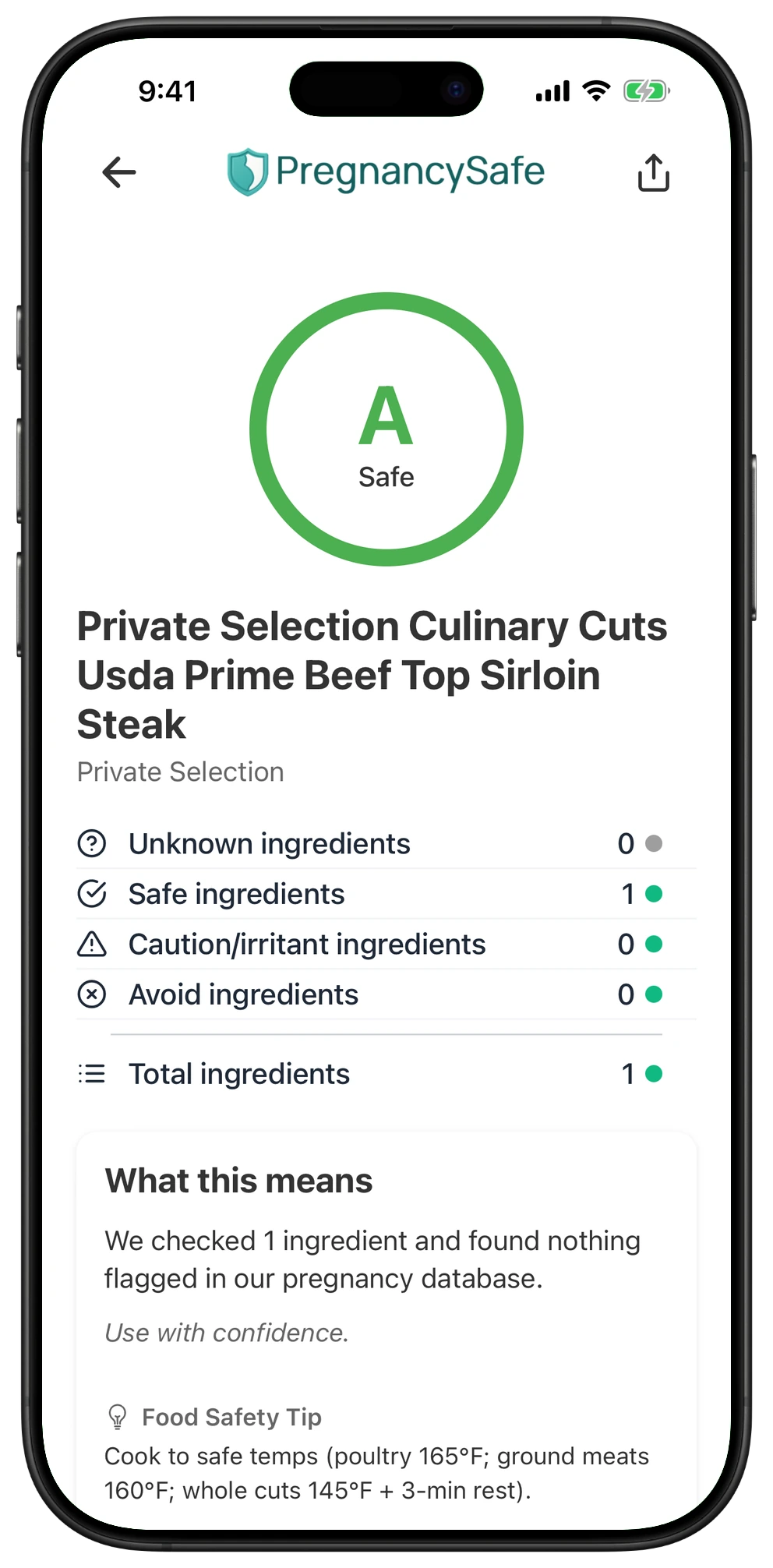
| A | Private Selection Culinary Cuts Usda Prime Beef Top Sirloin Steak | Private Selection |
| A | Angus Beef Ribeye Steak | Simple Truth |
| B+ | Fajita Steak | Soules Kitchen |
| A | Beef Top Round Steak For London Broil | Grass Run Farms |
| A | Seasoned Sirloin Philly Steak | Great Value |
Your Questions Answered
Should I avoid steak in the first trimester?
You do not need to avoid properly cooked steak simply because you are in the first trimester. For intact beef steak, reach at least 145°F and allow a three minute rest. Ground beef needs 160°F. Follow safe cooking and handling practices throughout pregnancy, not only during the first trimester.
I ate a medium steak when pregnant. Should I worry?
The word medium does not establish whether your steak reached a safe temperature. For intact beef steak, the relevant benchmark is at least 145°F followed by a three minute rest, rather than its color. Eating a steak with uncertain doneness does not by itself establish that an infection or harm occurred. If you believe it was undercooked or feel unwell afterward, contact your pregnancy care team for individual advice.
Can I eat medium rare steak while pregnant?
Do not rely on a medium rare order to meet pregnancy food safety guidance. Choose intact steak confirmed by thermometer to have reached at least 145°F, followed by a three minute rest. A seared exterior is not enough to verify the cooking temperature. Raw or undercooked steak is different from properly cooked steak.
How should I order steak at a restaurant during pregnancy?
Ask for the steak to reach at least 145°F internally and rest for three minutes if it is an intact beef cut. Doneness descriptions vary, so ask whether the kitchen can verify the temperature. For ground beef steak dishes, the target is 160°F instead. Check sauces and cheese toppings separately rather than assuming that safe steak preparation covers the entire meal.
Are packaged steak strips and seasoned steak the same as plain steak?
No: the word steak can describe raw cuts, cured strips, fully cooked meat, or prepared meals. Read the package for the product type, storage requirements, and cooking instructions. Sodium nitrite and sodium nitrate in cured meats raise different questions from the doneness of fresh beef; limited observational pregnancy evidence about frequent processed meat intake does not establish harm from an occasional regulated serving. Deli meats and dry sausages also have separate guidance to heat them to 165°F or steaming hot.
Does an A grade mean a steak product is safe during pregnancy?
No. Our catalog contains 496 products, including 379 with an A ingredient grade, but those are not counts of independently verified safe products. Grades do not measure pathogens, cooking temperature, exposure amount, or current package contents. Even a beef only raw steak still needs appropriate cooking and handling.
How to Interpret These Ratings
Our ingredient and category rules generate letter grades from the information recorded in the catalog. Missing ingredients and broad category assignments can affect the result. These grades do not measure your dose, confirm a complete current label, or test a product for contamination.
A high grade is not a guarantee of pregnancy safety. A low grade is not, by itself, proof of harm from every use. Follow the product-specific guidance above, check the actual package, and ask your prenatal clinician about supplements, treatment decisions or uncertain exposures.
People Also Checked
References
- https://www.foodsafety.gov/food-safety-charts/safe-minimum-internal-temperatures
- https://www.fda.gov/food/people-risk-foodborne-illness/cooking-food-safety-moms-be
- https://www.nhs.uk/pregnancy/keeping-well/foods-to-avoid/
- https://hfpappexternal.fda.gov/scripts/fdcc/index.cfm?id=SODIUMNITRITE&set=FoodSubstances
- https://www.ecfr.gov/current/title-9/section-424.21
- https://www.ecfr.gov/current/title-21/section-172.175
- https://www.efsa.europa.eu/en/press/news/170615
- https://www.inchem.org/documents/jecfa/jecmono/v50je07.htm
- https://pubmed.ncbi.nlm.nih.gov/41248583/
- https://www.cdc.gov/food-safety/foods/pregnant-women.html
- https://publications.iarc.who.int/Book-And-Report-Series/Iarc-Monographs-On-The-Identification-Of-Carcinogenic-Hazards-To-Humans/Red-Meat-And-Processed-Meat-2018
- https://dailymed.nlm.nih.gov/dailymed/drugInfo.cfm?setid=52f01c6e-172a-47a9-98a6-9eab7651a032
- https://www.atsdr.cdc.gov/toxprofiles/tp204.pdf
- https://health.ec.europa.eu/system/files/2022-08/sccs_o_257.pdf
- https://pubmed.ncbi.nlm.nih.gov/37751543/
- https://pubmed.ncbi.nlm.nih.gov/12396675/
- https://pmc.ncbi.nlm.nih.gov/articles/PMC13151845/
- https://www.ecfr.gov/current/title-21/chapter-I/subchapter-B/part-172/subpart-B/section-172.115
- https://www.ecfr.gov/current/title-21/chapter-I/subchapter-B/part-182/subpart-D/section-182.3173
- https://www.fda.gov/news-events/press-announcements/fda-finalizes-food-chemical-safety-post-market-assessment-program-launches-reassessment-bht-ada
- https://www.cdc.gov/alcohol-pregnancy/about/index.html
- https://www.cdc.gov/fasd/about/index.html
- https://www.acog.org/womens-health/infographics/alcohol-and-pregnancy
- https://www.niaaa.nih.gov/publications/brochures-and-fact-sheets/alcohol-and-your-pregnancy
- https://mothertobaby.org/fact-sheets/alcohol-pregnancy/
- https://pubmed.ncbi.nlm.nih.gov/26482673/
- https://pmc.ncbi.nlm.nih.gov/articles/PMC9543418/
- https://www.fda.gov/food/food-chemical-safety/list-select-chemicals-food-supply-under-fda-review
- https://www.federalregister.gov/documents/2026/02/11/2026-02761/butylated-hydroxyanisole-bha-request-for-information
- https://www.ecfr.gov/current/title-21/chapter-I/subchapter-B/part-182/subpart-D/section-182.3169
- https://www.ecfr.gov/current/title-21/chapter-I/subchapter-B/part-172/subpart-B/section-172.110
- https://www.efsa.europa.eu/en/efsajournal/pub/2392
- https://pmc.ncbi.nlm.nih.gov/articles/PMC13092903/
- https://www.ncbi.nlm.nih.gov/books/NBK590883/
- https://www.inchem.org/documents/iarc/vol40/butylatedhydroxyanisole.html
- https://pubmed.ncbi.nlm.nih.gov/7290287/
- https://pubmed.ncbi.nlm.nih.gov/3804125/
- https://www.epa.gov/ground-water-and-drinking-water/national-primary-drinking-water-regulations
- https://www.epa.gov/children/private-wells-and-drinking-water-safety-and-infants
- https://archive.cdc.gov/www_atsdr_cdc_gov/csem/nitrate-nitrite/who_risk.html
- https://doh.wa.gov/community-and-environment/drinking-water/contaminants/nitrate
- https://pmc.ncbi.nlm.nih.gov/articles/PMC9834225/
- https://www.efsa.europa.eu/en/efsajournal/pub/689
- https://www.food.gov.uk/safety-hygiene/nitrates-and-nitrites-the-science-explained
- https://www.ecfr.gov/current/title-21/chapter-I/subchapter-B/part-172/subpart-B/section-172.175
- https://www.cdc.gov/listeria/causes/dairy.html
- https://www.fda.gov/food/people-risk-foodborne-illness/ready-eat-foods-food-safety-moms-be
- https://www.foodsafety.gov/people-at-risk/pregnant-women
- https://www.cdc.gov/listeria/signs-symptoms/index.html
- https://wwwnc.cdc.gov/eid/article/24/6/17-1051_article
- https://mothertobaby.org/fact-sheets/capsaicin/
- https://www.accessdata.fda.gov/drugsatfda_docs/label/2023/022395s023lbl.pdf
- https://www.ema.europa.eu/en/documents/product-information/qutenza-epar-product-information_en.pdf
- https://pubmed.ncbi.nlm.nih.gov/16717036/
- https://pubmed.ncbi.nlm.nih.gov/37271593/
- https://www.nccih.nih.gov/health/sage
- https://www.ema.europa.eu/en/documents/herbal-monograph/final-european-union-herbal-monograph-salvia-officinalis-l-folium-revision-1_en.pdf
- https://www.ema.europa.eu/en/documents/public-statement/public-statement-salvia-officinalis-l-aetheroleum_en.pdf
- https://www.ema.europa.eu/en/documents/scientific-guideline/public-statement-use-herbal-medicinal-products-containing-thujone-revision-1_en.pdf
- https://webprod.hc-sc.gc.ca/nhpid-bdipsn/dbImages/mono_Sage_Oral_EN.pdf
- https://pubmed.ncbi.nlm.nih.gov/23933314/
- https://pmc.ncbi.nlm.nih.gov/articles/PMC7956842/
- https://www.fda.gov/food/people-risk-foodborne-illness/dairy-and-eggs-food-safety-moms-be
- https://www.fda.gov/food/people-risk-foodborne-illness/food-safety-moms-be-glance
- https://www.fda.gov/consumers/consumer-updates/avoid-queso-fresco-type-cheeses-if-youre-high-risk-groups
- https://www.acog.org/womens-health/faqs/listeria-and-pregnancy