Is Beef Safe During Pregnancy? (Updated 2026 Guide)
Updated September 9, 2026
The Answer
Yes properly cooked beef can be part of your pregnancy diet, but preparation matters because undercooked meat and unheated deli meat carry foodborne infection risks. Cook intact steaks and roasts to at least 145°F with a three minute rest, ground beef to 160°F, and refrigerated deli beef to 165°F or steaming hot.
The main pregnancy consideration is food safety: ordinary beef, ground beef, refrigerated deli slices, and dry sausages need different preparation precautions. Beef liver and bovine liver powder are separate from ordinary muscle meat and should be avoided because of their high preformed vitamin A content. Concerns about frequent processed meat intake containing sodium nitrite or sodium nitrate rely on limited observational evidence; they do not establish that an occasional serving causes pregnancy harm.
Pregnancy Safe is 100% independent and research driven. No companies pay to promote or sponsor products.
Stress Less This Pregnancy
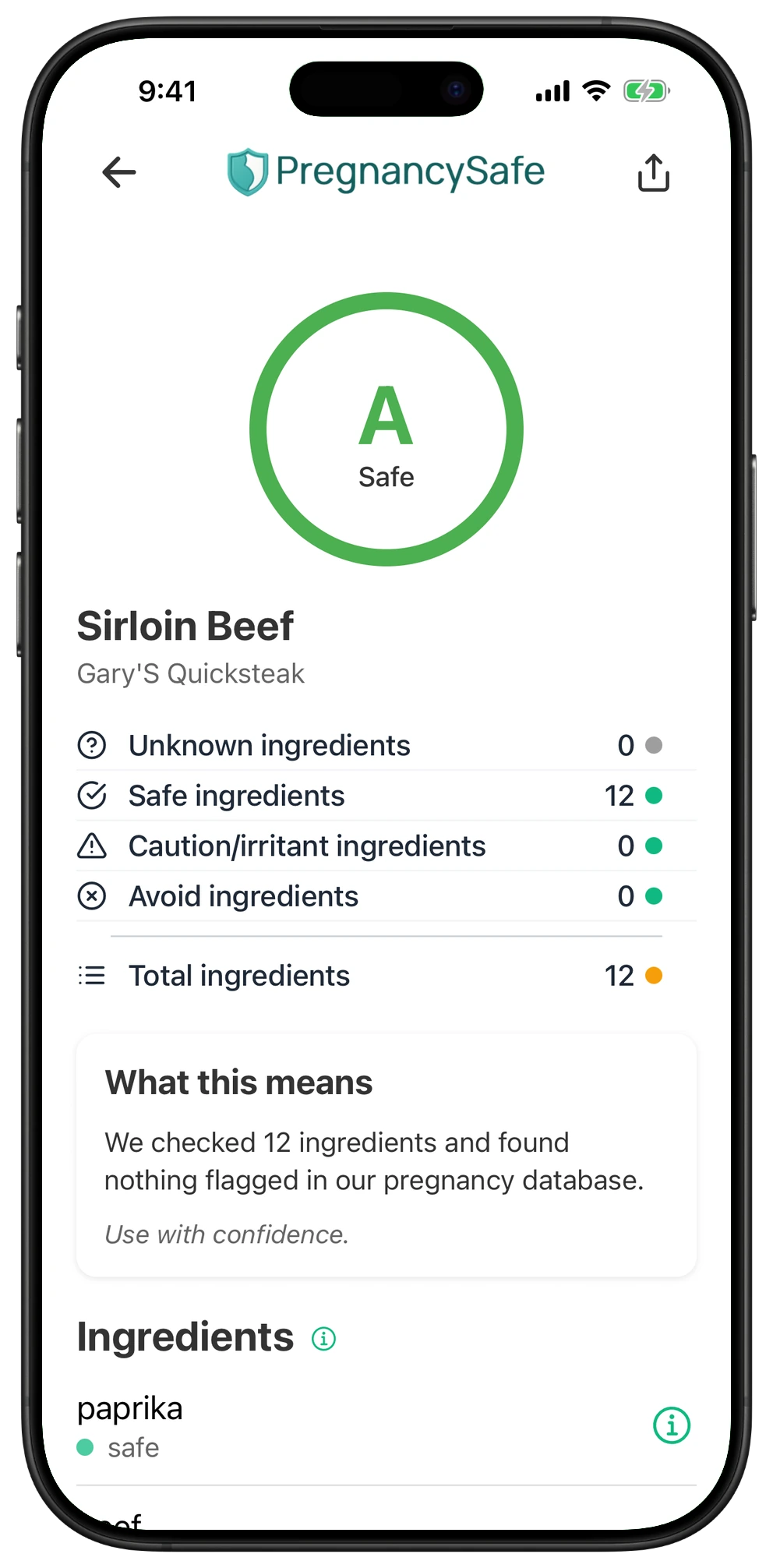
Check your exact beef in the app

✓ What's Safe
- • Use a food thermometer to check intact steaks and roasts reach at least 145°F, then let them rest for three minutes before eating.
- • Cook ground beef and burgers to an internal temperature of 160°F rather than judging doneness by color.
- • Heat refrigerated deli roast beef and beef sticks sold as dry sausages to 165°F or steaming hot before eating.
- • Read the package to distinguish raw meat, prepared meals, deli meat, dry sausage, and organ supplements; follow the storage and preparation instructions for that exact form.
- • Choose ordinary muscle meat rather than blends containing beef liver or bovine liver powder.
- • Choose freshly cooked, unprocessed beef more often than cured beef snacks, and check sauces if you want to avoid added alcohol.
✗ What to Avoid
- • Avoid raw or undercooked beef, including steak tartare and meat that has not reached the appropriate internal temperature.
- • Avoid eating refrigerated deli beef or dry sausage beef sticks cold; curing is not a substitute for the recommended heating step.
- • Avoid beef liver, liver containing meat blends, and bovine liver powder during pregnancy because their preformed vitamin A content can be excessive.
- • Avoid making cured meats containing sodium nitrite or sodium nitrate your everyday default; occasional intake is not equivalent to high dose exposure.
- • Avoid assuming an alcohol based sauce contains no remaining alcohol just because it was cooked. Choose a preparation without added alcohol when the amount remaining is unclear; an ingredient listing alone does not establish the dose.
- • Avoid relying on an A grade, a grass fed claim, or an incomplete ingredient record to decide whether beef is safely prepared.
Most Common Ingredients in Beef Products
We analyzed 357 beef products. Here are the most common ingredients, ranked by how often they appear:
Ingredients to Watch Out For in Beef
These are the most common flagged ingredients across 357 beef products we analyzed.
sodium nitrite
Caution
Sodium nitrite is a chemical compound commonly used as a preservative and color fixative in processed meats.
Is regulated at low food additive levels, but frequent cured or processed meat intake has limited observational pregnancy concerns; cyanide antidote and contaminated water exposures are separate issues.
Flagged in 21 of 357 products (6%)
alcohol
Caution
Alcohol is a volatile, colorless liquid commonly used as a solvent, disinfectant, or intoxicating beverage.
No amount of Alcohol is considered safe. Avoid alcohol beverages entirely. Be extremely careful when using in cooking or even with small percentages.
Flagged in 17 of 357 products (5%)
fennel
Caution
Fennel is a crunchy, aromatic vegetable with a bulbous base, feathery fronds, and a mild, sweet anise flavor often used in salads, soups, and Mediterranean dishes.
Is generally low concern at normal culinary amounts but should be avoided as concentrated medicinal tea, essential oil, or supplement during pregnancy because safety data are limited and estrogenic or uterine concerns exist.
Flagged in 4 of 357 products (1%)
ethyl alcohol
Avoid
Ethyl alcohol is a colorless, volatile, and flammable organic compound commonly used as a solvent, disinfectant, and in alcoholic beverages.
Has no established safe amount in pregnancy and is linked to fetal alcohol spectrum disorders and other adverse pregnancy outcomes.
Flagged in 3 of 357 products (1%)
and bht
Caution
And BHT (Butylated Hydroxytoluene) is a synthetic antioxidant commonly used as a preservative to prevent the oxidation of fats and oils in food products.
Has limited human pregnancy data, with low concern at reviewed cosmetic levels but reproductive and thyroid related findings in high dose oral animal studies.
Flagged in 1 of 357 products (0%)
beef liver
Avoid
Beef liver is a nutrient rich organ meat known for its high levels of iron, vitamin A, and essential amino acids.
Contains very high preformed vitamin A/retinol, which can exceed pregnancy upper limits and is advised against by several pregnancy food safety authorities.
Flagged in 1 of 357 products (0%)
bovine liver powder
Avoid
Contains very high preformed vitamin A/retinol, which can exceed pregnancy upper limits and is advised against by several pregnancy food safety authorities.
Flagged in 1 of 357 products (0%)
hydrochloride sodium nitrite
Caution
Is regulated at low food additive levels, but frequent cured or processed meat intake has limited observational pregnancy concerns; cyanide antidote and contaminated water exposures are separate issues.
Flagged in 1 of 357 products (0%)
Types of Beef
Beef Products We've Analyzed
Our catalog contains ratings for 357 beef products. These are database grades, not independent safety certifications.
Grades are ingredient scores, not clinical verdicts or measurements of pathogens, dose, preparation or current package contents. Cohorts include unreviewed catalog records and counts are not independently verified safe-product totals.
Pregnancy Safe Beef Products
Popular options from our catalog, prioritizing A and B ingredient grades, with C grade options used to fill remaining places. Within each group, products are ordered by searches in Pregnancy Safe, not retail sales. Read the cautions and guidance above; grades do not verify a complete current label or guarantee pregnancy safety.
| Grade | Product | Brand |
|---|---|---|
| A | 100% Grass Fed & Finished Pure American Beef | Heart & Soil |
| A | Roast Beef | Sainsbury'S |
| A | Beef Bulgogi | Trader Joe'S |
| A | Sliced Grass-Fed Beef Sirloin | Cuisine Solutions |
| A | Beef Sirloin Tri-Tip | Rock River Cattle Co. |
Your Questions Answered
Can I eat beef if I'm pregnant?
Yes, properly cooked beef can be part of your pregnancy diet. Cook intact steaks and roasts to at least 145°F and allow a three minute rest; ground beef needs to reach 160°F. Refrigerated deli beef needs reheating to 165°F or steaming hot. These recommendations concern ordinary meat, not liver or organ supplements.
Can you eat medium beef while pregnant?
The word medium does not reliably tell you whether beef has reached a safe temperature. For an intact steak or roast, use a thermometer to confirm at least 145°F, followed by a three minute rest. For a burger or other ground beef, the target is 160°F. Do not rely on pinkness or a restaurant's doneness label alone.
Can I eat beef sticks during pregnancy?
Check what kind of product the stick is rather than treating all beef snacks alike. If it is a dry or fermented sausage, heat it to 165°F or steaming hot before eating to reduce Listeria risk. Follow its storage instructions, and do not treat curing or an ingredient grade as proof it is free of pathogens. Keep cured snacks occasional rather than making them your main source of beef.
Is roast beef safe during pregnancy?
A freshly cooked intact beef roast should reach at least 145°F and rest for three minutes before you eat it. Refrigerated deli roast beef is a different situation: reheat the slices to 165°F or steaming hot. For a packaged prepared meal, follow its specific heating and storage instructions rather than assuming the whole roast rule applies.
Should I eat beef liver or take liver supplements for iron?
Avoid beef liver and liver products during pregnancy because they can supply excessive preformed vitamin A, also called retinol. Bovine liver powder is a liver product, not an ordinary serving of muscle meat. Beef's iron content does not make it a treatment for anemia. If you have low iron, ask your maternity clinician about appropriate testing and treatment rather than starting an organ supplement.
Are preservatives and seasonings in beef a pregnancy concern?
The ingredient, amount, and frequency matter. Sodium nitrite and sodium nitrate are curing ingredients; pregnancy concerns about frequent processed meat intake are based on limited observational evidence, not proof that an occasional serving causes harm. Fennel used as an ordinary culinary seasoning is low concern and should not be equated with concentrated medicinal tea, oil, or supplements. BHT has limited human pregnancy data, and findings from high dose oral animal studies do not establish harm from a normal serving of beef.
Does an A grade mean a beef product is pregnancy safe?
No grades are ingredient scores, not checks for pathogens, cooking temperature, dose, or current package contents. Our catalog contains 357 products, including 216 with an A grade, but these are not independently verified safe product totals. A lower grade does not automatically mean a product is unsafe, and missing information is not proof of harm. Use the exact package, product form, and preparation instructions to guide your choice.
How to Interpret These Ratings
Our ingredient and category rules generate letter grades from the information recorded in the catalog. Missing ingredients and broad category assignments can affect the result. These grades do not measure your dose, confirm a complete current label, or test a product for contamination.
A high grade is not a guarantee of pregnancy safety. A low grade is not, by itself, proof of harm from every use. Follow the product-specific guidance above, check the actual package, and ask your prenatal clinician about supplements, treatment decisions or uncertain exposures.
People Also Checked
References
- https://www.foodsafety.gov/food-safety-charts/safe-minimum-internal-temperatures
- https://www.fda.gov/food/people-risk-foodborne-illness/cooking-food-safety-moms-be
- https://www.cdc.gov/listeria/prevention/index.html
- https://www.nhs.uk/pregnancy/keeping-well/foods-to-avoid/
- https://hfpappexternal.fda.gov/scripts/fdcc/index.cfm?id=SODIUMNITRITE&set=FoodSubstances
- https://www.ecfr.gov/current/title-9/section-424.21
- https://www.ecfr.gov/current/title-21/section-172.175
- https://www.efsa.europa.eu/en/press/news/170615
- https://www.inchem.org/documents/jecfa/jecmono/v50je07.htm
- https://pubmed.ncbi.nlm.nih.gov/41248583/
- https://www.cdc.gov/food-safety/foods/pregnant-women.html
- https://publications.iarc.who.int/Book-And-Report-Series/Iarc-Monographs-On-The-Identification-Of-Carcinogenic-Hazards-To-Humans/Red-Meat-And-Processed-Meat-2018
- https://dailymed.nlm.nih.gov/dailymed/drugInfo.cfm?setid=52f01c6e-172a-47a9-98a6-9eab7651a032
- https://www.atsdr.cdc.gov/toxprofiles/tp204.pdf
- https://hfpappexternal.fda.gov/scripts/fdcc/index.cfm?id=FENNELCOMMON&set=FoodSubstances
- https://www.ema.europa.eu/en/documents/herbal-monograph/final-european-union-herbal-monograph-foeniculum-vulgare-miller-subsp-vulgare-var-dulce-mill-batt-trab-fructus-revision-1_en.pdf
- https://webprod.hc-sc.gc.ca/nhpid-bdipsn/dbImages/mono_fennel-sweet_english.pdf
- https://www.swissmedic.ch/swissmedic/en/home/news/mitteilungen/fencheltee-fuer-schwangere-kinder-unter-4-jahren.html
- https://www.efsa.europa.eu/en/news/have-your-say-estragole-fennel-seed-preparations
- https://www.ncbi.nlm.nih.gov/books/NBK501793/
- https://pubmed.ncbi.nlm.nih.gov/30969204/
- https://pubmed.ncbi.nlm.nih.gov/32733750/
- https://pubmed.ncbi.nlm.nih.gov/23275017/
- https://www.utep.edu/herbal-safety/populations/herbs-to-avoid-during-pregnancy.html
- https://www.cdc.gov/alcohol-pregnancy/about/index.html
- https://www.cdc.gov/fasd/about/index.html
- https://www.acog.org/womens-health/infographics/alcohol-and-pregnancy
- https://www.niaaa.nih.gov/publications/brochures-and-fact-sheets/alcohol-and-your-pregnancy
- https://mothertobaby.org/fact-sheets/alcohol-pregnancy/
- https://pubmed.ncbi.nlm.nih.gov/26482673/
- https://pmc.ncbi.nlm.nih.gov/articles/PMC9543418/
- https://health.ec.europa.eu/system/files/2022-08/sccs_o_257.pdf
- https://pubmed.ncbi.nlm.nih.gov/37751543/
- https://pubmed.ncbi.nlm.nih.gov/12396675/
- https://pmc.ncbi.nlm.nih.gov/articles/PMC13151845/
- https://www.ecfr.gov/current/title-21/chapter-I/subchapter-B/part-172/subpart-B/section-172.115
- https://www.ecfr.gov/current/title-21/chapter-I/subchapter-B/part-182/subpart-D/section-182.3173
- https://www.fda.gov/news-events/press-announcements/fda-finalizes-food-chemical-safety-post-market-assessment-program-launches-reassessment-bht-ada
- https://www.nhs.uk/conditions/vitamins-and-minerals/vitamin-a/
- https://cot.food.gov.uk/Lay%20Summary%20of%20the%20Statement%20on%20the%20effects%20of%20excess%20Vitamin%20A%20on%20maternal%20health
- https://pubmed.ncbi.nlm.nih.gov/38846679/
- https://ods.od.nih.gov/factsheets/VitaminA-HealthProfessional/
- https://www.canada.ca/en/public-health/services/publications/healthy-living/maternity-newborn-care-guidelines-chapter-3.html
- https://www.pregnancybirthbaby.org.au/foods-to-avoid-when-pregnant
- https://www.thewomens.org.au/images/uploads/fact-sheets/Food_safety_in_pregnancy_260316.pdf
- https://www.epa.gov/ground-water-and-drinking-water/national-primary-drinking-water-regulations
- https://www.epa.gov/children/private-wells-and-drinking-water-safety-and-infants
- https://archive.cdc.gov/www_atsdr_cdc_gov/csem/nitrate-nitrite/who_risk.html
- https://doh.wa.gov/community-and-environment/drinking-water/contaminants/nitrate
- https://pmc.ncbi.nlm.nih.gov/articles/PMC9834225/
- https://www.efsa.europa.eu/en/efsajournal/pub/689
- https://www.food.gov.uk/safety-hygiene/nitrates-and-nitrites-the-science-explained
- https://www.ecfr.gov/current/title-21/chapter-I/subchapter-B/part-172/subpart-B/section-172.175