Is Kefir Safe During Pregnancy? (Updated 2026 Guide)
Updated September 9, 2026
The Answer
Yes kefir made with pasteurized milk can fit your pregnancy diet when you follow refrigeration and handling instructions. Avoid raw milk kefir: fermentation does not replace pasteurization or reliably eliminate harmful germs.
The main pregnancy concern is unpasteurized milk, including cultured whole raw milk, which can carry Listeria and other foodborne pathogens. Live cultures do not make pasteurized milk kefir equivalent to raw dairy, but they do not guarantee freedom from pathogens or pregnancy specific benefits. Kefir with added algae powders, herbal flavorings or alcohol needs separate consideration of the actual ingredient, amount and production process.
Pregnancy Safe is 100% independent and research driven. No companies pay to promote or sponsor products.
Stress Less This Pregnancy
Check your exact kefir in the app

✓ What's Safe
- • Check that dairy kefir explicitly says it is made with pasteurized milk; ask the manufacturer if this is unclear.
- • Choose a source that keeps refrigerated kefir cold, and follow the package’s refrigeration instructions at home.
- • Read the storage and after opening directions on the exact bottle you buy.
- • Check whether you are buying milk kefir, water kefir or another non dairy ferment; their ingredients and production processes differ.
- • Read the full ingredient list for added algae powders, herbal ingredients or alcohol rather than relying on probiotic or organic claims.
✗ What to Avoid
- • Avoid kefir made with raw or unpasteurized milk, including labels listing cultured whole raw milk.
- • Do not rely on fermentation, tanginess or live cultures to make raw milk safe.
- • Avoid drinking kefir that has not been stored according to its refrigeration and after opening instructions.
- • Do not assume homemade kefir is equivalent to a commercially controlled product, even when the starting milk is pasteurized.
- • Avoid alcoholic kefir drinks; if a fermented drink’s alcohol content is unclear, check with the manufacturer rather than assuming it is alcohol free.
- • Avoid using kefir with organic chlorella broken cell wall powder or organic spirulina powder as a self prescribed supplement treatment; pregnancy evidence and product quality information are limited.
Most Common Ingredients in Kefir Products
We analyzed 312 kefir products. Here are the most common ingredients, ranked by how often they appear:
Ingredients to Watch Out For in Kefir
These are the most common flagged ingredients across 312 kefir products we analyzed.
cultured whole raw milk
Avoid
Cultured whole raw milk is unpasteurized milk that has been fermented with beneficial bacteria to develop a tangy flavor and probiotic qualities.
Can carry Listeria and other foodborne pathogens; pregnancy listeriosis can harm the fetus or newborn even when maternal illness seems mild.
Flagged in 4 of 312 products (1%)
organic chlorella broken cell wall powder
Caution
Is not proven harmful in small second trimester human studies but remains a supplement with limited pregnancy data and product quality or contamination concerns.
Flagged in 2 of 312 products (1%)
organic spirulina powder
Caution
Organic spirulina powder is a nutrient dense, blue green algae supplement rich in protein, vitamins, and antioxidants, supporting overall health and energy.
Has limited pregnancy safety data and product quality concerns because contaminated blue green algae supplements can contain microcystins, heavy metals, or pathogenic bacteria.
Flagged in 2 of 312 products (1%)
alcohol
Caution
Alcohol is a volatile, colorless liquid commonly used as a solvent, disinfectant, or intoxicating beverage.
No amount of Alcohol is considered safe. Avoid alcohol beverages entirely. Be extremely careful when using in cooking or even with small percentages.
Flagged in 1 of 312 products (0%)
color spirulina extract
Caution
Color spirulina extract is a vibrant, natural blue green pigment derived from spirulina algae, commonly used to add color to foods and cosmetics.
Has limited pregnancy safety data and product quality concerns because contaminated blue green algae supplements can contain microcystins, heavy metals, or pathogenic bacteria.
Flagged in 1 of 312 products (0%)
natural hibiscus flavor
Caution
A vibrant, tangy essence derived from natural hibiscus flowers, offering a floral and slightly tart flavor.
Has limited human pregnancy safety data; medicinal teas or supplements may lower blood pressure and uterine or menstrual effects are uncertain.
Flagged in 1 of 312 products (0%)
Kefir Products We've Analyzed
Our catalog contains ratings for 312 kefir products. These are database grades, not independent safety certifications.
Grades are ingredient scores, not clinical verdicts or measurements of pathogens, dose, preparation or current package contents. Cohorts include unreviewed catalog records and counts are not independently verified safe-product totals.
Pregnancy Safe Kefir Products
Popular options from our catalog, prioritizing A and B ingredient grades, with C grade options used to fill remaining places. Within each group, products are ordered by searches in Pregnancy Safe, not retail sales. Read the cautions and guidance above; grades do not verify a complete current label or guarantee pregnancy safety.
| Grade | Product | Brand |
|---|---|---|
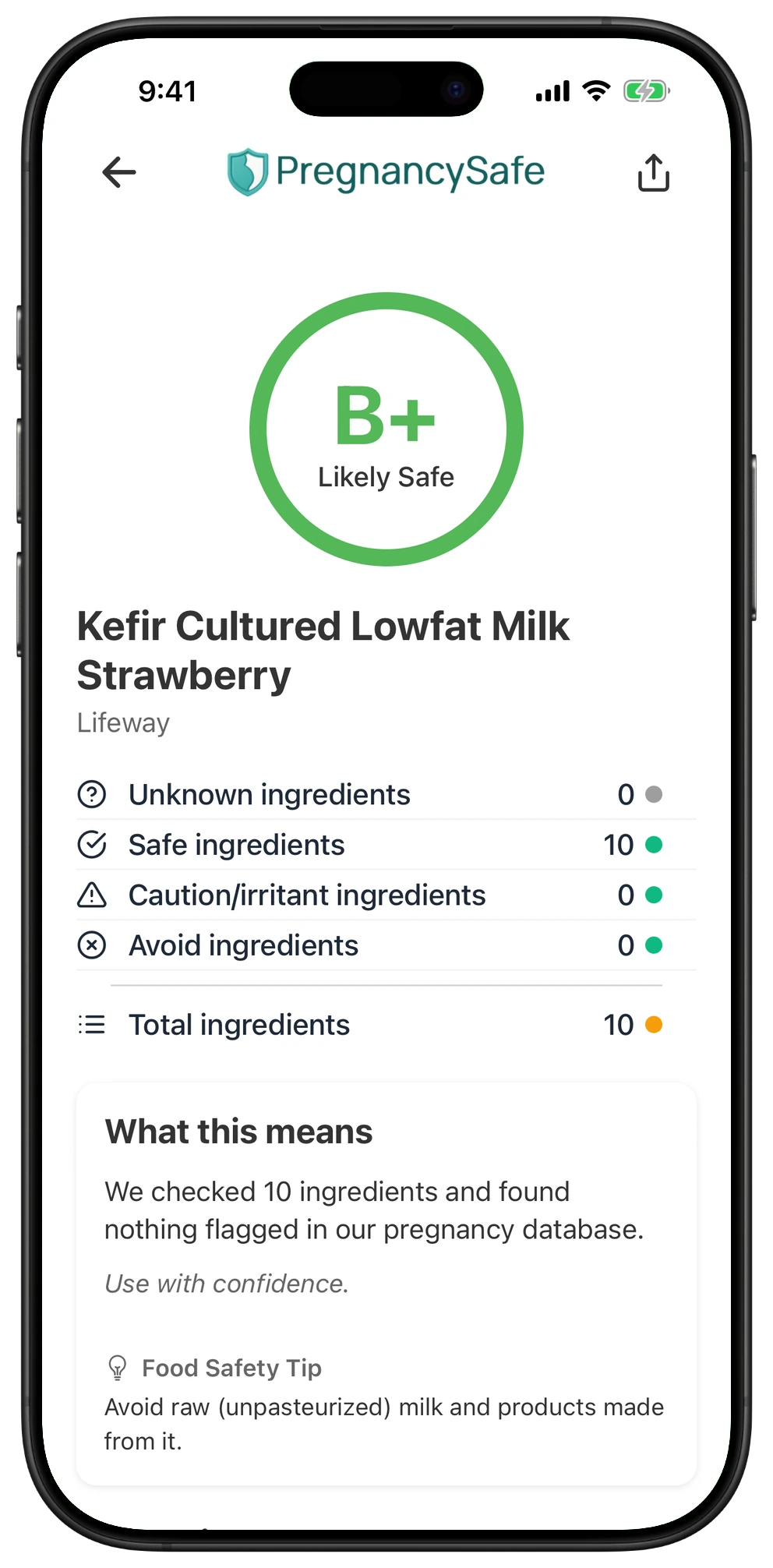
| B+ | Kefir Cultured Lowfat Milk Strawberry | Lifeway |
| B+ | Kefir Cultured Lowfat Milk | Lifeway |
| B+ | Lifeway Kefir Peach Cultured Lowfat Milk | Lifeway |
| B+ | Kefir Cultured Lowfat Milk Peach | Lifeway |
| A | Kefir Cultured Whole Milk | Lifeway |
Your Questions Answered
Is kefir milk safe during pregnancy?
Choose kefir made with pasteurized milk and follow its refrigeration instructions. Avoid versions made with raw milk because they can carry pathogens that are particularly concerning during pregnancy. Live fermentation cultures neither turn pasteurized milk into raw milk nor guarantee that a finished drink is free of harmful germs.
When should you not drink kefir?
Do not drink raw milk kefir during pregnancy or kefir that has not been stored as directed. If you cannot confirm whether the milk was pasteurized, choose a clearly labeled alternative. Water kefir, homemade ferments and drinks with added alcohol require separate checks rather than the same reassurance as pasteurized milk kefir.
Which probiotics are not safe during pregnancy?
A probiotic label alone cannot tell you whether a product is appropriate during pregnancy. For kefir, the practical checks are pasteurized milk, proper storage and the other ingredients not simply whether live cultures are present. Do not assume evidence about one probiotic strain or supplement dose applies to every kefir. Ask your prenatal clinician before using a probiotic supplement to treat a health problem.
How much kefir should I drink while pregnant?
There is no established pregnancy specific kefir dose for probiotic treatment. Use the package serving information to guide ordinary food portions rather than treating it as a prescribed daily target. Drinking more has not been established to provide extra pregnancy benefits, and kefir should not replace recommended prenatal care.
Is homemade or water kefir as safe as pasteurized milk kefir?
You cannot apply the same reassurance automatically. Home fermentation introduces different preparation and handling conditions, while water kefir has a different base and production process. Pasteurized starting milk does not by itself establish the safety of a home fermented batch. Check ingredients, production controls, storage instructions and any alcohol information for the specific drink.
Should I avoid kefir with spirulina, chlorella or hibiscus?
Added chlorella or spirulina powders warrant closer checking because pregnancy studies are limited and supplement quality can vary; their presence is not proof that a drink is harmful. Supplement dose findings do not establish the risk from a smaller, unspecified amount in kefir. Color spirulina extract is used as a colorant and should not automatically be treated as a full spirulina supplement dose. Likewise, evidence about medicinal hibiscus teas or continuous animal extract doses does not establish harm from natural hibiscus flavor.
Does an A grade mean kefir is guaranteed safe during pregnancy?
No. Our catalog contains 312 kefir records, including 125 with an A ingredient grade, but those are not independently verified safe product totals. Ingredient grades do not measure pathogens, storage conditions, dose or current package contents. Check the exact label and handling instructions regardless of the grade.
How to Interpret These Ratings
Our ingredient and category rules generate letter grades from the information recorded in the catalog. Missing ingredients and broad category assignments can affect the result. These grades do not measure your dose, confirm a complete current label, or test a product for contamination.
A high grade is not a guarantee of pregnancy safety. A low grade is not, by itself, proof of harm from every use. Follow the product-specific guidance above, check the actual package, and ask your prenatal clinician about supplements, treatment decisions or uncertain exposures.
People Also Checked
References
- https://www.cdc.gov/foodsafety/rawmilk/index.html
- https://www.cdc.gov/listeria/prevention/index.html
- https://www.nhs.uk/pregnancy/keeping-well/foods-to-avoid/
- https://www.cdc.gov/food-safety/foods/raw-milk.html
- https://www.cdc.gov/food-safety/foods/pregnant-women.html
- https://www.fda.gov/food/buy-store-serve-safe-food/dangers-raw-milk-unpasteurized-milk-can-pose-serious-health-risk
- https://www.fda.gov/food/people-risk-foodborne-illness/food-safety-booklet-pregnant-women-their-unborn-babies-and-children-under-five
- https://www.acog.org/womens-health/faqs/listeria-and-pregnancy
- https://www.acog.org/womens-health/faqs/healthy-eating-during-pregnancy
- https://www.ars.usda.gov/oc/utm/eating-right-before-and-after-pregnancy/
- https://www.usda.gov/about-usda/news/blog/listeria-monocytogenes-listeriosis-and-you
- https://www.ncbi.nlm.nih.gov/books/NBK501822/
- https://pmc.ncbi.nlm.nih.gov/articles/PMC10804112/
- https://pubmed.ncbi.nlm.nih.gov/20013055/
- https://pubmed.ncbi.nlm.nih.gov/17472477/
- https://pubmed.ncbi.nlm.nih.gov/15985279/
- https://pubmed.ncbi.nlm.nih.gov/24635025/
- https://www.fda.gov/food/information-consumers-using-dietary-supplements/questions-and-answers-dietary-supplements
- https://ods.od.nih.gov/factsheets/Pregnancy-HealthProfessional/
- https://pmc.ncbi.nlm.nih.gov/articles/PMC7551278/
- https://www.fda.gov/food/natural-toxins-food/blue-green-algae-products-and-microcystins
- https://www.ncbi.nlm.nih.gov/books/NBK548312/
- https://www.ncbi.nlm.nih.gov/books/NBK501849/
- https://pubmed.ncbi.nlm.nih.gov/21793723/
- https://journal.ugm.ac.id/v3/InaJBCS/article/view/23573
- https://doi.org/10.4236/ojog.2017.71016
- https://pubmed.ncbi.nlm.nih.gov/37317149/
- https://pubmed.ncbi.nlm.nih.gov/37368655/
- https://pubmed.ncbi.nlm.nih.gov/23036452/
- https://pubmed.ncbi.nlm.nih.gov/21842336/
- https://mothertobaby.org/fact-sheets/herbal-products-pregnancy/
- https://www.ncbi.nlm.nih.gov/books/NBK501882/
- https://pubmed.ncbi.nlm.nih.gov/19434218/
- https://pubmed.ncbi.nlm.nih.gov/18066103/
- https://pmc.ncbi.nlm.nih.gov/articles/PMC9086798/
- https://www.nccih.nih.gov/health/hypertension-high-blood-pressure
- https://www.ffhdj.com/index.php/ffhd/article/view/1768