Best Pregnancy Safe Body Wash (Updated 2026 Guide)
Updated September 9, 2026
The Answer
For ordinary washing during pregnancy, choose a gentle rinse off body wash that suits your skin; fragrance free is a practical option if you are sensitive. Most entries in our catalog carry C or C+ ingredient scores, but those scores do not establish fetal harm from normal washing.
Focus on skin comfort, the exact formula, and using body wash as a rinse off product. Fragrance can cause irritation or allergy, while flags for preservatives such as phenoxyethanol reflect evidence limitations rather than proven fetal harm at normal cosmetic concentrations. Medicated acne and exfoliating washes need separate consideration of strength, application area, and frequency; do not stop clinician recommended treatment based on a catalog grade.
Pregnancy Safe is 100% independent and research driven. No companies pay to promote or sponsor products.
Stress Less This Pregnancy
Check your exact body wash in the app

✓ What's Safe
- • Choose a fragrance free formula if scents irritate your skin or airways; check the ingredient list for fragrance and parfum.
- • Read the full ingredient list for the exact version you are buying, rather than relying on a brand name or highlighted ingredients.
- • Look for an ordinary rinse off cleanser when your goal is daily cleansing, rather than automatically choosing an acne or exfoliating treatment.
- • For medicated washes, check the active ingredient, stated strength, application instructions, and frequency before use.
- • Choose a formulation your skin tolerates, and follow its rinsing instructions rather than leaving it on for extra benefit.
✗ What to Avoid
- • Avoid fragrance, parfum, or fragrance parfum if scented washes trigger itching, irritation, or airway symptoms; these are related label terms, not separate pregnancy hazards.
- • Avoid benzyl salicylate if you have a known allergy to it; its fragrance allergy concern is not proof of fetal harm from ordinary washing.
- • Avoid using salicylic acid washes more frequently, over larger areas, or for longer contact times than directed; seek advice before using them on broken skin.
- • Avoid choosing a wash solely because it excludes phenoxyethanol or bht; their presence does not establish that normal rinse off use is harmful.
- • Avoid treating natural, sulfate free, or preservative free claims as pregnancy safety guarantees.
Most Common Ingredients in Body Wash Products
We analyzed 1,384 body wash products. Here are the most common ingredients, ranked by how often they appear:
Ingredients to Watch Out For in Body Wash
These are the most common flagged ingredients across 1,384 body wash products we analyzed.
fragrance
Caution
A fragrant substance used to add a pleasant aroma to products or environments.
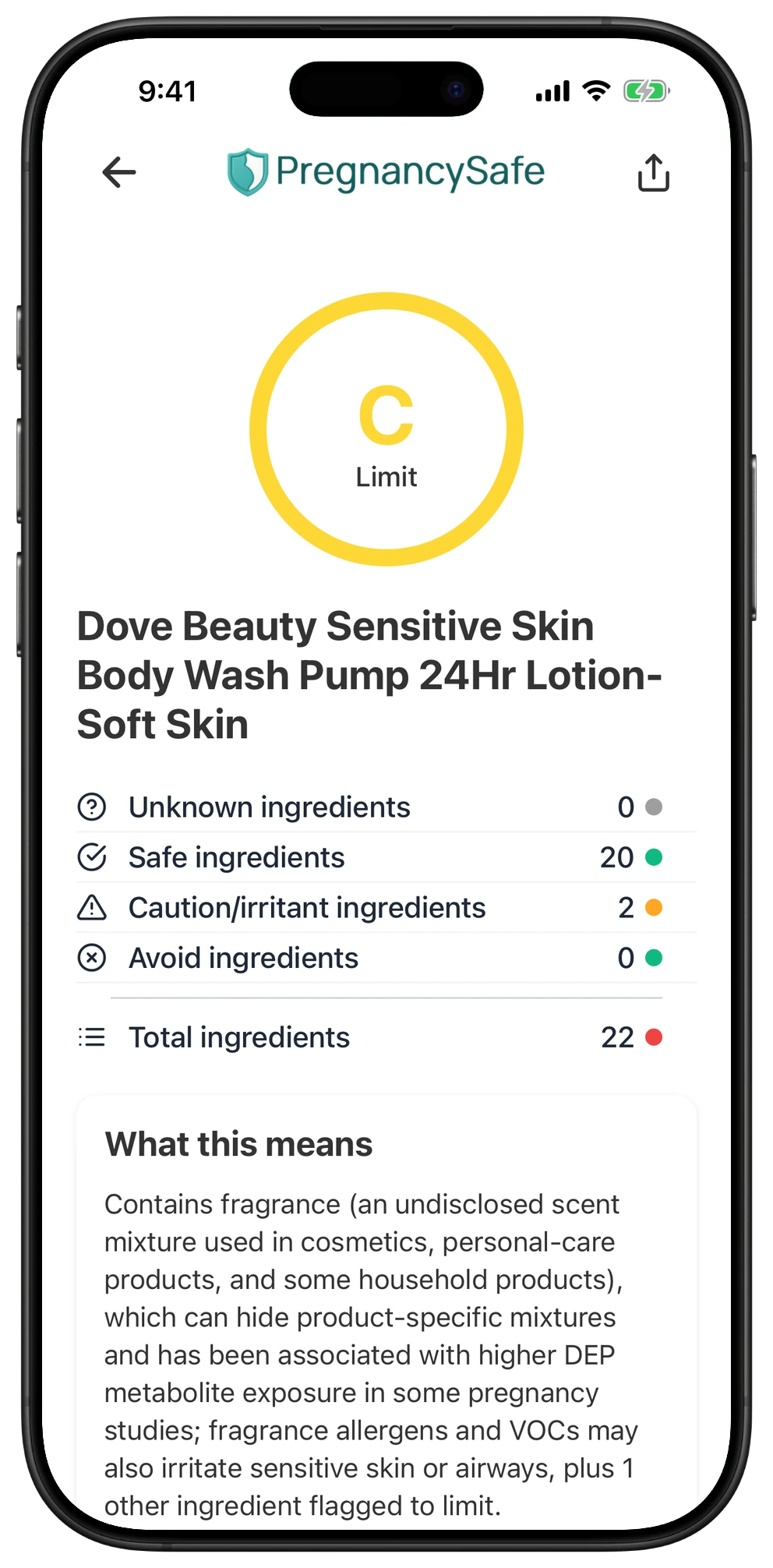
Can hide product specific mixtures and has been associated with higher DEP metabolite exposure in some pregnancy studies; fragrance allergens and VOCs may also irritate sensitive skin or airways.
Fragrance describes a scent mixture whose individual components may not be fully disclosed. In body wash, choosing fragrance free can help reduce irritation and optional scent exposure; associations from fragranced product studies do not establish fetal harm from normal rinse off use or show that every fragrance contains phthalates.
Flagged in 815 of 1,384 products (59%)
Caution
Phenoxyethanol is a preservative commonly used in cosmetics and skincare products to prevent microbial growth and extend shelf life.
Has limited direct pregnancy data and possible infant oral exposure concerns from nipple area products, while regulated cosmetic concentrations are generally considered low systemic risk.
Phenoxyethanol preserves body wash against microbial growth. Direct pregnancy data are limited, but cosmetic safety reviews support its use at reviewed concentrations; high dose animal findings and infant ingestion concerns from nipple creams should not be applied to ordinary rinse off cleansing.
Flagged in 380 of 1,384 products (27%)
parfum
Caution
Parfum is a fragrant mixture of essential oils, aroma compounds, and solvents used to impart a pleasant scent.
Can hide product specific mixtures and has been associated with higher DEP metabolite exposure in some pregnancy studies; fragrance allergens and VOCs may also irritate sensitive skin or airways.
Parfum is another label term for fragrance, not a separate pregnancy hazard. In body wash, the practical considerations are an incompletely disclosed scent mixture and possible irritation or allergy, rather than established fetal harm from normal washing.
Flagged in 174 of 1,384 products (13%)
cocamide mea
Caution
Cocamide MEA is a foaming agent and thickener derived from coconut oil and monoethanolamine, commonly used in shampoos and cleansers.
Has limited direct pregnancy cosmetic data and can irritate skin or airways, with concern increasing for leave on, nitrosating, aerosol, high concentration, or occupational exposure.
Cocamide MEA is a foaming agent and thickener used in cleansers, not the same ingredient as free ethanolamine. Evidence about ethanolamine, hair dyes, or occupational exposure does not establish pregnancy harm from cocamide MEA in rinse off body wash. Its name alone is not a reason to apply another ingredient's toxicity findings.
Flagged in 103 of 1,384 products (7%)
sodium salicylate
Caution
Sodium salicylate is a salt derived from salicylic acid commonly used as an analgesic, anti inflammatory agent, and preservative in various pharmaceutical and cosmetic products.
Is usually low concern at permitted cosmetic levels but oral NSAID like salicylate use after 20 weeks and high absorption topical use require caution.
Sodium salicylate is a salicylic acid salt that can serve a preservative or related formulation role in body wash. Routine low level cosmetic use is distinct from oral salicylate medication; oral pregnancy warnings do not establish the same risk from normal washing. Higher concentration or high absorption topical use needs separate consideration.
Flagged in 94 of 1,384 products (7%)
benzyl salicylate
Caution
Benzyl salicylate is a fragrant compound commonly used as a UV filter and scent ingredient in perfumes and cosmetics.
Has limited pregnancy specific human data and weak endocrine mode signals, but regulated low dose cosmetic use has wide safety margins compared with high dose oral salicylates.
Benzyl salicylate is a fragrance allergen and light stabilizing ingredient. Direct human pregnancy data are limited, but reviewed cosmetic exposures are much lower than high dose oral exposures used in animal assessments. For body wash, a known allergy is a practical reason to choose another formula.
Flagged in 85 of 1,384 products (6%)
bht
Caution
BHT (butylated hydroxytoluene) is a synthetic antioxidant commonly used as a preservative to prevent the oxidation of fats and oils in food products.
Has limited human pregnancy data, with low concern at reviewed cosmetic levels but reproductive and thyroid related findings in high dose oral animal studies.
BHT, or butylated hydroxytoluene, is an antioxidant used to stabilize a formula. High dose oral animal findings do not establish harm from rinse off body wash, and cosmetic reviews support specified use concentrations. Limited direct pregnancy data should not be presented as proof that ordinary topical use is unsafe.
Flagged in 75 of 1,384 products (5%)
fragrance parfum
Caution
A fragrant, concentrated scent used to enhance personal aroma and add a touch of elegance.
Can hide product specific mixtures and has been associated with higher DEP metabolite exposure in some pregnancy studies; fragrance allergens and VOCs may also irritate sensitive skin or airways.
Fragrance parfum is a combined label expression for a scent mixture, not evidence of two distinct hazardous ingredients. In body wash, fragrance sensitivity and uncertainty about the mixture are the relevant considerations; a fragrance free alternative is optional exposure reduction, not a response to proven fetal harm.
Flagged in 67 of 1,384 products (5%)
How Do Body Wash Products Stack Up?
Our catalog contains ratings for 1,384 body wash products. These are database grades, not independent safety certifications.
Catalog ingredient scores do not establish fetal harm from normal rinse-off use. Some candidate records contain only highlighted ingredients; this page does not independently verify every formula.
Best Pregnancy Safe Body Wash
Popular options from our catalog, prioritizing A and B ingredient grades, with C grade options used to fill remaining places. Within each group, products are ordered by searches in Pregnancy Safe, not retail sales. Read the cautions and guidance above; grades do not verify a complete current label or guarantee pregnancy safety.
| Grade | Product | Brand |
|---|---|---|
| B+ | Aveeno Active Naturals Skin Relief Body Wash, Fragrance Free | Aveeno |
| B+ | Aveeno Body Wash, Skin Relief | Aveeno |
| B+ | Aloe Scented Body Wash, Mild & Gentle - Super C | Super C |
| B+ | Sensitive Skin Body Wash - Eczema Seal - Fragrance Free - Up&Up™ | Up&Up |
| B+ | Aveeno Baby Cleansing Therapy Moisturizing Wash | Aveeno |
Your Questions Answered
Is ordinary body wash safe to use during pregnancy?
For everyday cleansing, focus on a gentle rinse off formula that your skin tolerates. Fragrance and preservative flags do not by themselves establish fetal harm from normal washing. Use the product as directed and rinse it off, rather than treating it as a leave on product. If it is a medicated or exfoliating wash, check its active ingredients and directions separately.
Should I switch to fragrance free body wash?
Fragrance free is a reasonable choice if scented products irritate your skin or airways, or if you prefer to reduce fragrance exposure. Fragrance mixtures are not usually fully disclosed, so their composition can be uncertain. That does not mean every scented wash contains phthalates or that ordinary use is proven harmful during pregnancy. Fragrance, parfum, and fragrance parfum are related labeling terms.
Can I use a salicylic acid body wash while pregnant?
Directed, low dose topical salicylic acid acne use is generally considered low concern during pregnancy. Whole body application, broken skin, prolonged contact, and higher concentrations need more caution because they can increase exposure. Follow the exact wash's directions and ask your clinician about extensive or frequent use. Do not stop a clinician recommended acne treatment solely because of its catalog grade.
Do I need a preservative free or natural body wash?
Neither label guarantees pregnancy safety. Phenoxyethanol helps prevent microbial growth, and safety reviews consider it acceptable at reviewed cosmetic concentrations despite limited direct pregnancy data. High dose animal findings or infant ingestion concerns from nipple products are not equivalent to rinsing body wash off your skin. Choose based on the complete formula, intended use, and your skin's tolerance.
Does an A grade mean a body wash is verified safe for pregnancy?
No. Our catalog contains 1,384 body washes, including 27 with an A ingredient score, but that is not a count of independently verified pregnancy safe products. Some records contain only highlighted ingredients, and incomplete information is not proof of either safety or harm. The products listed above are selected from eligible catalog records using searches in Pregnancy Safe; their grades are not pregnancy safety guarantees. Likewise, a low score does not by itself establish that normal rinse off use is unsafe.
Can I judge every body wash from a brand the same way?
No; formulas can differ by scent, version, and market. Check the full label on the exact bottle rather than extending one product's assessment to an entire brand. Confirm whether it is an ordinary cleanser or a medicated treatment. When comparing a listed product, match the exact version and read its qualifications.
How to Interpret These Ratings
Our ingredient and category rules generate letter grades from the information recorded in the catalog. Missing ingredients and broad category assignments can affect the result. These grades do not measure your dose, confirm a complete current label, or test a product for contamination.
A high grade is not a guarantee of pregnancy safety. A low grade is not, by itself, proof of harm from every use. Follow the product-specific guidance above, check the actual package, and ask your prenatal clinician about supplements, treatment decisions or uncertain exposures.
People Also Checked
References
- https://www.aad.org/public/everyday-care/skin-care-secrets/routine/pregnancy-skin-care
- https://www.fda.gov/cosmetics/resources-consumers-cosmetics/cosmetics-pregnancy
- https://www.aad.org/public/diseases/eczema/adult/pregnancy
- https://www.fda.gov/cosmetics/cosmetic-ingredients/fragrances-cosmetics
- https://www.fda.gov/cosmetics/cosmetic-ingredients/phthalates-cosmetics
- https://www.fda.gov/cosmetics/cosmetic-ingredients/allergens-cosmetics
- https://pmc.ncbi.nlm.nih.gov/articles/PMC3110684/
- https://pmc.ncbi.nlm.nih.gov/articles/PMC4016195/
- https://pmc.ncbi.nlm.nih.gov/articles/PMC4097177/
- https://pmc.ncbi.nlm.nih.gov/articles/PMC8453372/
- https://pmc.ncbi.nlm.nih.gov/articles/PMC10999525/
- https://www.epa.gov/indoor-air-quality-iaq/volatile-organic-compounds-impact-indoor-air-quality
- https://health.ec.europa.eu/system/files/2021-08/sccs_o_195_0.pdf
- https://ec.europa.eu/growth/tools-databases/cosing/details/28157
- https://journals.sagepub.com/doi/10.3109/10915819009078737
- https://link.springer.com/article/10.1007/s00204-024-03938-5
- https://www.sfda.gov.sa/en/warnings/1156
- https://www.industrialchemicals.gov.au/sites/default/files/Ethanol%2C%202-phenoxy-_Human%20health%20tier%20II%20assessment.pdf
- https://hero.epa.gov/reference/2857875
- https://books.publisso.de/sites/default/files/documents/series/mak/dam/Vol2019/Iss1/Alt006/mb12299kske6319_w.pdf
- https://www.cir-safety.org/sites/default/files/MEA032012FAR.pdf
- https://pubmed.ncbi.nlm.nih.gov/8998947/
- https://hpvchemicals.oecd.org/UI/handler.axd?id=27d71248-4be0-45ad-81bc-069b0fe7839c
- https://www.cdc.gov/niosh/npg/npgd0256.html
- https://www.tceq.texas.gov/downloads/toxicology/dsd/final/monoethanolamine.pdf/@@download/file/monoethanolamine.pdf
- https://ec.europa.eu/health/scientific_committees/consumer_safety/docs/sccs_o_072.pdf
- https://mothertobaby.org/fact-sheets/hair-treatments-pregnancy/pdf/
- https://www.acog.org/womens-health/experts-and-stories/ask-acog/is-it-safe-to-dye-my-hair-during-pregnancy
- https://www.nhs.uk/best-start-in-life/pregnancy/using-hair-dye-in-pregnancy-is-it-safe/
- https://www.federalregister.gov/documents/2017/04/12/2017-07130/monoethanolamine-exemption-from-the-requirement-of-a-tolerance
- https://mothertobaby.org/fact-sheets/topical-acne-treatments-pregnancy/
- https://www.acog.org/womens-health/faqs/skin-conditions-during-pregnancy
- https://www.fda.gov/safety/medical-product-safety-information/nonsteroidal-anti-inflammatory-drugs-nsaids-drug-safety-communication-avoid-use-nsaids-pregnancy-20
- https://dailymed.nlm.nih.gov/dailymed/drugInfo.cfm?audience=consumer&setid=ac0f9a8c-164a-4908-8b1d-bb714a82550d
- https://dailymed.nlm.nih.gov/dailymed/drugInfo.cfm?audience=consumer&setid=41eaa88c-a980-ea4f-e063-6294a90a411a
- https://www.cir-safety.org/sites/default/files/salicy042019FAR.pdf
- https://health.ec.europa.eu/system/files/2023-06/sccs_o_268.pdf
- https://www.industrialchemicals.gov.au/sites/default/files/2024-04/EVA00150%20-%20Draft%20Evaluation%20Statement%20-%2015%20April%202024.pdf
- https://health.ec.europa.eu/system/files/2023-11/sccs_o_277.pdf
- https://eur-lex.europa.eu/legal-content/EN/TXT/HTML/?uri=OJ%3AL_202600909
- https://pmc.ncbi.nlm.nih.gov/articles/PMC10955127/
- https://pubmed.ncbi.nlm.nih.gov/29410076/
- https://www.cir-safety.org/sites/default/files/bensal042019FR.pdf
- https://health.ec.europa.eu/system/files/2022-08/sccs_o_257.pdf
- https://pubmed.ncbi.nlm.nih.gov/37751543/
- https://pubmed.ncbi.nlm.nih.gov/12396675/
- https://pmc.ncbi.nlm.nih.gov/articles/PMC13151845/
- https://www.ecfr.gov/current/title-21/chapter-I/subchapter-B/part-172/subpart-B/section-172.115
- https://www.ecfr.gov/current/title-21/chapter-I/subchapter-B/part-182/subpart-D/section-182.3173
- https://www.fda.gov/news-events/press-announcements/fda-finalizes-food-chemical-safety-post-market-assessment-program-launches-reassessment-bht-ada
- https://www.aad.org/public/diseases/acne/derm-treat/pregnancy
- https://pmc.ncbi.nlm.nih.gov/articles/PMC9823189/
- https://www.accessdata.fda.gov/drugsatfda_docs/omuf/Order/Final%20Administrative%20Order%20OTC000013_M006-Topical%20Acne%20drug%20products%20for%20OTC%20Human%20Use.pdf
- https://www.fda.gov/drugs/drug-safety-and-availability/fda-recommends-avoiding-use-nsaids-pregnancy-20-weeks-or-later-because-they-can-result-low-amniotic
- https://www.accessdata.fda.gov/drugsatfda_docs/omuf/monographs/OTCMonograph_M028-WartRemoverDrugProductsforOTCHumanUse10012021.pdf
- https://www.ncbi.nlm.nih.gov/books/NBK582985/
- https://pmc.ncbi.nlm.nih.gov/articles/PMC3114665/
- https://pubmed.ncbi.nlm.nih.gov/9269866/
- https://pubmed.ncbi.nlm.nih.gov/10026401/
- https://pubmed.ncbi.nlm.nih.gov/24472429/
- https://www.ecfr.gov/current/title-21/chapter-I/subchapter-D/part-333/subpart-D/section-333.310
- https://pubmed.ncbi.nlm.nih.gov/38453786/
- https://www.accessdata.fda.gov/drugsatfda_docs/omuf/monographs/OTC%20Monograph_M006-Topical%20Acne%20drug%20products%20for%20OTC%20Human%20Use%2011.23.2021.pdf
- https://dermnetnz.org/topics/acne-in-pregnancy
- https://www.inchem.org/documents/icsc/icsc/eics0563.htm
- https://www.ncbi.nlm.nih.gov/books/NBK582985
- https://pubmed.ncbi.nlm.nih.gov/23914887
- https://www.fda.gov/drugs/drug-alerts-and-statements/fda-warns-against-purchasing-or-using-chemical-peel-skin-products-without-professional-supervision
- https://www.fda.gov/food/food-additives-petitions/trans-fat
- https://www.fda.gov/food/hfp-constituent-updates/fda-completes-final-administrative-actions-partially-hydrogenated-oils-foods
- https://www.federalregister.gov/documents/2013/11/08/2013-26854/tentative-determination-regarding-partially-hydrogenated-oils-request-for-comments-and-for
- https://www.who.int/news-room/fact-sheets/detail/trans-fat
- https://cdn.realfood.gov/DGA.pdf
- https://www.fda.gov/food/people-risk-foodborne-illness/dietary-advice-and-during-pregnancy
- https://www.rcpi.ie/Portals/0/Document%20Repository/Institute%20of%20Obstetricians%20and%20Gynaecologists/National%20Clinical%20Guidelines/IOG_National%20Clinical%20Guidelines_Nutrition%20in%20pregnancy%20Guideline_2019.pdf
- https://pmc.ncbi.nlm.nih.gov/articles/PMC8027310/
- https://pmc.ncbi.nlm.nih.gov/articles/PMC3192475/