Best Pregnancy Safe Shampoo (Updated 2026 Guide)
Updated September 9, 2026
The Answer
Choose a regular rinse off shampoo suited to your scalp, with a fragrance free option if scents or irritation bother you; medicated dandruff shampoos need active ingredient specific guidance. Our catalog contains mostly C range grades, but those scores do not establish that routine shampoo use is unsafe during pregnancy.
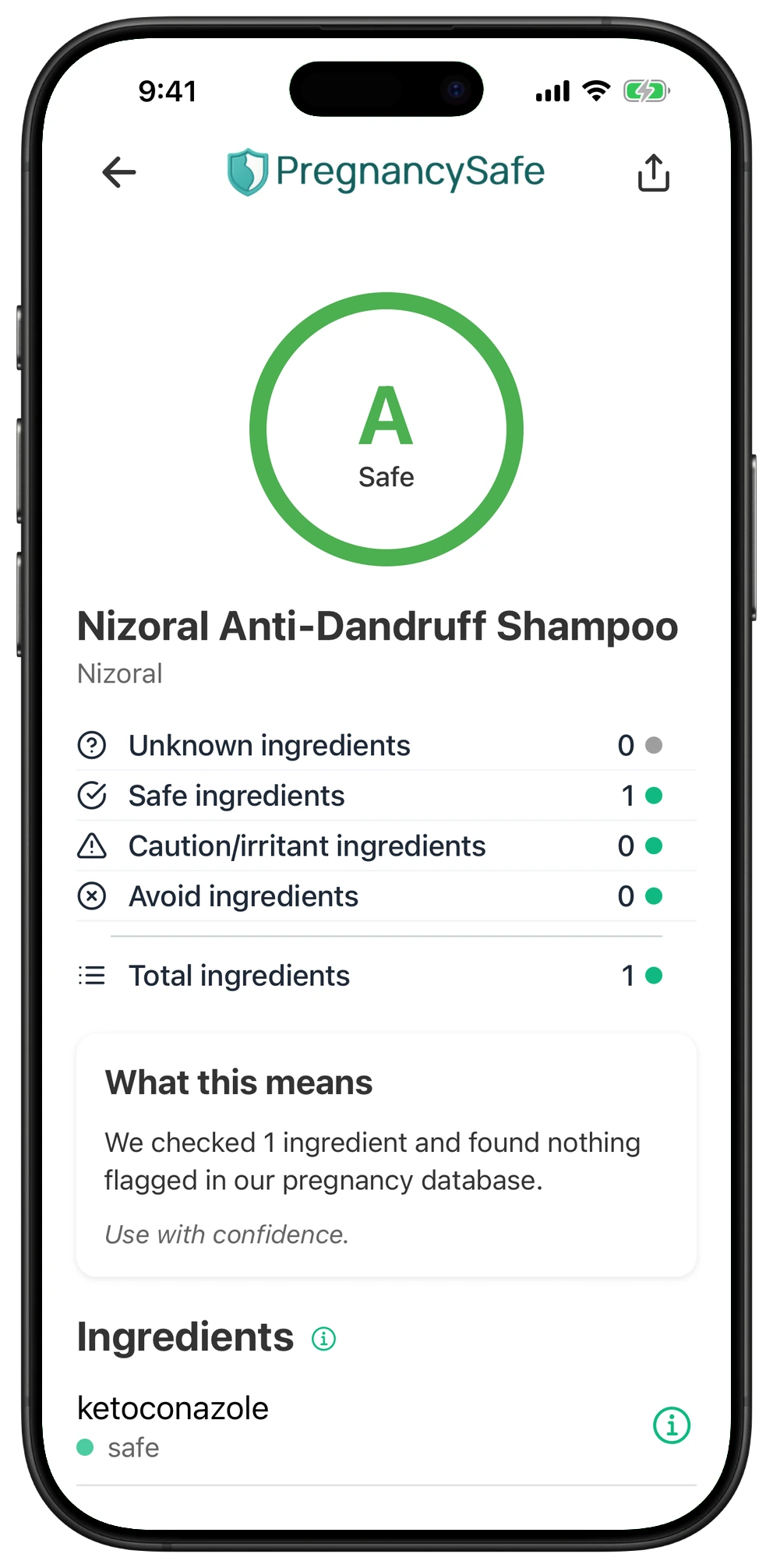
The main distinction is between routine rinse off washing, leave on or aerosol dry shampoo, and medicated scalp treatment. Fragrance can trigger irritation or allergy, while limited pregnancy specific evidence for ingredients such as phenoxyethanol does not establish harm from ordinary rinse off use at regulated concentrations. NHS guidance permits ketoconazole shampoo during pregnancy; check other medicated active ingredients with a pharmacist or clinician rather than stopping treatment because of a catalog grade.
Pregnancy Safe is 100% independent and research driven. No companies pay to promote or sponsor products.
Stress Less This Pregnancy
Check your exact shampoo in the app

✓ What's Safe
- • Choose a regular rinse off formula suited to your scalp, and follow its washing and rinsing directions.
- • Look for fragrance free options if scent causes discomfort or your scalp reacts to fragranced products.
- • Check the complete ingredient label; for medicated shampoos, read both active and inactive ingredients and the active ingredient's concentration.
- • Choose dandruff treatment with a pharmacist or clinician based on your scalp condition and the specific medicinal ingredient.
- • For dry shampoo, check whether it is a spray or powder and follow its application instructions; keep washing with shampoo and water.
- • Prioritize a formula you tolerate over sulfate free, preservative free or natural claims, which do not automatically establish pregnancy safety.
✗ What to Avoid
- • Avoid fragrance or parfum if these scent mixtures trigger scalp irritation or airway symptoms; their presence alone does not prove fetal harm.
- • Avoid benzyl salicylate if you have a known allergy to it, and stop using a formula that causes a reaction.
- • Avoid chamomilla recutita flower extract if you have reacted to chamomile; check with a clinician if you have ragweed or related plant allergies.
- • Avoid leaving salicylic acid shampoo on longer than directed or using it on broken skin without professional advice; concentration and absorption matter.
- • Avoid inhaling dry shampoo spray or powder directly, and do not use dry shampoo as a replacement for regular washing.
- • Avoid selecting a medicated shampoo from its catalog grade alone or discontinuing prescribed scalp treatment because it has a low score.
Most Common Ingredients in Shampoo Products
We analyzed 3,224 shampoo products. Here are the most common ingredients, ranked by how often they appear:
Ingredients to Watch Out For in Shampoo
These are the most common flagged ingredients across 3,224 shampoo products we analyzed.
fragrance
Caution
A fragrant substance used to add a pleasant aroma to products or environments.
Can hide product specific mixtures and has been associated with higher DEP metabolite exposure in some pregnancy studies; fragrance allergens and VOCs may also irritate sensitive skin or airways.
Fragrance denotes a scent mixture in shampoo whose individual components may not be disclosed. It can cause irritation or allergy; exposure associations from fragranced personal care products do not prove that every shampoo contains phthalates or harms pregnancy. Fragrance free is an optional exposure reduction choice, especially if you are sensitive.
Flagged in 1468 of 3,224 products (46%)
Caution
Phenoxyethanol is a preservative commonly used in cosmetics and skincare products to prevent microbial growth and extend shelf life.
Has limited direct pregnancy data and possible infant oral exposure concerns from nipple area products, while regulated cosmetic concentrations are generally considered low systemic risk.
Phenoxyethanol preserves shampoo against microbial growth. Cosmetic assessments consider it acceptable at assessed use levels, while direct pregnancy outcome evidence remains limited. High dose animal effects and infant ingestion from nipple products do not establish harm from ordinary rinse off shampoo use.
Flagged in 1099 of 3,224 products (34%)
parfum
Caution
Parfum is a fragrant mixture of essential oils, aroma compounds, and solvents used to impart a pleasant scent.
Can hide product specific mixtures and has been associated with higher DEP metabolite exposure in some pregnancy studies; fragrance allergens and VOCs may also irritate sensitive skin or airways.
Parfum is another label term for fragrance, not a separate pregnancy hazard. In shampoo, its practical concerns are undisclosed mixture components and possible irritation or allergy. Choose a fragrance free formula if needed; typical rinse off use is not proven harmful merely because parfum appears on the label.
Flagged in 576 of 3,224 products (18%)
cocamide mea
Caution
Cocamide MEA is a foaming agent and thickener derived from coconut oil and monoethanolamine, commonly used in shampoos and cleansers.
Has limited direct pregnancy cosmetic data and can irritate skin or airways, with concern increasing for leave on, nitrosating, aerosol, high concentration, or occupational exposure.
Cocamide MEA is a shampoo foaming agent and thickener derived from coconut fatty acids and monoethanolamine; it is not the same ingredient as free ethanolamine. Evidence about ethanolamine does not directly establish cocamide MEA's pregnancy effects. Its caution flag should not be read as proof of fetal harm from routine rinse off use.
Flagged in 479 of 3,224 products (15%)
salicylic acid
Caution
Salicylic acid is a beta hydroxy acid commonly used in skincare to exfoliate the skin, unclog pores, and treat acne.
Is generally low concern in directed low dose topical acne use during pregnancy but needs caution with high concentration peels, wart or callus removers, large area, occlusive, broken skin, or raw chemical exposure; oral salicylates are separate medication exposures.
Salicylic acid can be part of an exfoliating scalp treatment. Directed low dose topical acne use is considered low concern, but that does not cover every shampoo strength or treatment schedule. Check the concentration and directions with a pharmacist, particularly for broken skin or prolonged use; oral salicylate warnings concern a different exposure.
Flagged in 453 of 3,224 products (14%)
parfum fragrance
Caution
A parfum fragrance is a concentrated aromatic blend designed to impart a pleasing and lasting scent when applied to the skin or clothing.
Can hide product specific mixtures and has been associated with higher DEP metabolite exposure in some pregnancy studies; fragrance allergens and VOCs may also irritate sensitive skin or airways.
Parfum fragrance is combined label wording for a fragrance mixture, not evidence of a distinct ingredient or a higher dose. In rinse off shampoo, mixture uncertainty and sensitivity are the relevant considerations. It does not establish phthalate content or demonstrated pregnancy harm.
Flagged in 452 of 3,224 products (14%)
benzyl salicylate
Caution
Benzyl salicylate is a fragrant compound commonly used as a UV filter and scent ingredient in perfumes and cosmetics.
Has limited pregnancy specific human data and weak endocrine mode signals, but regulated low dose cosmetic use has wide safety margins compared with high dose oral salicylates.
Benzyl salicylate is a fragrance ingredient and light stabilizer that can cause fragrance allergy. Direct human pregnancy evidence is limited, but assessments of low dose cosmetic exposure differ substantially from high dose oral salicylate exposure. Its presence in shampoo is not equivalent to taking a salicylate medicine; avoid it if you have a known allergy.
Flagged in 358 of 3,224 products (11%)
fragrance parfum
Caution
A fragrant, concentrated scent used to enhance personal aroma and add a touch of elegance.
Can hide product specific mixtures and has been associated with higher DEP metabolite exposure in some pregnancy studies; fragrance allergens and VOCs may also irritate sensitive skin or airways.
Fragrance parfum is another combined label expression for fragrance rather than a separate chemical identity. Shampoo containing it may irritate sensitive skin or airways, and the mixture's components may be undisclosed. Choosing fragrance free can reduce exposure without implying that previous routine washing harmed your pregnancy.
Flagged in 200 of 3,224 products (6%)
Types of Shampoo
How Do Shampoo Products Stack Up?
Our catalog contains ratings for 3,224 shampoo products. These are database grades, not independent safety certifications.
The Earth Science record uses the current manufacturer formula and is a non-medicated cleanser, not Nizoral. Other catalog records may still reflect older labels or only drug actives. Grades are ingredient scores, not pregnancy verdicts or proof that routine shampoo is unsafe.
Best Pregnancy Safe Shampoo
Popular options from our catalog, prioritizing A and B ingredient grades, with C grade options used to fill remaining places. Within each group, products are ordered by searches in Pregnancy Safe, not retail sales. Read the cautions and guidance above; grades do not verify a complete current label or guarantee pregnancy safety.
| Grade | Product | Brand |
|---|---|---|
| B+ | Vanicream Shampoo | Vanicream |
| B+ | Natural Shampoo - Nourishing & Strengthening | Attitude |
| B+ | Strength Cure Shampoo | Pureology |
| A | Batiste Dry Shampoo Sensitive Scalp | Batiste |
| B+ | Head & Shoulders Bare Itchy Scalp Relief Dandruff Shampoo | Head & Shoulders |
Your Questions Answered
Is regular shampoo safe to use during pregnancy?
A regular rinse off shampoo suited to your scalp is a reasonable choice during pregnancy. Follow the label and choose fragrance free if scents or irritation bother you. Ingredient caution flags can reflect uncertainty or allergy concerns rather than demonstrated fetal harm. Routine washing should not be equated with swallowing ingredients or prolonged occupational exposure.
Which dandruff shampoo can I use during pregnancy?
The answer depends on the active ingredient, its concentration and your scalp condition. NHS guidance permits ketoconazole shampoo during pregnancy. Other medicated shampoos need their own ingredient specific check with a pharmacist or clinician. Follow the treatment directions, and do not stop prescribed treatment solely because of a catalog grade.
Can I use dry shampoo while pregnant?
Dry shampoo is a leave on product, and sprays or powders introduce an inhalation consideration that differs from rinse off washing. Follow the application instructions and avoid breathing the product directly. Dry shampoo absorbs oil but does not replace washing with shampoo and water. A grade or an unscented label alone does not establish that a particular formula is suitable for you.
Do I need to avoid fragrance and phenoxyethanol in shampoo?
Neither ingredient's caution flag establishes that ordinary rinse off shampoo use harms a pregnancy. Fragrance mixtures may be incompletely disclosed and can trigger allergy or irritation, so fragrance free is a practical option if you are sensitive or want to reduce fragrance exposure. Phenoxyethanol is a preservative considered acceptable in cosmetics at assessed concentrations, although direct pregnancy outcome data are limited. Infant ingestion concerns from nipple products and high dose animal findings should not be treated as evidence about routine shampoo use.
Is shampoo with salicylic acid safe during pregnancy?
Salicylic acid is not a blanket pregnancy prohibition: guidance allows directed low dose topical acne use. That guidance does not automatically establish the suitability of every scalp treatment concentration or regimen. Ask a pharmacist or clinician about the specific shampoo, especially if your scalp is broken or irritated. Avoid extending contact time beyond the label; oral salicylate medicines are a separate exposure.
Does an A grade mean a shampoo is verified safe during pregnancy?
No. Our catalog contains 3,224 products, including 79 with an A grade, but grades are catalog scores rather than pregnancy safety guarantees. Some records contain only a medicine's active ingredient rather than the complete formulation; incomplete information is not proof of harm either. The product list prioritizes A/B ingredient grades, with C grades filling remaining slots, and uses searches in Pregnancy Safe within each group, not clinical effectiveness. Dry shampoos and rinse off shampoos serve different purposes. Read the current label rather than treating either an A or a low grade as a clinical verdict.
How to Interpret These Ratings
Our ingredient and category rules generate letter grades from the information recorded in the catalog. Missing ingredients and broad category assignments can affect the result. These grades do not measure your dose, confirm a complete current label, or test a product for contamination.
A high grade is not a guarantee of pregnancy safety. A low grade is not, by itself, proof of harm from every use. Follow the product-specific guidance above, check the actual package, and ask your prenatal clinician about supplements, treatment decisions or uncertain exposures.
People Also Checked
References
- https://www.aad.org/public/everyday-care/skin-care-secrets/routine/pregnancy-skin-care
- https://www.aad.org/public/everyday-care/hair-scalp-care/hair/dry-shampoo-best-results
- https://www.nhs.uk/medicines/ketoconazole/pregnancy-breastfeeding-and-fertility-while-using-ketoconazole/
- https://www.superdrug.com/hair/shampoo/dry-shampoo/batiste-sensitive-scalp-lightly-scented-dry-shampoo-200ml/p/849063
- https://www.fda.gov/cosmetics/cosmetic-ingredients/fragrances-cosmetics
- https://www.fda.gov/cosmetics/cosmetic-ingredients/phthalates-cosmetics
- https://www.fda.gov/cosmetics/cosmetic-ingredients/allergens-cosmetics
- https://pmc.ncbi.nlm.nih.gov/articles/PMC3110684/
- https://pmc.ncbi.nlm.nih.gov/articles/PMC4016195/
- https://pmc.ncbi.nlm.nih.gov/articles/PMC4097177/
- https://pmc.ncbi.nlm.nih.gov/articles/PMC8453372/
- https://pmc.ncbi.nlm.nih.gov/articles/PMC10999525/
- https://www.epa.gov/indoor-air-quality-iaq/volatile-organic-compounds-impact-indoor-air-quality
- https://health.ec.europa.eu/system/files/2021-08/sccs_o_195_0.pdf
- https://ec.europa.eu/growth/tools-databases/cosing/details/28157
- https://journals.sagepub.com/doi/10.3109/10915819009078737
- https://link.springer.com/article/10.1007/s00204-024-03938-5
- https://www.sfda.gov.sa/en/warnings/1156
- https://www.industrialchemicals.gov.au/sites/default/files/Ethanol%2C%202-phenoxy-_Human%20health%20tier%20II%20assessment.pdf
- https://hero.epa.gov/reference/2857875
- https://books.publisso.de/sites/default/files/documents/series/mak/dam/Vol2019/Iss1/Alt006/mb12299kske6319_w.pdf
- https://www.cir-safety.org/sites/default/files/MEA032012FAR.pdf
- https://pubmed.ncbi.nlm.nih.gov/8998947/
- https://hpvchemicals.oecd.org/UI/handler.axd?id=27d71248-4be0-45ad-81bc-069b0fe7839c
- https://www.cdc.gov/niosh/npg/npgd0256.html
- https://www.tceq.texas.gov/downloads/toxicology/dsd/final/monoethanolamine.pdf/@@download/file/monoethanolamine.pdf
- https://ec.europa.eu/health/scientific_committees/consumer_safety/docs/sccs_o_072.pdf
- https://mothertobaby.org/fact-sheets/hair-treatments-pregnancy/pdf/
- https://www.acog.org/womens-health/experts-and-stories/ask-acog/is-it-safe-to-dye-my-hair-during-pregnancy
- https://www.nhs.uk/best-start-in-life/pregnancy/using-hair-dye-in-pregnancy-is-it-safe/
- https://www.federalregister.gov/documents/2017/04/12/2017-07130/monoethanolamine-exemption-from-the-requirement-of-a-tolerance
- https://www.acog.org/womens-health/faqs/skin-conditions-during-pregnancy
- https://mothertobaby.org/fact-sheets/topical-acne-treatments-pregnancy/
- https://www.aad.org/public/diseases/acne/derm-treat/pregnancy
- https://pmc.ncbi.nlm.nih.gov/articles/PMC9823189/
- https://www.accessdata.fda.gov/drugsatfda_docs/omuf/Order/Final%20Administrative%20Order%20OTC000013_M006-Topical%20Acne%20drug%20products%20for%20OTC%20Human%20Use.pdf
- https://health.ec.europa.eu/system/files/2023-06/sccs_o_268.pdf
- https://www.fda.gov/drugs/drug-safety-and-availability/fda-recommends-avoiding-use-nsaids-pregnancy-20-weeks-or-later-because-they-can-result-low-amniotic
- https://www.accessdata.fda.gov/drugsatfda_docs/omuf/monographs/OTCMonograph_M028-WartRemoverDrugProductsforOTCHumanUse10012021.pdf
- https://www.ncbi.nlm.nih.gov/books/NBK582985/
- https://pmc.ncbi.nlm.nih.gov/articles/PMC3114665/
- https://pubmed.ncbi.nlm.nih.gov/9269866/
- https://pubmed.ncbi.nlm.nih.gov/10026401/
- https://pubmed.ncbi.nlm.nih.gov/24472429/
- https://www.ecfr.gov/current/title-21/chapter-I/subchapter-D/part-333/subpart-D/section-333.310
- https://pubmed.ncbi.nlm.nih.gov/38453786/
- https://www.accessdata.fda.gov/drugsatfda_docs/omuf/monographs/OTC%20Monograph_M006-Topical%20Acne%20drug%20products%20for%20OTC%20Human%20Use%2011.23.2021.pdf
- https://www.fda.gov/safety/medical-product-safety-information/nonsteroidal-anti-inflammatory-drugs-nsaids-drug-safety-communication-avoid-use-nsaids-pregnancy-20
- https://dermnetnz.org/topics/acne-in-pregnancy
- https://www.inchem.org/documents/icsc/icsc/eics0563.htm
- https://www.ncbi.nlm.nih.gov/books/NBK582985
- https://pubmed.ncbi.nlm.nih.gov/23914887
- https://www.fda.gov/drugs/drug-alerts-and-statements/fda-warns-against-purchasing-or-using-chemical-peel-skin-products-without-professional-supervision
- https://health.ec.europa.eu/system/files/2023-11/sccs_o_277.pdf
- https://eur-lex.europa.eu/legal-content/EN/TXT/HTML/?uri=OJ%3AL_202600909
- https://pmc.ncbi.nlm.nih.gov/articles/PMC10955127/
- https://pubmed.ncbi.nlm.nih.gov/29410076/
- https://www.cir-safety.org/sites/default/files/bensal042019FR.pdf
- https://www.nccih.nih.gov/health/chamomile
- https://www.ema.europa.eu/en/documents/herbal-monograph/final-european-union-herbal-monograph-matricaria-recutita-l-flos-first-version_en.pdf
- https://www.ema.europa.eu/en/documents/herbal-monograph/final-community-herbal-monograph-chamaemelum-nobile-l-all-flos_en.pdf
- https://journals.sagepub.com/doi/10.1177/1091581818801814
- https://journals.sagepub.com/doi/10.1177/1091581817705620
- https://pubmed.ncbi.nlm.nih.gov/40314057/
- https://pubmed.ncbi.nlm.nih.gov/40374153/
- https://dailymed.nlm.nih.gov/dailymed/drugInfo.cfm?audience=consumer&setid=ac0f9a8c-164a-4908-8b1d-bb714a82550d
- https://dailymed.nlm.nih.gov/dailymed/drugInfo.cfm?audience=consumer&setid=41eaa88c-a980-ea4f-e063-6294a90a411a
- https://www.cir-safety.org/sites/default/files/salicy042019FAR.pdf
- https://www.industrialchemicals.gov.au/sites/default/files/2024-04/EVA00150%20-%20Draft%20Evaluation%20Statement%20-%2015%20April%202024.pdf