Is Whey Protein Safe During Pregnancy?
Updated September 11, 2026
The Answer
Whey protein from pasteurized foods is generally safe during pregnancy. Protein powders need additional quality and ingredient checks and should not replace balanced pregnancy nutrition.
Whey in pasteurized foods is different from high protein supplementation that displaces balanced nutrition.
WHO does not recommend high protein supplementation to improve pregnancy outcomes in undernourished populations; this is different from balanced nutrition and ordinary whey containing foods.
Already used it? If you have already used a whey powder, check its milk source, full ingredient list, and quality information, including testing for heavy metal contamination.
Pregnancy Safe is 100% independent and research driven. No companies pay to promote or sponsor products.
Stressless Pregnancy
Check your exact product with whey protein in the app
What Is Whey Protein?
You may also see it listed as: whey proteins
Whey protein is a milk derived protein used in dairy foods, protein powders, and nutrition supplements. It supplies protein and is commonly marketed for muscle growth and recovery. You may encounter concentrate, isolate, or blends in powders, bars, and ready to drink shakes.
What Other Ingredients Should You Look Out for in Products With Whey Protein?
A product's full ingredient list determines whether it's pregnancy-safe or not. These ingredients also appear in some of the whey protein products we analyzed and may deserve a closer look.
Hydrogenated Oils
CautionCheck whether a powder or shake lists partially hydrogenated oil, such as partially hydrogenated cottonseed oil the main industrial trans fat concern. Fully hydrogenated oils are mainly a saturated fat consideration; if a label says only hydrogenated palm oil, clarify the form rather than assuming it is partially hydrogenated.
Flagged in 236 products (27.3%) in this analysis.
Creatine
CautionLook for creatine or creatine monohydrate, including within a recovery blend, in whey powders. Supplemental dose pregnancy evidence remains limited despite reassuring early findings, so review the amount with your clinician.
Flagged in 19 products (2.2%) in this analysis.
High Fructose Corn Syrup
CautionHigh fructose corn syrup is an added sweetener in some whey powders, not a known pregnancy teratogen at occasional food amounts. Check total added sugars and how often you use the product; if you have gestational diabetes, review carbohydrate intake with your care team.
Flagged in 15 products (1.7%) in this analysis.
Butylated Hydroxytoluene
CautionBHT is an antioxidant preservative in some protein bars. Pregnancy concerns come mainly from high dose oral animal studies, not established harm from ordinary bar consumption; check how frequently BHT containing foods feature in your diet and limit avoidable high intake.
Flagged in 7 products (0.8%) in this analysis.
Erythrosine
CautionLook for Red 3 or FD&C Red No. 3 in protein powders. FDA is phasing it out of foods following high dose male rat thyroid tumor findings not proven pregnancy harm so check for this dye if you want to avoid unnecessary intake.
Flagged in 4 products (0.5%) in this analysis.
Hibiscus
CautionHibiscus extract appears in some protein powders, and pregnancy safety evidence for concentrated use is limited. Check its amount and discuss it with your clinician, especially if you have low blood pressure or take blood pressure medication, because hibiscus can lower blood pressure.
Flagged in 2 products (0.2%) in this analysis.
Does the Form or Amount of Whey Protein Matter During Pregnancy?
For food use, choose pasteurized dairy sources rather than raw milk whey. With powders, consider product quality, added stimulants, milk allergy, lactose sensitivity, and your blood sugar needs. The nutritional concern is high protein supplementation that crowds out balanced meals not simply the presence of whey on a label.
What Products Contain Whey Protein?
Pregnancy Safe has looked at 1,573 products that have whey protein as an ingredient. The category and grade breakdowns below use 866 products whose names mention Whey Protein or another name for it.
What Types of Products Contain Whey Protein?
Products You May Have That Contain Whey Protein
| Grade | Product | Brand | Type |
|---|---|---|---|
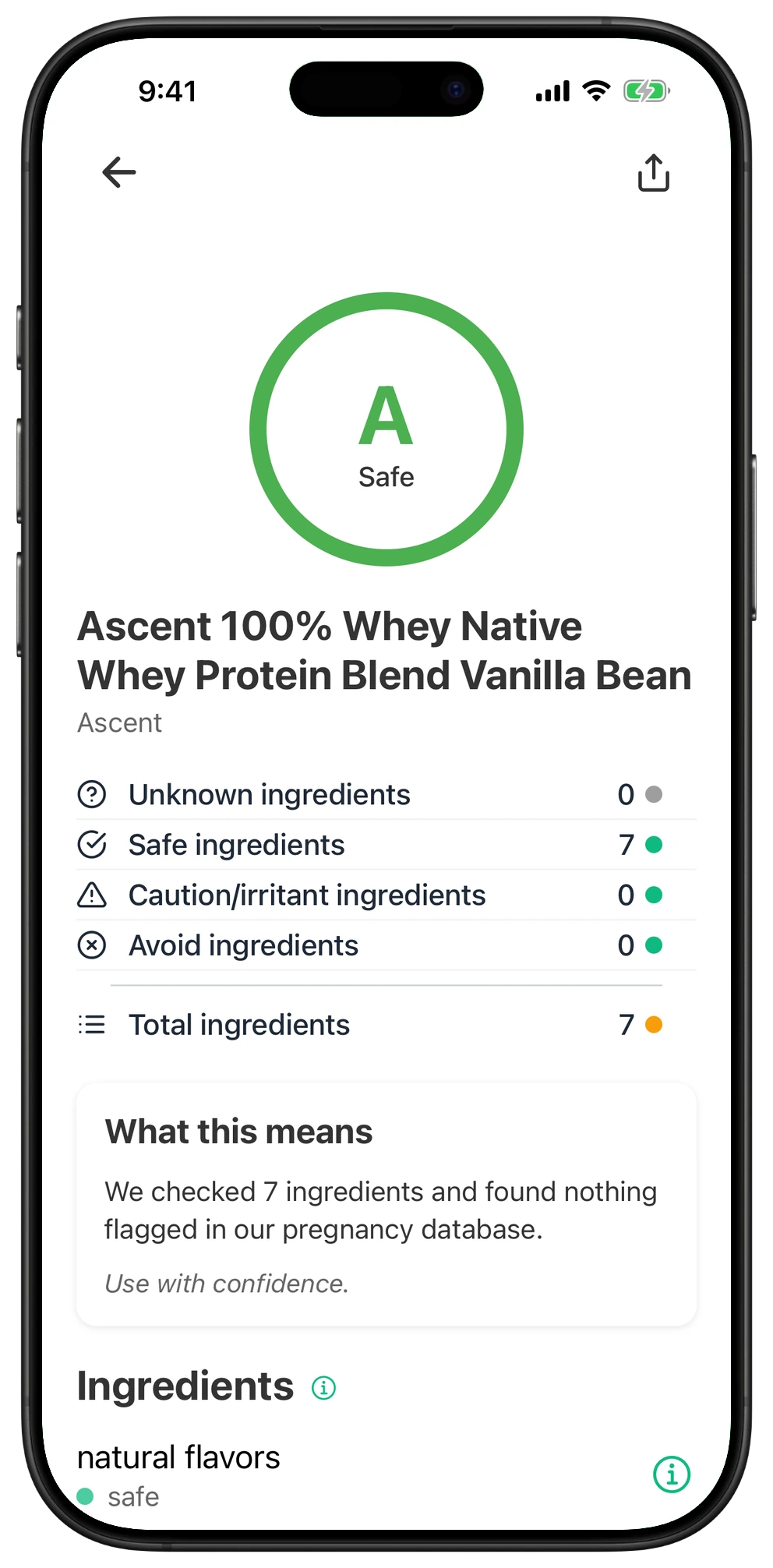
| A | Ascent 100% Whey Native Whey Protein Blend Vanilla Bean | Ascent | Whey Protein |
| B+ | Whey Protein Blend – Elevation – 907 G | Elevation By Millville | Protein Powder |
| B+ | Phormula-1 Clear Whey Protein Isolate | 1St Phorm | Whey Protein Isolate |
| A | Clear Whey Protein Isolate Lemon Italian Ice | 1Up Nutrition | Protein Powder |
| A | 100% Whey Native Whey Protein Blend | Ascent | Protein Powder |
| A | Iso100 Hydrolyzed Whey Protein Powder - Chocolate Peanut Butter - 5 Lb | Dymatize | Protein Powder |
| A | Kirkland Signature Whey Protein Creamy Chocolate 5.4Lbs | Kirkland Signature | Whey Protein |
| A | Whey Protein | Lean Fit | Protein Powder |
How Do Products Containing Whey Protein Score?
It can be helpful to see how products containing whey protein generally score during pregnancy. This does not tell you whether your exact product is safe, but it gives you a general idea of what we found. In this breakdown of 866 products, 37% receive an A grade. An A grade means the complete formula is considered safe during pregnancy.
Frequently Asked Questions About Whey Protein During Pregnancy
Is whey isolate a better pregnancy choice than concentrate?
Isolate is a more purified form of milk derived protein, but the available evidence does not establish it as a safer pregnancy choice than concentrate. Milk source, product quality, added ingredients, and how the powder fits your diet still matter.
What should I check when choosing a whey protein powder?
Check for a pasteurized milk source, a reputable manufacturer, quality information addressing heavy metal contamination, and added stimulants. Also consider milk allergy, lactose sensitivity, and your blood sugar needs.
Which month should I start taking whey protein powder?
The available guidance does not identify a month or trimester when you should start whey powder. Adequate protein matters during pregnancy, but that does not mean everyone needs a protein supplement.
How much whey protein can I take each day?
The available evidence does not establish a universal daily whey powder amount. The key distinction is meeting protein needs within balanced nutrition rather than adding high protein supplementation that displaces other needed foods.
Can a whey shake replace meals during pregnancy?
Whey protein should not be used to replace balanced pregnancy nutrition. WHO does not recommend high protein supplementation to improve pregnancy outcomes in undernourished populations.
Does milk allergy or lactose sensitivity change the answer?
Yes. Whey is milk derived, so its general compatibility with pregnancy does not override a milk allergy. Lactose sensitivity is also a reason to check the specific formulation rather than relying on the whey name alone.
How Do We Score Products for Pregnancy Safety?
We analyze each product's ingredients and category to flag known risks and provide cautionary notices for general category safety concerns.
A - Safe
Excellent choice! All ingredients are considered safe during pregnancy.
What to do: Use with confidence.
B - Likely Safe
Pretty much safe with very minimal risk. Some ingredients may have limited pregnancy studies, but no significant safety concerns have been identified.
What to do: Use with confidence.
C - Limit
Contains ingredients with some pregnancy considerations. Research shows these ingredients may have limited safety data, potential for minor hormonal effects, or require caution based on animal studies.
What to do: Use sparingly and consider safer alternatives when available.
D - Caution
Similar to C grade but contains multiple cautionary ingredients. The combination increases overall concern.
What to do: Try to avoid if that makes you feel better. If you've already used it, no need to panic.
F - Avoid
Contains an ingredient Pregnancy Safe recommends avoiding during pregnancy. This may reflect an established risk or a precaution based on limited evidence; check the ingredient guidance and exposure context.
What to do: Do not use during pregnancy. If you've already used it, don't worry - contact your OBGYN if concerned.
Sources
- https://pubmed.ncbi.nlm.nih.gov/41203981/
- https://www.foodallergy.org/living-food-allergy/food-allergy-essentials/common-allergens/milk
- https://www.foodsafety.gov/people-at-risk/pregnant-women
- https://www.ncbi.nlm.nih.gov/books/NBK562630/
- https://www.who.int/tools/elena/interventions/energy-protein-pregnancy
- https://www.who.int/tools/elena/interventions/high-protein-pregnancy
- https://www.fda.gov/food/food-additives-petitions/trans-fat
- https://www.fda.gov/food/hfp-constituent-updates/fda-completes-final-administrative-actions-partially-hydrogenated-oils-foods
- https://www.federalregister.gov/documents/2013/11/08/2013-26854/tentative-determination-regarding-partially-hydrogenated-oils-request-for-comments-and-for
- https://www.who.int/news-room/fact-sheets/detail/trans-fat
- https://cdn.realfood.gov/DGA.pdf
- https://www.fda.gov/food/people-risk-foodborne-illness/dietary-advice-and-during-pregnancy
- https://www.rcpi.ie/Portals/0/Document%20Repository/Institute%20of%20Obstetricians%20and%20Gynaecologists/National%20Clinical%20Guidelines/IOG_National%20Clinical%20Guidelines_Nutrition%20in%20pregnancy%20Guideline_2019.pdf
- https://pmc.ncbi.nlm.nih.gov/articles/PMC8027310/
- https://pmc.ncbi.nlm.nih.gov/articles/PMC3192475/
- https://pubmed.ncbi.nlm.nih.gov/38432717/
- https://pmc.ncbi.nlm.nih.gov/articles/PMC12291183/
- https://pubmed.ncbi.nlm.nih.gov/25523279/
- https://pmc.ncbi.nlm.nih.gov/articles/PMC12086928/
- https://pmc.ncbi.nlm.nih.gov/articles/PMC7912953/
- https://pubmed.ncbi.nlm.nih.gov/32549301/
- https://pmc.ncbi.nlm.nih.gov/articles/PMC12702719/
- https://www.hfpappexternal.fda.gov/scripts/fdcc/index.cfm?id=931&set=GRASNotices
- https://webprod.hc-sc.gc.ca/nhpid-bdipsn/atReq?atid=creatine.mono&lang=eng
- https://www.dietaryguidelines.gov/sites/default/files/2021-12/DGA_Pregnancy_FactSheet-508c.pdf
- https://www.acog.org/womens-health/faqs/healthy-eating-during-pregnancy
- https://www.cdc.gov/nutrition/php/data-research/added-sugars.html
- https://www.cdc.gov/diabetes/about/gestational-diabetes.html
- https://www.who.int/publications/i/item/9789241549028
- https://nesr.usda.gov/2025-dietary-guidelines-advisory-committee-systematic-reviews/dietary-patterns_gestational-diabetes
- https://health.ec.europa.eu/system/files/2022-08/sccs_o_257.pdf
- https://pubmed.ncbi.nlm.nih.gov/37751543/
- https://pubmed.ncbi.nlm.nih.gov/12396675/
- https://pmc.ncbi.nlm.nih.gov/articles/PMC13151845/
- https://www.ecfr.gov/current/title-21/chapter-I/subchapter-B/part-172/subpart-B/section-172.115
- https://www.ecfr.gov/current/title-21/chapter-I/subchapter-B/part-182/subpart-D/section-182.3173
- https://www.fda.gov/news-events/press-announcements/fda-finalizes-food-chemical-safety-post-market-assessment-program-launches-reassessment-bht-ada
- https://www.fda.gov/industry/color-additives/fdc-red-no-3
- https://www.federalregister.gov/documents/2025/01/16/2025-00830/color-additive-petition-from-center-for-science-in-the-public-interest-et-al-request-to-revoke-color
- https://efsa.onlinelibrary.wiley.com/doi/10.2903/j.efsa.2011.1854
- https://pubmed.ncbi.nlm.nih.gov/2824305/
- https://pubmed.ncbi.nlm.nih.gov/2177442/
- https://pubmed.ncbi.nlm.nih.gov/8296313/
- https://pubmed.ncbi.nlm.nih.gov/8386132/
- https://pmc.ncbi.nlm.nih.gov/articles/PMC9368057/
- https://mothertobaby.org/fact-sheets/herbal-products-pregnancy/
- https://www.ncbi.nlm.nih.gov/books/NBK501882/
- https://pubmed.ncbi.nlm.nih.gov/19434218/
- https://pubmed.ncbi.nlm.nih.gov/18066103/
- https://pmc.ncbi.nlm.nih.gov/articles/PMC9086798/
- https://www.nccih.nih.gov/health/hypertension-high-blood-pressure
- https://www.ffhdj.com/index.php/ffhd/article/view/1768