Best Pregnancy Safe Protein Shake (Updated 2026 Guide)
Updated September 9, 2026
The Answer
A ready to drink, treated dairy protein shake can be a food option during pregnancy when it helps meet your intake needs; check the exact formula, allergens and total nutrients. Our catalog contains mostly B+ ingredient scores, but grades do not establish pregnancy suitability or replace checking the current label.
Choose a shake to complement varied meals, not replace them or your prescribed prenatal nutrients. Count caffeine from cocoa, coffee and added caffeine toward a daily total below 200 mg, and discuss supplemental ingredients such as creatine monohydrate or algae with your clinician. Ordinary vitamin fortification and sweeteners are not equivalent to high dose retinol supplements; the amount you consume and your overall intake matter.
Pregnancy Safe is 100% independent and research driven. No companies pay to promote or sponsor products.
Stress Less This Pregnancy
Check your exact protein shake in the app

✓ What's Safe
- • Check the current ingredient and nutrition labels for the exact flavor, size and formulation rather than relying on the brand name.
- • For dairy shakes, choose a treated ready to drink formulation and follow its storage and after opening instructions.
- • Choose a protein source that fits your dietary needs, and check the allergen statement, including milk ingredients such as calcium caseinate.
- • Check caffeine per serving, including caffeine contributed by cocoa or coffee, and account for how many servings you drink.
- • Compare protein, calories and added vitamins with your meals and prenatal supplement rather than automatically choosing the highest protein option.
- • Prefer a straightforward formulation without optional sports or algae supplements; if considering algae ingredients, ask about contaminant testing and the amount per serving.
✗ What to Avoid
- • Avoid shakes with caffeine amounts that bring your total to 200 mg or more per day; do not assume a chocolate shake is caffeine free.
- • Avoid adding creatine monohydrate to your shake without clinician guidance: supplemental dose pregnancy evidence remains limited.
- • Avoid choosing spirulina or chlorella blends with unclear sourcing or contaminant testing; their presence alone does not prove contamination or harm.
- • Minimize industrial trans fat, especially from partially hydrogenated oils. Fully hydrogenated oils are mainly a saturated fat consideration, not the same exposure.
- • Limit unnecessary red 3, blue 1 and red 40 when an otherwise suitable dye free shake is available; ordinary food exposure is not established to cause fetal harm.
- • Avoid adding concentrated spoonfuls of flaxseed oil or organic flax oil without discussing them with your clinician; ordinary food amounts are a different exposure.
Most Common Ingredients in Protein Shake Products
We analyzed 1,109 protein shake products. Here are the most common ingredients, ranked by how often they appear:
Ingredients to Watch Out For in Protein Shake
These are the most common flagged ingredients across 1,109 protein shake products we analyzed.
trans fat
Caution
Trans fat is a type of unsaturated fat artificially created through hydrogenation, known to increase bad cholesterol levels and raise the risk of heart disease.
Mainly raise concern when partially hydrogenated and high in artificial trans fat; fully hydrogenated oils are mostly a saturated fat limit rather than the same trans fat issue.
For protein shakes, the main avoidable concern is industrial trans fat from partially hydrogenated oils. A trans fat declaration alone does not identify its source; check the ingredient list. Fully hydrogenated oils are mostly saturated fat and should not receive the same trans fat warning. Minimize regular industrial trans fat intake without treating an occasional exposure as proof of pregnancy harm.
Flagged in 68 of 1,109 products (6%)
caffeine
Caution
Caffeine is a natural stimulant found in coffee, tea, and various plants that temporarily boosts alertness and reduces fatigue.
Should be counted across all sources and generally limited to below 200 mg/day in pregnancy because higher intake has observational links to miscarriage and fetal growth outcomes.
Count caffeine in your shake, including cocoa, coffee and added caffeine, toward a total below 200 mg per day from all sources. Serving size matters, and the ingredient list may not disclose the amount. Higher intake has observational links to adverse pregnancy outcomes, but those studies do not establish a precise causal threshold.
Flagged in 41 of 1,109 products (4%)
creatine monohydrate
Caution
Creatine monohydrate is a popular supplement that helps increase muscle strength, power, and performance during high intensity exercise.
Has limited human pregnancy safety data at supplemental doses despite reassuring early findings.
Creatine monohydrate is an added sports supplement, not simply the protein in a shake. Human pregnancy evidence at supplemental doses remains limited despite reassuring early findings. Discuss use with your clinician; normal dietary creatine exposure from food is not equivalent to a supplemental dose.
Flagged in 27 of 1,109 products (2%)
spirulina
Caution
Spirulina is a nutrient rich blue green algae known for its high protein, vitamin, and antioxidant content, often used as a dietary supplement.
Has limited pregnancy safety data and product quality concerns because contaminated blue green algae supplements can contain microcystins, heavy metals, or pathogenic bacteria.
Spirulina is a blue green algae ingredient sometimes added to protein shakes. Pregnancy supplement studies are limited, and poorly controlled products may contain microcystins, heavy metals or microbes. Quality controlled cultivated spirulina differs from poorly tested material, but testing does not establish routine pregnancy benefit or safety. Ask about dose and quality before choosing a spirulina supplement blend.
Flagged in 18 of 1,109 products (2%)
red 3
Caution
Red 3 is a synthetic red dye commonly used to add vibrant color to food and beverages.
Has limited human pregnancy outcome data and is being phased out of U.S. foods and ingested drugs after high dose male rat thyroid tumor findings.
Red 3, also called erythrosine, adds color rather than protein to a shake. Its U.S. phase out follows high dose male rat thyroid tumor findings, not established harm from ordinary food exposure during human pregnancy. Human pregnancy data are limited, so choosing a version without it is reasonable, while occasional exposure is unlikely to be an emergency.
Flagged in 17 of 1,109 products (2%)
chlorella
Caution
Chlorella is a nutrient dense, freshwater algae rich in vitamins, minerals, and antioxidants, often used as a dietary supplement to support detoxification and immune health.
Is not proven harmful in small second trimester human studies but remains a supplement with limited pregnancy data and product quality or contamination concerns.
Chlorella is freshwater green algae, distinct from spirulina. Small studies, mostly using 6 g daily from the second trimester, did not show obvious newborn harm but do not establish routine benefit or first trimester safety. In protein shakes, the amount and product quality matter because microalgae supplements can vary in composition and contamination.
Flagged in 15 of 1,109 products (1%)
blue 1
Caution
Blue 1 is a synthetic blue dye commonly used to add vibrant color to foods, beverages, and cosmetics.
Has limited human pregnancy data; regulated food use is not shown to cause fetal harm, but high dose animal neurobehavior findings and child sensitivity concerns support minimizing frequent exposure.
Blue 1, also called Brilliant Blue FCF, is a synthetic color used in some shakes. Human pregnancy evidence is limited, and ordinary regulated food use has not been shown to cause fetal harm. High dose animal findings and concerns about sensitivity in children are indirect evidence, not proof that a serving harms a fetus. A dye free formula can reduce unnecessary exposure.
Flagged in 14 of 1,109 products (1%)
Caution
Red 40 is a synthetic food dye commonly used to add vibrant red color to candies, beverages, and processed foods.
Has limited human pregnancy data and is allowed at regulated food additive levels, but child neurobehavior concerns and high dose animal findings make frequent high dye intake worth limiting.
Red 40, also called Allura Red AC, is a synthetic color rather than a nutritional component of your shake. Pregnancy specific human data are limited; child attention concerns and high dose animal findings do not establish fetal harm from ordinary food amounts. Limiting frequent high dye intake is reasonable without treating occasional consumption as a major pregnancy hazard.
Flagged in 13 of 1,109 products (1%)
How Do Protein Shake Products Stack Up?
Our catalog contains ratings for 1,109 protein shake products. These are database grades, not independent safety certifications.
Grades are catalog ingredient scores, not measurements of current labels, preparation, pathogens, dose or clinical pregnancy suitability. Unreviewed products remain in the aggregate counts.
Best Pregnancy Safe Protein Shake
Popular options from our catalog, prioritizing A and B ingredient grades, with C grade options used to fill remaining places. Within each group, products are ordered by searches in Pregnancy Safe, not retail sales. Read the cautions and guidance above; grades do not verify a complete current label or guarantee pregnancy safety.
| Grade | Product | Brand |
|---|---|---|
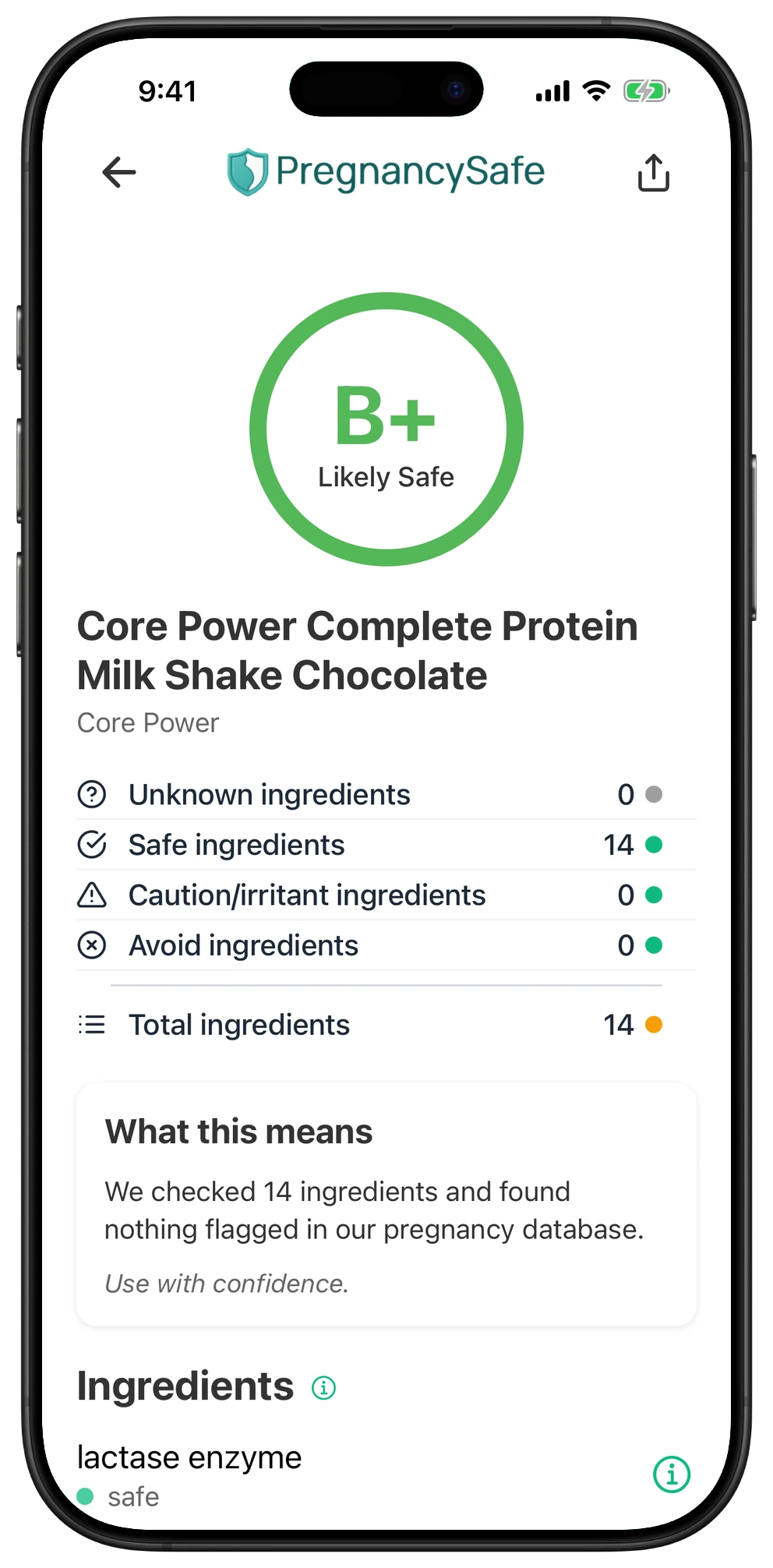
| B+ | Core Power Complete Protein Milk Shake Chocolate | Core Power |
| B+ | Core Power Protein Shake, Vanilla, Bottle Vanilla | Core Power |
| B+ | Premier Protein Vanilla Shake | Premier Protein |
| B+ | Oikos Protein Shake Chocolate | Oikos |
| B+ | Oikos Protein Shake Vanilla | Oikos |
Your Questions Answered
Can I still drink protein shakes while pregnant?
A treated, ready to drink dairy protein shake can be an option when it helps you meet your intake needs. Check the exact formulation, allergens, caffeine and nutrients rather than treating every shake as interchangeable. Use it alongside varied meals and prescribed prenatal nutrients. If poor intake or kidney disease is a concern, ask your clinician how a shake fits your needs.
How do protein shakes affect fetal development?
Meeting your nutritional needs matters during pregnancy, but a protein shake is not automatically beneficial for fetal development. Its role depends on what your diet already provides and whether it fills an actual gap. A higher protein number or catalog grade does not demonstrate better fetal growth. If you are struggling to eat enough, your clinician can help assess your overall nutrition rather than focusing only on protein.
Can I drink a protein shake every day?
Daily use should depend on the exact shake and your overall intake, not a universal serving rule. Check the nutrients contributed by each serving alongside your meals and prenatal supplement, and include its caffeine in your daily total. A shake should not routinely displace varied meals or prescribed prenatal nutrients. Ask for individualized guidance if you need it because you cannot eat enough or have kidney disease.
Do chocolate protein shakes contain caffeine?
Cocoa contributes caffeine, even when a shake does not advertise an energy boost. Coffee flavored formulas and added caffeine can contribute additional amounts. Keep your total from drinks, foods, supplements and medicines below 200 mg per day during pregnancy. If the label does not state the amount, ask the manufacturer rather than assuming it is zero.
Should I avoid protein shakes with vitamin A palmitate or sweeteners?
Do not treat ordinary shake fortification or sweeteners as equivalent to taking high dose retinol supplements. Vitamin A palmitate is a form of preformed vitamin A, so assess the amount alongside your prenatal supplement and other sources rather than judging the ingredient name alone. Sweeteners also need to be considered in the context of the exact formulation and consumption amount. If you regularly combine fortified shakes and supplements, ask your clinician to check the total nutrients.
Does an A grade mean a protein shake is verified safe for pregnancy?
No. Our catalog contains 1,109 protein shakes, including 173 with A ingredient scores and 678 with B+ scores, but these are not counts of independently verified pregnancy safe products. Grades do not measure current labels, preparation, pathogens, dose or your clinical needs, and unreviewed products remain in those totals. A listed product is not a safety guarantee or an endorsement of every flavor and formulation; likewise, a low grade or incomplete record alone does not prove harm.
How to Interpret These Ratings
Our ingredient and category rules generate letter grades from the information recorded in the catalog. Missing ingredients and broad category assignments can affect the result. These grades do not measure your dose, confirm a complete current label, or test a product for contamination.
A high grade is not a guarantee of pregnancy safety. A low grade is not, by itself, proof of harm from every use. Follow the product-specific guidance above, check the actual package, and ask your prenatal clinician about supplements, treatment decisions or uncertain exposures.
People Also Checked
References
- https://ods.od.nih.gov/factsheets/Pregnancy-HealthProfessional/
- https://www.acog.org/womens-health/experts-and-stories/ask-acog/how-much-coffee-can-i-drink-while-pregnant
- https://www.fda.gov/food/food-additives-petitions/trans-fat
- https://www.fda.gov/food/hfp-constituent-updates/fda-completes-final-administrative-actions-partially-hydrogenated-oils-foods
- https://www.federalregister.gov/documents/2013/11/08/2013-26854/tentative-determination-regarding-partially-hydrogenated-oils-request-for-comments-and-for
- https://www.who.int/news-room/fact-sheets/detail/trans-fat
- https://cdn.realfood.gov/DGA.pdf
- https://www.fda.gov/food/people-risk-foodborne-illness/dietary-advice-and-during-pregnancy
- https://www.rcpi.ie/Portals/0/Document%20Repository/Institute%20of%20Obstetricians%20and%20Gynaecologists/National%20Clinical%20Guidelines/IOG_National%20Clinical%20Guidelines_Nutrition%20in%20pregnancy%20Guideline_2019.pdf
- https://pmc.ncbi.nlm.nih.gov/articles/PMC8027310/
- https://pmc.ncbi.nlm.nih.gov/articles/PMC3192475/
- https://www.acog.org/clinical/clinical-guidance/committee-opinion/articles/2010/08/moderate-caffeine-consumption-during-pregnancy
- https://www.ncbi.nlm.nih.gov/books/NBK582613/
- https://www.who.int/tools/elena/interventions/caffeine-pregnancy
- https://www.fda.gov/consumers/consumer-updates/spilling-beans-how-much-caffeine-too-much
- https://pubmed.ncbi.nlm.nih.gov/25179792/
- https://pubmed.ncbi.nlm.nih.gov/25238871/
- https://pubmed.ncbi.nlm.nih.gov/38432717/
- https://pmc.ncbi.nlm.nih.gov/articles/PMC12291183/
- https://pubmed.ncbi.nlm.nih.gov/25523279/
- https://pmc.ncbi.nlm.nih.gov/articles/PMC12086928/
- https://pmc.ncbi.nlm.nih.gov/articles/PMC7912953/
- https://pubmed.ncbi.nlm.nih.gov/32549301/
- https://pmc.ncbi.nlm.nih.gov/articles/PMC12702719/
- https://www.hfpappexternal.fda.gov/scripts/fdcc/index.cfm?id=931&set=GRASNotices
- https://webprod.hc-sc.gc.ca/nhpid-bdipsn/atReq?atid=creatine.mono&lang=eng
- https://www.fda.gov/food/natural-toxins-food/blue-green-algae-products-and-microcystins
- https://www.ncbi.nlm.nih.gov/books/NBK548312/
- https://www.ncbi.nlm.nih.gov/books/NBK501849/
- https://pubmed.ncbi.nlm.nih.gov/21793723/
- https://journal.ugm.ac.id/v3/InaJBCS/article/view/23573
- https://doi.org/10.4236/ojog.2017.71016
- https://pubmed.ncbi.nlm.nih.gov/37317149/
- https://pubmed.ncbi.nlm.nih.gov/37368655/
- https://pubmed.ncbi.nlm.nih.gov/23036452/
- https://pubmed.ncbi.nlm.nih.gov/21842336/
- https://www.fda.gov/industry/color-additives/fdc-red-no-3
- https://www.federalregister.gov/documents/2025/01/16/2025-00830/color-additive-petition-from-center-for-science-in-the-public-interest-et-al-request-to-revoke-color
- https://efsa.onlinelibrary.wiley.com/doi/10.2903/j.efsa.2011.1854
- https://pubmed.ncbi.nlm.nih.gov/2824305/
- https://pubmed.ncbi.nlm.nih.gov/2177442/
- https://pubmed.ncbi.nlm.nih.gov/8296313/
- https://pubmed.ncbi.nlm.nih.gov/8386132/
- https://pmc.ncbi.nlm.nih.gov/articles/PMC9368057/
- https://www.ncbi.nlm.nih.gov/books/NBK501822/
- https://pmc.ncbi.nlm.nih.gov/articles/PMC10804112/
- https://pubmed.ncbi.nlm.nih.gov/20013055/
- https://pubmed.ncbi.nlm.nih.gov/17472477/
- https://pubmed.ncbi.nlm.nih.gov/15985279/
- https://pubmed.ncbi.nlm.nih.gov/24635025/
- https://www.fda.gov/food/information-consumers-using-dietary-supplements/questions-and-answers-dietary-supplements
- https://pmc.ncbi.nlm.nih.gov/articles/PMC7551278/
- https://www.hfpappexternal.fda.gov/scripts/fdcc/index.cfm?id=FDCBlue1&set=ColorAdditives
- https://www.ecfr.gov/current/title-21/chapter-I/subchapter-A/part-74
- https://www.fda.gov/food/color-additives-information-consumers/tracking-food-industry-pledges-remove-petroleum-based-food-dyes
- https://efsa.onlinelibrary.wiley.com/doi/10.2903/j.efsa.2010.1853
- https://apps.who.int/food-additives-contaminants-jecfa-database/Home/Chemical/3309
- https://pubmed.ncbi.nlm.nih.gov/23208798/
- https://pubmed.ncbi.nlm.nih.gov/24257113/
- https://oehha.ca.gov/risk-assessment/report/health-effects-assessment-potential-neurobehavioral-effects-synthetic-food-dyes-children
- https://www.hfpappexternal.fda.gov/scripts/fdcc/index.cfm?id=FDCRed40&set=ColorAdditives
- https://www.ecfr.gov/current/title-21/chapter-I/subchapter-A/part-74/subpart-A/section-74.340
- https://www.efsa.europa.eu/en/efsajournal/pub/1327
- https://www.efsa.europa.eu/en/efsajournal/pub/4007
- https://apps.who.int/food-additives-contaminants-jecfa-database/Home/Chemical/2361
- https://pubmed.ncbi.nlm.nih.gov/6636206/
- https://pubmed.ncbi.nlm.nih.gov/2613118/
- https://pubmed.ncbi.nlm.nih.gov/7940558/
- https://www.nccih.nih.gov/health/flaxseed-and-flaxseed-oil
- https://webprod.hc-sc.gc.ca/nhpid-bdipsn/dbImages/858
- https://pubmed.ncbi.nlm.nih.gov/16579802/
- https://www.unlockfood.ca/en/Articles/Pregnancy/Keeping-Your-Baby-Healthy-During-Pregnancy.aspx
- https://www.ncbi.nlm.nih.gov/books/NBK501895/
- https://pmc.ncbi.nlm.nih.gov/articles/PMC10353157/