Is Protein Bars Safe During Pregnancy? (Updated 2026 Guide)
Updated September 9, 2026
The Answer
Yes a protein bar can be an occasional snack during pregnancy; check the exact label for allergens, added stimulants or botanicals, and vitamins that overlap with your prenatal supplement. Most entries in our catalog have A or B+ ingredient scores, but those scores do not establish pregnancy safety.
Treat protein bars as food, not a prenatal treatment or replacement for meals and indicated supplements. Ingredient form and amount matter: concentrated kelp can add substantial iodine, while concerns about papaya latex or seed supplements do not establish harm from ripe papaya in food. Commercially treated egg whites are different from raw shell eggs; check processing information and follow the package’s storage instructions.
Pregnancy Safe is 100% independent and research driven. No companies pay to promote or sponsor products.
Stress Less This Pregnancy
Check your exact protein bars in the app

✓ What's Safe
- • Read the current label for the exact flavor and version, including serving size and allergens such as milk, egg, soy, peanuts and tree nuts.
- • Choose a snack portion that fits your overall diet, comparing added sugars and saturated fat rather than protein grams alone.
- • For bars containing egg whites, look for manufacturer confirmation that they are pasteurized or otherwise appropriately treated.
- • Check added vitamin and mineral amounts against your prenatal supplement before making a fortified bar a regular habit.
- • Follow storage directions, including refrigeration when required; do not assume every protein bar is shelf stable.
✗ What to Avoid
- • Avoid using protein bars to replace varied meals or prescribed prenatal supplements.
- • Skip added stimulant or concentrated botanical blends unless your prenatal clinician has checked their ingredients and amounts.
- • Avoid unripe or green papaya and papaya seed, latex or medicinal supplement forms; do not treat ripe papaya fruit as the same exposure.
- • Avoid regularly eating kelp containing bars without clarifying their iodine contribution. Dulse also warrants an amount check, but is not automatically equivalent to high iodine kelp.
- • Avoid partially hydrogenated oils as a source of industrial trans fat; fully hydrogenated oils are a different, mainly saturated fat consideration.
- • Limit frequent high added sugar choices, including bars with high fructose corn syrup. Occasional food exposure is not an established birth defect risk.
Most Common Ingredients in Protein Bars Products
We analyzed 2,761 protein bars products. Here are the most common ingredients, ranked by how often they appear:
Ingredients to Watch Out For in Protein Bars
These are the most common flagged ingredients across 2,761 protein bars products we analyzed.
papaya
Caution
Papaya is a tropical fruit known for its sweet, orange flesh and rich supply of vitamins, enzymes, and antioxidants.
Is low concern as ripe well washed fruit but calls for avoiding unripe or green papaya and seed/latex/concentrated supplement forms because of animal or in vitro uterine evidence and limited human pregnancy data.
Flagged in 49 of 2,761 products (2%)
kelp
Caution
Kelp is a nutrient rich, brown seaweed commonly used as a savory, mineral dense ingredient in soups, salads, and health supplements.
Can contain highly variable iodine, with high dose brown seaweed or kelp products and hijiki arsenic exposure requiring caution in pregnancy.
Flagged in 48 of 2,761 products (2%)
dulse
Caution
Dulse is a reddish, edible seaweed rich in vitamins, minerals, and antioxidants, often used as a nutritious addition to soups, salads, and snacks.
Can contain highly variable iodine, with high dose brown seaweed or kelp products and hijiki arsenic exposure requiring caution in pregnancy.
Flagged in 47 of 2,761 products (2%)
trans fat
Caution
Trans fat is a type of unsaturated fat artificially created through hydrogenation, known to increase bad cholesterol levels and raise the risk of heart disease.
Mainly raise concern when partially hydrogenated and high in artificial trans fat; fully hydrogenated oils are mostly a saturated fat limit rather than the same trans fat issue.
Flagged in 41 of 2,761 products (1%)
blue 1
Caution
Blue 1 is a synthetic blue dye commonly used to add vibrant color to foods, beverages, and cosmetics.
Has limited human pregnancy data; regulated food use is not shown to cause fetal harm, but high dose animal neurobehavior findings and child sensitivity concerns support minimizing frequent exposure.
Flagged in 29 of 2,761 products (1%)
Caution
Red 40 is a synthetic food dye commonly used to add vibrant red color to candies, beverages, and processed foods.
Has limited human pregnancy data and is allowed at regulated food additive levels, but child neurobehavior concerns and high dose animal findings make frequent high dye intake worth limiting.
Flagged in 20 of 2,761 products (1%)
yellow 5
Caution
Yellow 5 is a synthetic food dye used to impart a bright yellow color to various processed foods and beverages.
Has limited human pregnancy data, rare hypersensitivity labeling concerns, and animal/children's neurobehavior signals despite regulated dietary use under ADI based limits.
Flagged in 20 of 2,761 products (1%)
red 3
Caution
Red 3 is a synthetic red dye commonly used to add vibrant color to food and beverages.
Has limited human pregnancy outcome data and is being phased out of U.S. foods and ingested drugs after high dose male rat thyroid tumor findings.
Flagged in 15 of 2,761 products (1%)
Protein Bars Products We've Analyzed
Our catalog contains ratings for 2,761 protein bars products. These are database grades, not independent safety certifications.
Grades are ingredient scores, not clinical verdicts or measurements of pathogens, dose, preparation or current package contents. Cohorts include unreviewed catalog records and counts are not independently verified safe-product totals.
Pregnancy Safe Protein Bars Products
Popular options from our catalog, prioritizing A and B ingredient grades, with C grade options used to fill remaining places. Within each group, products are ordered by searches in Pregnancy Safe, not retail sales. Read the cautions and guidance above; grades do not verify a complete current label or guarantee pregnancy safety.
| Grade | Product | Brand |
|---|---|---|
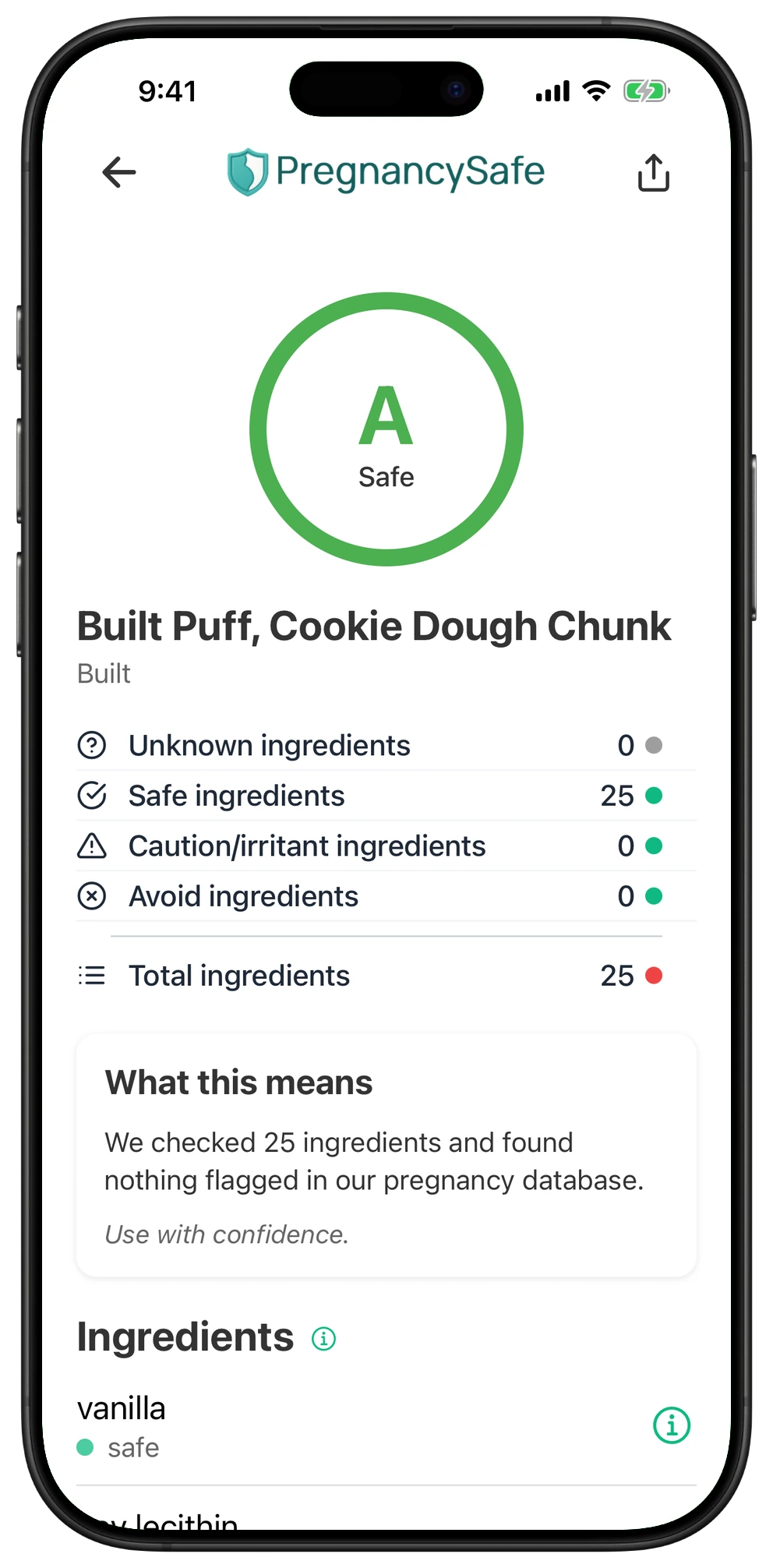
| A | Built Puff, Cookie Dough Chunk | Built |
| A | Rxbar Protein Bars Blueberry | Rxbar |
| A | Quest Protein Bar Chocolate Chip Cookie Dough | Quest Nutrition |
| B+ | Breakfast Protein | Kind |
| B+ | Kind Breakfast Peanut Butter Banana Bars | Kind |
Your Questions Answered
Can I eat one protein bar while pregnant?
Yes, a protein bar can be an occasional food option during pregnancy. Check the exact package for allergens, added stimulants or botanicals, and extra vitamins or minerals. A bar does not need to be part of your prenatal routine, and its protein content alone does not establish whether it suits you.
Can I eat protein bars every day during pregnancy?
There is no universal number of bars or protein gram target that makes daily use appropriate for everyone. If you eat them regularly, consider the serving size, added sugars, fortified nutrients and what other foods they replace. Keep varied meals and indicated prenatal supplements in your routine. Ask your prenatal clinician or dietitian for individualized guidance if bars are becoming a main source of nutrition.
Are egg whites in protein bars the same as raw eggs?
No commercially treated egg whites are not the same exposure as raw shell eggs. Some manufacturers use pasteurized, dried egg whites, but you should confirm the processing for your exact bar rather than assume it applies to every product. Follow its storage instructions as well. An ingredient score does not measure pathogens or verify processing.
Should I avoid protein bars containing papaya, kelp or dulse?
The ingredient’s form and amount matter more than its name alone. Ripe papaya in food is a lower concern exposure than unripe papaya, latex or concentrated seed products; the uterine concerns come largely from animal and laboratory evidence. Kelp can supply high, variable iodine amounts, making regular concentrated intake worth avoiding without an amount check. Dulse also contains variable iodine, but findings about high dose kelp do not establish that every dulse containing bar is harmful.
Are food dyes in protein bars harmful during pregnancy?
Limited human pregnancy data do not establish fetal harm from occasional regulated food exposure to blue 1, red 40 or yellow 5. Animal findings at high doses and behavioral findings in children are not direct evidence of harm to a fetus from a bar. Choosing bars without these colors is a reasonable way to reduce unnecessary frequent exposure, rather than a reason to panic about one serving. Red 3 has a separate regulatory concern based on high dose male rat thyroid tumors, not a demonstrated pregnancy effect.
Does an A grade mean a protein bar is verified safe for pregnancy?
No. Our catalog contains 2,761 protein bars, including 1,454 with A ingredient scores, but these are not independently verified safe product totals. Grades do not measure dose, pathogens, preparation or the contents of your current package. A listed product still requires checking the exact version and its qualifications, while a lower grade or incomplete record is not proof that a bar is harmful.
How to Interpret These Ratings
Our ingredient and category rules generate letter grades from the information recorded in the catalog. Missing ingredients and broad category assignments can affect the result. These grades do not measure your dose, confirm a complete current label, or test a product for contamination.
A high grade is not a guarantee of pregnancy safety. A low grade is not, by itself, proof of harm from every use. Follow the product-specific guidance above, check the actual package, and ask your prenatal clinician about supplements, treatment decisions or uncertain exposures.
People Also Checked
References
- https://ods.od.nih.gov/factsheets/Pregnancy-HealthProfessional/
- https://www.fda.gov/food/people-risk-foodborne-illness/cooking-food-safety-moms-be
- https://pubmed.ncbi.nlm.nih.gov/12144723/
- https://pubmed.ncbi.nlm.nih.gov/10837984/
- https://pubmed.ncbi.nlm.nih.gov/14623029/
- https://pubmed.ncbi.nlm.nih.gov/34040647/
- https://www.fda.gov/food/people-risk-foodborne-illness/fruits-veggies-and-juices-food-safety-moms-be
- https://www.cdc.gov/food-safety/foods/pregnant-women.html
- https://journals.sagepub.com/doi/10.1177/10507256261445624
- https://ods.od.nih.gov/factsheets/Iodine-HealthProfessional/
- https://www.foodstandards.gov.au/consumer/nutrition/pregnancy/iodine-and-pregnancy
- https://www.foodstandards.gov.au/consumer/prevention-of-foodborne-illness/arseniciodine
- https://inspection.canada.ca/en/food-safety-consumers/fact-sheets/specific-products-and-risks/chemical-hazards/inorganic-arsenic
- https://pubmed.ncbi.nlm.nih.gov/35947162/
- https://pubmed.ncbi.nlm.nih.gov/20919974/
- https://pubmed.ncbi.nlm.nih.gov/30632947/
- https://pmc.ncbi.nlm.nih.gov/articles/PMC8077470/
- https://www.fda.gov/food/food-additives-petitions/trans-fat
- https://www.fda.gov/food/hfp-constituent-updates/fda-completes-final-administrative-actions-partially-hydrogenated-oils-foods
- https://www.federalregister.gov/documents/2013/11/08/2013-26854/tentative-determination-regarding-partially-hydrogenated-oils-request-for-comments-and-for
- https://www.who.int/news-room/fact-sheets/detail/trans-fat
- https://cdn.realfood.gov/DGA.pdf
- https://www.fda.gov/food/people-risk-foodborne-illness/dietary-advice-and-during-pregnancy
- https://www.rcpi.ie/Portals/0/Document%20Repository/Institute%20of%20Obstetricians%20and%20Gynaecologists/National%20Clinical%20Guidelines/IOG_National%20Clinical%20Guidelines_Nutrition%20in%20pregnancy%20Guideline_2019.pdf
- https://pmc.ncbi.nlm.nih.gov/articles/PMC8027310/
- https://pmc.ncbi.nlm.nih.gov/articles/PMC3192475/
- https://www.hfpappexternal.fda.gov/scripts/fdcc/index.cfm?id=FDCBlue1&set=ColorAdditives
- https://www.ecfr.gov/current/title-21/chapter-I/subchapter-A/part-74
- https://www.fda.gov/food/color-additives-information-consumers/tracking-food-industry-pledges-remove-petroleum-based-food-dyes
- https://efsa.onlinelibrary.wiley.com/doi/10.2903/j.efsa.2010.1853
- https://apps.who.int/food-additives-contaminants-jecfa-database/Home/Chemical/3309
- https://pubmed.ncbi.nlm.nih.gov/23208798/
- https://pubmed.ncbi.nlm.nih.gov/24257113/
- https://oehha.ca.gov/risk-assessment/report/health-effects-assessment-potential-neurobehavioral-effects-synthetic-food-dyes-children
- https://www.hfpappexternal.fda.gov/scripts/fdcc/index.cfm?id=FDCRed40&set=ColorAdditives
- https://www.ecfr.gov/current/title-21/chapter-I/subchapter-A/part-74/subpart-A/section-74.340
- https://www.efsa.europa.eu/en/efsajournal/pub/1327
- https://www.efsa.europa.eu/en/efsajournal/pub/4007
- https://apps.who.int/food-additives-contaminants-jecfa-database/Home/Chemical/2361
- https://pubmed.ncbi.nlm.nih.gov/6636206/
- https://pubmed.ncbi.nlm.nih.gov/2613118/
- https://pubmed.ncbi.nlm.nih.gov/7940558/
- https://hfpappexternal.fda.gov/scripts/fdcc/index.cfm?id=FDCYellow5&set=ColorAdditives
- https://www.ecfr.gov/current/title-21/chapter-I/subchapter-A/part-74#74.705
- https://www.fda.gov/food/nutrition-food-labeling-and-critical-foods/food-allergies
- https://apps.who.int/food-additives-contaminants-jecfa-database/Home/Chemical/3885
- https://efsa.onlinelibrary.wiley.com/doi/10.2903/j.efsa.2009.1331
- https://pubmed.ncbi.nlm.nih.gov/1628860/
- https://pmc.ncbi.nlm.nih.gov/articles/PMC7023231/
- https://pmc.ncbi.nlm.nih.gov/articles/PMC6354951/
- https://www.fda.gov/industry/color-additives/fdc-red-no-3
- https://www.federalregister.gov/documents/2025/01/16/2025-00830/color-additive-petition-from-center-for-science-in-the-public-interest-et-al-request-to-revoke-color
- https://efsa.onlinelibrary.wiley.com/doi/10.2903/j.efsa.2011.1854
- https://pubmed.ncbi.nlm.nih.gov/2824305/
- https://pubmed.ncbi.nlm.nih.gov/2177442/
- https://pubmed.ncbi.nlm.nih.gov/8296313/
- https://pubmed.ncbi.nlm.nih.gov/8386132/
- https://pmc.ncbi.nlm.nih.gov/articles/PMC9368057/
- https://www.dietaryguidelines.gov/sites/default/files/2021-12/DGA_Pregnancy_FactSheet-508c.pdf
- https://www.acog.org/womens-health/faqs/healthy-eating-during-pregnancy
- https://www.cdc.gov/nutrition/php/data-research/added-sugars.html
- https://www.cdc.gov/diabetes/about/gestational-diabetes.html
- https://www.who.int/publications/i/item/9789241549028
- https://nesr.usda.gov/2025-dietary-guidelines-advisory-committee-systematic-reviews/dietary-patterns_gestational-diabetes
- https://www.fda.gov/food/natural-toxins-food/blue-green-algae-products-and-microcystins
- https://www.ncbi.nlm.nih.gov/books/NBK548312/
- https://www.ncbi.nlm.nih.gov/books/NBK501849/
- https://pubmed.ncbi.nlm.nih.gov/21793723/
- https://journal.ugm.ac.id/v3/InaJBCS/article/view/23573
- https://doi.org/10.4236/ojog.2017.71016
- https://pubmed.ncbi.nlm.nih.gov/37317149/
- https://pubmed.ncbi.nlm.nih.gov/37368655/
- https://pubmed.ncbi.nlm.nih.gov/23036452/
- https://pubmed.ncbi.nlm.nih.gov/21842336/