Is Tranexamic Acid Safe During Pregnancy?
Updated September 14, 2026
The Answer
Topical tranexamic acid is likely safe in low concentration skin products used on small areas of intact skin, but direct pregnancy studies are lacking. This reassurance does not extend to high strength products, microneedling, injections, or elective oral use.
How you use it matters: low concentration skincare is a different exposure from oral or intravenous treatment, where the reason for treatment and your clotting risk require clinician assessment.
An Australian regulatory review found low risk for preparations up to 3%, and a peer reviewed primary care review favored topical tranexamic acid among pregnancy melasma options, although direct pregnancy studies of routine cosmetic use are lacking.
Already used it? If you have already used tranexamic acid, share the product or medicine name, strength, and how you used it with your pregnancy clinician so they can assess the relevant exposure.
Pregnancy Safe is 100% independent and research driven. No companies pay to promote or sponsor products.
Stressless Pregnancy
Check your exact product with tranexamic acid in the app

What Is Tranexamic Acid?
You may also see it listed as: TXA, trans-AMCHA, trans-4-(aminomethyl)cyclohexanecarboxylic acid
Tranexamic acid helps reduce bleeding by preventing blood clots from breaking down. It is used as an oral or intravenous medicine and as a skin brightening ingredient for melasma and dark spots. You may find it in serums, dark spot correctors, and eye creams.
What Other Ingredients Should You Look Out for in Products With Tranexamic Acid?
A product's full ingredient list determines whether it's pregnancy-safe or not. These ingredients also appear in some of the tranexamic acid products we analyzed and may deserve a closer look.
Retinol
AvoidCheck dark spot correctors for retinol, an anti aging ingredient that pregnancy guidance generally recommends avoiding despite low topical absorption. If it appears alongside tranexamic acid, ask your clinician to review the complete formula.
Flagged in 1 product (25%) in this analysis.
Alpha Arbutin
CautionLook for alpha arbutin or alpha arbutin in brightening serums and dark spot correctors: direct pregnancy data are lacking, and it can release small amounts of hydroquinone. Check its strength and whether hydroquinone is also present, especially with large area or compounded use.
Flagged in 2 products (50%) in this analysis.
Phenoxyethanol
CautionPhenoxyethanol is a preservative in these serums and dark spot correctors; cosmetic safety reviews consider typical regulated levels acceptable, although direct pregnancy data are limited. Check that the product meets applicable cosmetic concentration limits rather than treating its presence alone as a reason to avoid it.
Flagged in 2 products (50%) in this analysis.
Fragrance
CautionFragrance or parfum in an eye cream denotes a scent mixture that may irritate sensitive skin; its presence does not prove phthalate content or pregnancy harm. If you want to reduce fragrance exposure, check for a fragrance free option.
Flagged in 1 product (25%) in this analysis.
Sage
CautionSalvia officinalis oil is sage oil; direct pregnancy studies of topical use are lacking, and exposure depends on concentration and formulation. Check whether your serum is a low concentration finished cosmetic rather than a concentrated or DIY oil mixture, which warrants greater caution.
Flagged in 1 product (25%) in this analysis.
Does Tranexamic Acid Strength or Product Type Matter During Pregnancy?
Low concentration topical use is expected to produce much less systemic exposure than oral or intravenous treatment. An Australian regulatory review judged preparations up to 3% low risk, but this is not a pregnancy specific safety threshold. Reassurance does not cover higher strengths, large or broken skin areas, use under an occlusive covering, microneedling, or injection. Prescribed treatment for serious bleeding has a separate risk benefit basis and should not be equated with elective cosmetic treatment.
What Products Contain Tranexamic Acid?
Pregnancy Safe has looked at 87 products that have tranexamic acid as an ingredient. The category and grade breakdowns below use 4 products whose names mention Tranexamic Acid or another name for it.
What Types of Products Contain Tranexamic Acid?
Products You May Have That Contain Tranexamic Acid
| Grade | Product | Brand | Type |
|---|---|---|---|
| C+ | Mary&May Tranexamic Acid + Glutathione Eye Cream Mini | Mary&May | Eye Cream |
| C+ | Good.Clean.Goop Beauty Aging Serum With Peptides And Tranexamic Acid - 1.0 Fl. Oz. | Good.Clean.Goop | Serum |
| C- | Naturium Tranexamic Acid Brightening Face Serum - 1 Fl Oz | Naturium | Face Serum |
| F | Replenix Tranexamic Acid Dark Spot Corrector | Replenix | Dark Spot Corrector |
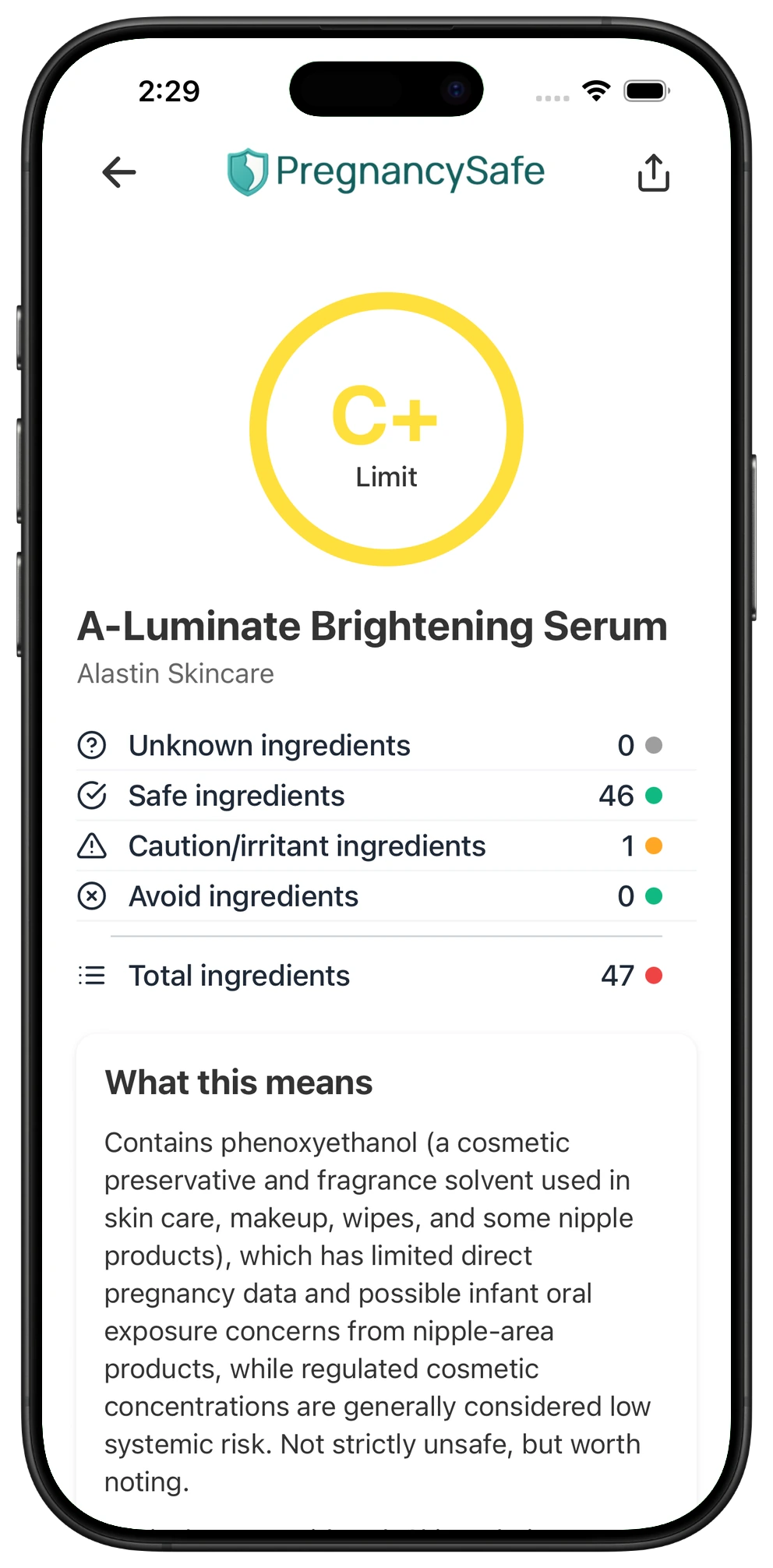
| C+ | A-Luminate Brightening Serum | Alastin Skincare | Serum |
| C- | Day Dream Brightening Serum | Bubble Skincare | Serum |
| F | Celimax Pore + Dark Spot Brightening Cream 35Ml | Celimax | Face Cream |
| C+ | Skinmedica Even And Correct Advanced Brightening Treatment 2 Oz | Skinmedica | Skin Treatment |
How Do Products Containing Tranexamic Acid Score?
It can be helpful to see how products containing tranexamic acid generally score during pregnancy. This does not tell you whether your exact product is safe, but it gives you a general idea of what we found. In this breakdown of 4 products, 75% receive a C grade. A C grade means the complete formula has some pregnancy considerations, so use it sparingly and consider a higher scoring alternative when one is available.
Frequently Asked Questions About Tranexamic Acid During Pregnancy
Can I use a tranexamic acid serum in the first trimester?
The available evidence does not establish a separate first trimester conclusion. Low concentration topical use appears low concern, but direct pregnancy studies of routine cosmetic use are lacking.
Does the 3% review mean every 3% product is pregnancy safe?
No. The Australian regulatory review judged preparations up to 3% low risk, but it did not establish a pregnancy specific safety threshold or assess every complete formula. Other ingredients and how you apply the product still matter.
Does the skincare reassurance cover microneedling or injections?
No. The reassurance for low concentration topical use does not extend to microneedling, injection, broken skin, large treatment areas, or occlusive coverings. Those uses are not well assessed.
Can I take oral tranexamic acid for melasma while pregnant?
The evidence for low concentration skincare does not support self starting oral tranexamic acid for cosmetic purposes. The medicine crosses the placenta, and pregnancy safety data outside acute bleeding care remain limited; oral use requires a clinician's risk benefit assessment.
Why is tranexamic acid used for bleeding around childbirth?
WHO recommends early intravenous tranexamic acid within 3 hours of birth for clinically diagnosed postpartum hemorrhage as part of standard care. Large obstetric trials and meta analyses support reduced bleeding related death or life threatening postpartum bleeding; that evidence does not establish routine cosmetic safety.
Can tranexamic acid treat miscarriage bleeding?
The evidence described here does not establish tranexamic acid as a treatment for miscarriage bleeding. Its role in postpartum hemorrhage cannot be extended to early pregnancy bleeding, which requires clinician assessment.
What clotting risks matter with prescribed tranexamic acid?
Medicine labeling and teratology guidance emphasize avoiding use with active or high risk thrombosis. Obstetric trials have not shown a clear increase in maternal thromboembolic events, but that does not remove the need for an individual clinician assessment.
How Do We Score Products for Pregnancy Safety?
We analyze each product's ingredients and category to flag known risks and provide cautionary notices for general category safety concerns.
A - Safe
Excellent choice! All ingredients are considered safe during pregnancy.
What to do: Use with confidence.
B - Likely Safe
Pretty much safe with very minimal risk. Some ingredients may have limited pregnancy studies, but no significant safety concerns have been identified.
What to do: Use with confidence.
C - Limit
Contains ingredients with some pregnancy considerations. Research shows these ingredients may have limited safety data, potential for minor hormonal effects, or require caution based on animal studies.
What to do: Use sparingly and consider safer alternatives when available.
D - Caution
Similar to C grade but contains multiple cautionary ingredients. The combination increases overall concern.
What to do: Try to avoid if that makes you feel better. If you've already used it, no need to panic.
F - Avoid
Contains an ingredient Pregnancy Safe recommends avoiding during pregnancy. This may reflect an established risk or a precaution based on limited evidence; check the ingredient guidance and exposure context.
What to do: Do not use during pregnancy. If you've already used it, don't worry - contact your OBGYN if concerned.
Sources
- https://dailymed.nlm.nih.gov/dailymed/drugInfo.cfm?setid=6f033f1e-8c78-4c87-b870-6493944315ff
- https://dailymed.nlm.nih.gov/dailymed/drugInfo.cfm?setid=a93d6ef3-e160-db0d-142f-9b91af8d8428
- https://dailymed.nlm.nih.gov/dailymed/lookup.cfm?setid=3f07e93b-3568-487e-894f-8f90e5a0960a
- https://dermnetnz.org/topics/tranexamic-acid
- https://pubmed.ncbi.nlm.nih.gov/28456509/
- https://pubmed.ncbi.nlm.nih.gov/31136475/
- https://pubmed.ncbi.nlm.nih.gov/31961048/
- https://pubmed.ncbi.nlm.nih.gov/36566490/
- https://pubmed.ncbi.nlm.nih.gov/39461793/
- https://uktis.org/monographs/use-of-tranexamic-acid-in-pregnancy/
- https://www.acog.org/clinical/clinical-guidance/practice-bulletin/articles/2017/10/postpartum-hemorrhage
- https://www.ncbi.nlm.nih.gov/books/NBK493076/
- https://www.ncbi.nlm.nih.gov/books/NBK501734/
- https://www.tga.gov.au/sites/default/files/2024-07/public_notice_of_interim_decisions_-_acms44_accs38_joint_acms-accs36_-_march_2024.pdf
- https://www.who.int/publications/i/item/9789241550154
- https://www1.racgp.org.au/RACGP/media/AJGP/documents/AJGP-12-24-Cancer-and-Chronic-Disease-Supplement_FA.pdf
- https://www.aad.org/public/everyday-care/skin-care-secrets/routine/pregnancy-skin-care
- https://mothertobaby.org/fact-sheets/topical-acne-treatments-pregnancy/
- https://mothertobaby.org/fact-sheets/tretinoin-retin-a-pregnancy/
- https://www.medicinesinpregnancy.org/leaflets-a-z/isotretinoin-gel/
- https://www.ema.europa.eu/en/news/updated-measures-pregnancy-prevention-during-retinoid-use
- https://dailymed.nlm.nih.gov/dailymed/lookup.cfm?setid=34d79c31-1568-4797-a4f5-31200c7788db
- https://pubmed.ncbi.nlm.nih.gov/26215715/
- https://pubmed.ncbi.nlm.nih.gov/41365815/
- https://pubmed.ncbi.nlm.nih.gov/16243460/
- https://health.ec.europa.eu/publications/revision-scientific-opinion-sccs157616-vitamin-retinol-retinyl-acetate-retinyl-palmitate_en
- https://health.ec.europa.eu/publications/safety-alpha-arbutin-and-beta-arbutin-cosmetic-products_en
- https://health.ec.europa.eu/system/files/2023-02/sccs_o_264.pdf
- https://pmc.ncbi.nlm.nih.gov/articles/PMC8884185/
- https://pmc.ncbi.nlm.nih.gov/articles/PMC3114665/
- https://dermnetnz.org/topics/hydroquinone
- https://pmc.ncbi.nlm.nih.gov/articles/PMC8301119/
- https://pubmed.ncbi.nlm.nih.gov/18789053/
- https://health.ec.europa.eu/system/files/2021-08/sccs_o_195_0.pdf
- https://ec.europa.eu/growth/tools-databases/cosing/details/28157
- https://journals.sagepub.com/doi/10.3109/10915819009078737
- https://link.springer.com/article/10.1007/s00204-024-03938-5
- https://www.sfda.gov.sa/en/warnings/1156
- https://www.industrialchemicals.gov.au/sites/default/files/Ethanol%2C%202-phenoxy-_Human%20health%20tier%20II%20assessment.pdf
- https://hero.epa.gov/reference/2857875
- https://books.publisso.de/sites/default/files/documents/series/mak/dam/Vol2019/Iss1/Alt006/mb12299kske6319_w.pdf
- https://www.fda.gov/cosmetics/cosmetic-ingredients/fragrances-cosmetics
- https://www.fda.gov/cosmetics/cosmetic-ingredients/phthalates-cosmetics
- https://www.fda.gov/cosmetics/cosmetic-ingredients/allergens-cosmetics
- https://pmc.ncbi.nlm.nih.gov/articles/PMC3110684/
- https://pmc.ncbi.nlm.nih.gov/articles/PMC4016195/
- https://pmc.ncbi.nlm.nih.gov/articles/PMC4097177/
- https://pmc.ncbi.nlm.nih.gov/articles/PMC8453372/
- https://pmc.ncbi.nlm.nih.gov/articles/PMC10999525/
- https://www.epa.gov/indoor-air-quality-iaq/volatile-organic-compounds-impact-indoor-air-quality
- https://www.ema.europa.eu/en/documents/herbal-monograph/final-european-union-herbal-monograph-salvia-officinalis-l-folium-revision-1_en.pdf
- https://journals.sagepub.com/doi/10.1177/10915818261425569
- https://www.canada.ca/en/environment-climate-change/services/evaluating-existing-substances/draft-assessment-fourteen-terpene-and-terpenoid-substances-group.html
- https://pubmed.ncbi.nlm.nih.gov/19535210/