Is Alpha Arbutin Safe During Pregnancy?
Updated September 14, 2026
The Answer
Use caution with topical alpha arbutin during pregnancy, especially in high strength, large area, compounded, or hydroquinone combined brightening products. Direct human pregnancy outcome data are lacking, and alpha arbutin can release small amounts of hydroquinone.
The EU SCCS concentration limits concern general consumer cosmetic safety, not established safety during pregnancy.
A pregnancy dermatology review describes low systemic absorption of arbutin and no reported animal fetomaternal risk, but direct human pregnancy outcome data for topical alpha arbutin are lacking and the review makes no pregnancy specific recommendation.
Already used it? If you have already used alpha arbutin, check the concentration, whether hydroquinone is also listed, and how much skin you treated. Share those details with your prenatal clinician, particularly for high strength, large area, or compounded use.
Pregnancy Safe is 100% independent and research driven. No companies pay to promote or sponsor products.
Stressless Pregnancy
Check your exact product with alpha arbutin in the app

What Is Alpha Arbutin?
You may also see it listed as: α-arbutin, 4-hydroxyphenyl-alpha-D-glucopyranoside, hydroquinone O-alpha-D-glucopyranoside
Alpha arbutin is a hydroquinone glucose compound used to brighten skin and address melasma, dark spots, and other hyperpigmentation that can worsen during pregnancy. You will commonly find it in serums and creams; the catalog also includes masks and an oral supplement, which should not be assessed using topical cosmetic evidence.
What Other Ingredients Should You Look Out for in Products With Alpha Arbutin?
A product's full ingredient list determines whether it's pregnancy-safe or not. These ingredients also appear in some of the alpha arbutin products we analyzed and may deserve a closer look.
Phenoxyethanol
CautionLook for phenoxyethanol, a preservative in these creams and serums. SCCS and CIR reviews support typical cosmetic use despite limited direct pregnancy data; check that the product follows regulated cosmetic concentration limits rather than treating this label term as an automatic avoid signal.
Flagged in 5 products (55.6%) in this analysis.
Glycyrrhiza Glabra
CautionGlycyrrhiza glabra root extract is licorice extract used for brightening and soothing in serums. Check that you are assessing topical skincare rather than an oral licorice product: typical topical use is lower concern, though pregnancy specific data are limited, and heavy oral intake findings should not be applied to your serum.
Flagged in 3 products (33.3%) in this analysis.
Ginseng
CautionPanax quinquefolius root extract is a ginseng derived skin conditioning ingredient in this serum. Pregnancy specific topical studies are lacking; check that use is conventional and on intact skin, because the lower concern cosmetic evidence does not extend to concentrated or enhanced delivery products or broken skin use.
Flagged in 1 product (11.1%) in this analysis.
Glutathione
CautionLook for L glutathione in the oral supplement, not as a skincare warning. Isolated oral glutathione has limited pregnancy safety and benefit data; review the dose and formulation with your clinician rather than assuming that an antioxidant made by the body is established as safe to supplement.
Flagged in 1 product (11.1%) in this analysis.
Willow Bark
CautionSalix alba bark extract is willow bark, a salicylate containing botanical used in this serum. Dilute topical use is lower concern than oral use, but pregnancy data are limited; check whether use involves a concentrated peel, large areas, covered skin, or broken skin, which fall outside that lower concern context.
Flagged in 1 product (11.1%) in this analysis.
Does Alpha Arbutin Strength or Product Type Matter During Pregnancy?
The EU SCCS considers alpha arbutin safe for general consumers at up to 2% in face creams and 0.5% in body lotions, provided hydroquinone is only unavoidable trace contamination. These are not pregnancy specific limits or a blanket clearance for serums, masks, or supplements. High strength formulas, application over large areas, compounded preparations, and products combining alpha arbutin with hydroquinone warrant particular caution.
What Products Contain Alpha Arbutin?
Pregnancy Safe has looked at 70 products that have alpha arbutin as an ingredient. The category and grade breakdowns below use 9 products whose names mention Alpha Arbutin or another name for it.
What Types of Products Contain Alpha Arbutin?
Products You May Have That Contain Alpha Arbutin
| Grade | Product | Brand | Type |
|---|---|---|---|
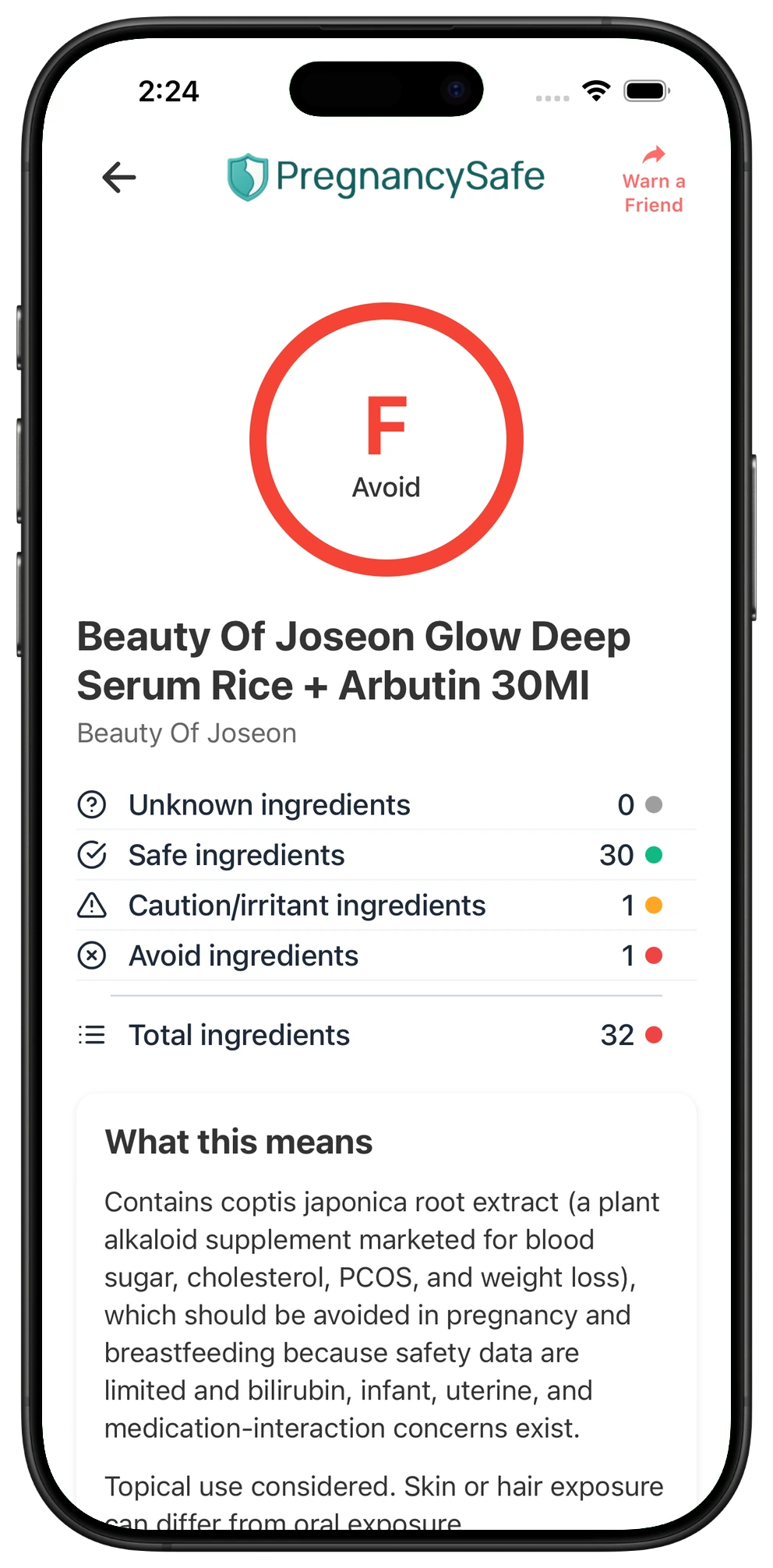
| F | Beauty Of Joseon Glow Deep Serum Rice + Arbutin 30Ml | Beauty Of Joseon | Serum |
| C | The Ordinary Alpha Arbutin 2% + Hyaluronic Acid For Hyperpigmentation - 1 Fl Oz - Ulta Beauty | The Ordinary | Skin Serum |
| C+ | Cosrx Arbutin Discoloration Hydrogel Mask | Cosrx | Face Mask |
| C- | Allies Of Skin Tranexamic And Arbutin Advanced Brightening Serum 30Ml | Allies Of Skin | Serum |
| C- | Allies Of Skin Tranexamic & Arbutin Advanced Brightening Serum | Allies Of Skin | Serum |
| C | Clear Skincare Lighten Cream With 0.4% Arbutin 50G | Clear Skincare | Skin Cream |
| C | L-Glutathione With Alpha-Arbutin & Hyaluronic Acid | Herbadiet | Dietary Supplement |
| D | Seoul Ceuticals Korean Skin Care Kojic Acid Serum Alpha Arbutin Serum - Korean Beauty Skincare Dark Spot Remover Corrector Glycolic Acid Serum, 1Oz | Seoul Ceuticals | Serum |
How Do Products Containing Alpha Arbutin Score?
It can be helpful to see how products containing alpha arbutin generally score during pregnancy. This does not tell you whether your exact product is safe, but it gives you a general idea of what we found. In this breakdown of 9 products, 78% receive a C grade. A C grade means the complete formula has some pregnancy considerations, so use it sparingly and consider a higher scoring alternative when one is available.
Frequently Asked Questions About Alpha Arbutin During Pregnancy
Does a 2% alpha arbutin label mean it is safe in pregnancy?
No. The SCCS assessment covers up to 2% in face creams for general consumers, with hydroquinone restricted to unavoidable trace contamination. It does not establish pregnancy safety or automatically cover a 2% serum.
Is alpha arbutin the same as hydroquinone?
No. Alpha arbutin is a hydroquinone glucose compound, but it can release small amounts of hydroquinone during storage or through skin microbes or metabolism. AAD pregnancy skincare guidance lists hydroquinone itself as an ingredient to avoid.
Can I use The Ordinary Alpha Arbutin during pregnancy?
The ingredient level conclusion remains caution, not a pregnancy safe endorsement of the product. Check the exact formula and concentration; a product grade reflects the complete formula, while direct pregnancy outcome data for topical alpha arbutin are lacking.
Is alpha arbutin safer in the second or third trimester?
The available evidence does not establish trimester specific safety differences. There is no supported trimester after which topical alpha arbutin can be called proven safe.
Has topical alpha arbutin been shown to harm a pregnancy?
Direct human pregnancy outcome data are lacking, so the evidence does not establish either harm or safety. The caution reflects this gap and the potential release of small amounts of hydroquinone, not demonstrated human pregnancy harm from ordinary topical use.
Why is alpha arbutin used for pregnancy related dark spots?
It is a skin brightening active used for melasma, dark spots, and other hyperpigmentation, which can worsen during pregnancy. Its use for these concerns does not establish that it is suitable during pregnancy.
How Do We Score Products for Pregnancy Safety?
We analyze each product's ingredients and category to flag known risks and provide cautionary notices for general category safety concerns.
A - Safe
Excellent choice! All ingredients are considered safe during pregnancy.
What to do: Use with confidence.
B - Likely Safe
Pretty much safe with very minimal risk. Some ingredients may have limited pregnancy studies, but no significant safety concerns have been identified.
What to do: Use with confidence.
C - Limit
Contains ingredients with some pregnancy considerations. Research shows these ingredients may have limited safety data, potential for minor hormonal effects, or require caution based on animal studies.
What to do: Use sparingly and consider safer alternatives when available.
D - Caution
Similar to C grade but contains multiple cautionary ingredients. The combination increases overall concern.
What to do: Try to avoid if that makes you feel better. If you've already used it, no need to panic.
F - Avoid
Contains an ingredient Pregnancy Safe recommends avoiding during pregnancy. This may reflect an established risk or a precaution based on limited evidence; check the ingredient guidance and exposure context.
What to do: Do not use during pregnancy. If you've already used it, don't worry - contact your OBGYN if concerned.
Sources
- https://dermnetnz.org/topics/hydroquinone
- https://health.ec.europa.eu/publications/safety-alpha-arbutin-and-beta-arbutin-cosmetic-products_en
- https://health.ec.europa.eu/system/files/2023-02/sccs_o_264.pdf
- https://pmc.ncbi.nlm.nih.gov/articles/PMC3114665/
- https://pmc.ncbi.nlm.nih.gov/articles/PMC8301119/
- https://pmc.ncbi.nlm.nih.gov/articles/PMC8884185/
- https://pubmed.ncbi.nlm.nih.gov/18789053/
- https://www.aad.org/public/everyday-care/skin-care-secrets/routine/pregnancy-skin-care
- https://health.ec.europa.eu/system/files/2021-08/sccs_o_195_0.pdf
- https://ec.europa.eu/growth/tools-databases/cosing/details/28157
- https://journals.sagepub.com/doi/10.3109/10915819009078737
- https://link.springer.com/article/10.1007/s00204-024-03938-5
- https://www.sfda.gov.sa/en/warnings/1156
- https://www.industrialchemicals.gov.au/sites/default/files/Ethanol%2C%202-phenoxy-_Human%20health%20tier%20II%20assessment.pdf
- https://hero.epa.gov/reference/2857875
- https://books.publisso.de/sites/default/files/documents/series/mak/dam/Vol2019/Iss1/Alt006/mb12299kske6319_w.pdf
- https://www.nccih.nih.gov/health/licorice-root
- https://cosmileeurope.eu/inci/detail/6154/glycyrrhiza-glabra-root-extract/
- https://pubmed.ncbi.nlm.nih.gov/11390327/
- https://pubmed.ncbi.nlm.nih.gov/12396997/
- https://pubmed.ncbi.nlm.nih.gov/28158597/
- https://pubmed.ncbi.nlm.nih.gov/28833680/
- https://pubmed.ncbi.nlm.nih.gov/16884839/
- https://www.cir-safety.org/sites/default/files/S-breakout-092020.pdf
- https://vkm.no/download/18.948158f1633d1b9fb95930/1525764185285/Hazard%20assessment%20of%20glycyrrhizic%20acid%20from%20liquorice.pdf
- https://www.cir-safety.org/sites/default/files/Ginsen092012rep.pdf
- https://www.nccih.nih.gov/health/asian-ginseng
- https://www.ema.europa.eu/en/documents/herbal-monograph/final-european-union-herbal-monograph-panax-ginseng-camey-radix-revision-1_en.pdf
- https://pmc.ncbi.nlm.nih.gov/articles/PMC9864683/
- https://pubmed.ncbi.nlm.nih.gov/31484368/
- https://pubmed.ncbi.nlm.nih.gov/24791752/
- https://pubmed.ncbi.nlm.nih.gov/21875351/
- https://www.nature.com/articles/ejcn2017132
- https://pubmed.ncbi.nlm.nih.gov/35624676/
- https://www.nccih.nih.gov/health/antioxidant-supplements-what-you-need-to-know
- https://www.fda.gov/food/dietary-supplements
- https://www.fda.gov/drugs/human-drug-compounding/fda-highlights-concerns-using-dietary-ingredient-glutathione-compound-sterile-injectables
- https://www.fda.gov/safety/recalls-market-withdrawals-safety-alerts/flawless-beauty-llc-issues-voluntary-recall-unapproved-drugs
- https://pubmed.ncbi.nlm.nih.gov/40013212/
- https://www.ema.europa.eu/en/medicines/herbal/salicis-cortex
- https://webprod.hc-sc.gc.ca/nhpid-bdipsn/dbImages/mono_willow-bark_english.pdf
- https://www.fda.gov/drugs/drug-safety-and-availability/fda-recommends-avoiding-use-nsaids-pregnancy-20-weeks-or-later-because-they-can-result-low-amniotic
- https://mothertobaby.org/fact-sheets/topical-acne-treatments-pregnancy/
- https://cir-safety.org/sites/default/files/SLR_Willow_092025.pdf