Is Salicylates Safe During Pregnancy?
Updated September 14, 2026
The Answer
Salicylates warrant caution during pregnancy, but not every use needs to be avoided. Low dose over the counter topical salicylic acid for acne is generally lower concern when used as directed; oral salicylates, strong peels, and medicinal strength pain rubs raise different exposure concerns.
The key distinction is low dose topical salicylic acid acne care versus uses that deliver more salicylate into your bloodstream, not simply whether a label contains the word “salicylate.”
ACOG and MotherToBaby list OTC topical salicylic acid as an option when needed, while FDA warns that NSAID medicines around 20 weeks or later can cause fetal kidney problems and low amniotic fluid.
Already used it? Check the exact ingredient, strength, amount, and how you used it. If your exposure involved an oral medicine, a strong peel, wintergreen oil, a medicinal strength rub, or repeated application over large or damaged skin areas, discuss those details with your prenatal clinician or pharmacist.
Pregnancy Safe is 100% independent and research driven. No companies pay to promote or sponsor products.
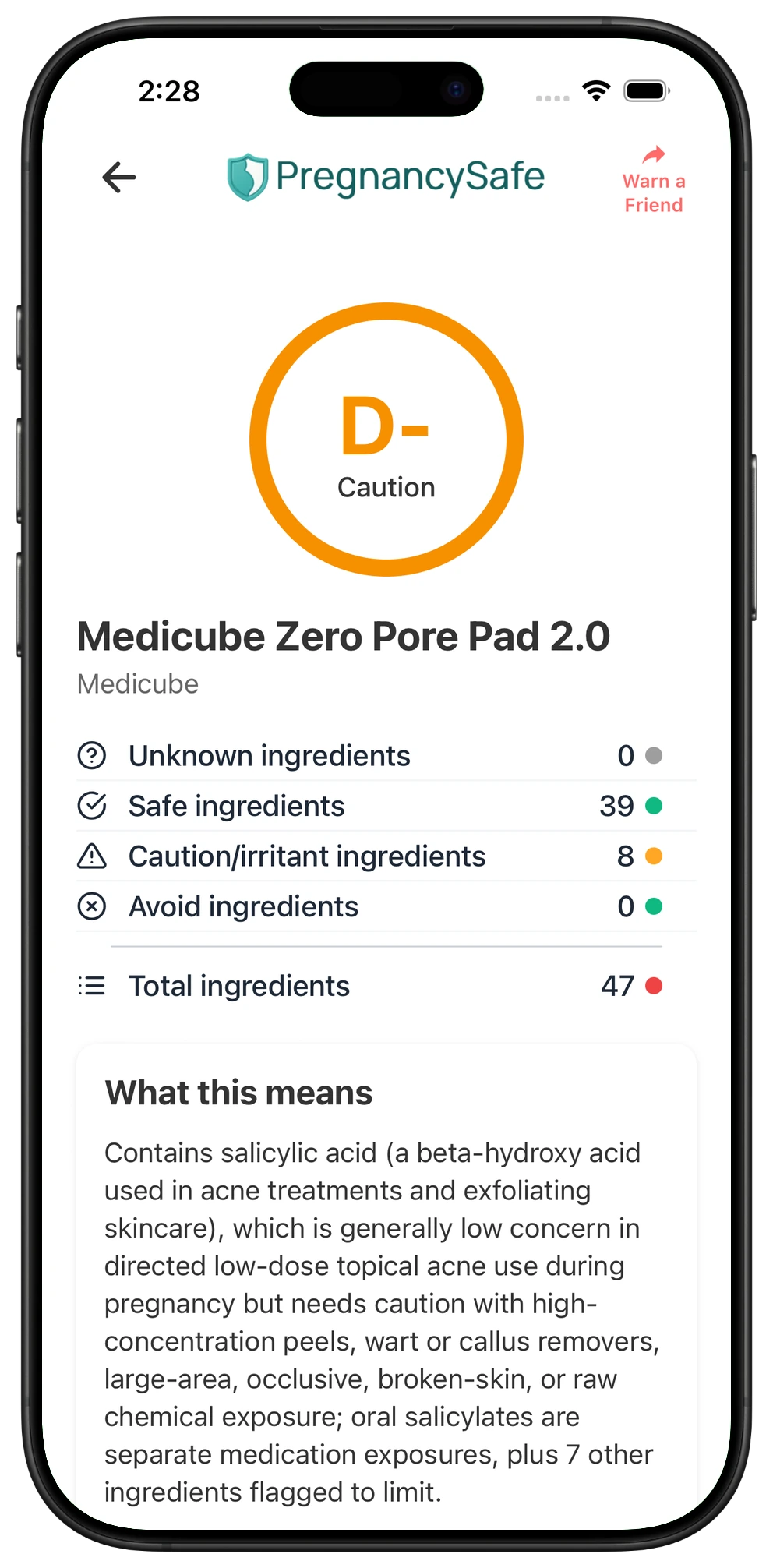
Stressless Pregnancy
Check your exact product with salicylates in the app
What Is Salicylates?
You may also see it listed as: salicylate
Salicylates are a family of salicylic acid derivatives, not one interchangeable ingredient. They appear in acne exfoliants, fragrance ingredients, sunscreen filters such as octisalate and homosalate, and topical pain rubs containing methyl salicylate. Their purpose can range from exfoliation and scent to UV filtering or pain relief.
What Other Ingredients Should You Look Out for in Products With Salicylates?
A product's full ingredient list determines whether it's pregnancy-safe or not. These ingredients also appear in some of the salicylates products we analyzed and may deserve a closer look.
Butylphenyl Methylpropional
AvoidLook for butylphenyl methylpropional, also called Lilial or BMHCA, on perfume labels. Regulatory reproductive toxicity concerns, based largely on animal evidence rather than direct human pregnancy studies, support choosing a product without this fragrance ingredient.
Flagged in 1 product (6.2%) in this analysis.
Fragrance
Caution“Fragrance” or “parfum” can represent an undisclosed scent mixture; it does not prove a product contains phthalates or causes pregnancy harm. If you want to reduce cumulative fragrance exposure or have sensitive skin or airways, check for fragrance free or lower fragrance options.
Flagged in 13 products (81.2%) in this analysis.
Phenoxyethanol
CautionPhenoxyethanol is a preservative found here in sunscreen, conditioner, and hand care; cosmetic safety reviews accept typical regulated levels despite limited direct pregnancy data. Check the intended use and directions rather than treating its presence as an automatic reason to avoid the product.
Flagged in 4 products (25%) in this analysis.
Octocrylene
CautionCheck sunscreen and hand care labels for octocrylene, a UV filter with limited pregnancy outcome data and a benzophenone impurity or degradation concern; measurable absorption alone does not establish harm. If you prefer to reduce this uncertainty, compare options without octocrylene while maintaining sun protection.
Flagged in 2 products (12.5%) in this analysis.
Chamomile
CautionChamomilla recutita flower extract is chamomile in the conditioner label. Pregnancy specific topical evidence is inadequate, and irritation or allergy is the clearest known concern, so check your history of ragweed or daisy family sensitivity rather than equating conditioner use with concentrated oils or medicinal preparations.
Flagged in 1 product (6.2%) in this analysis.
Homosalate
CautionLook for homosalate in the sunscreen's active ingredients and check its concentration, especially for frequent large area use. Pregnancy outcome data are limited and absorption is measurable without established human harm; lower homosalate or mineral broad spectrum options can reduce uncertainty while preserving sun protection.
Flagged in 1 product (6.2%) in this analysis.
Does Salicylates Strength or Product Type Matter During Pregnancy?
Skin absorption from low dose topical salicylic acid acne care is usually small. High concentrations, repeated large area application, leave on use under a covering, and broken or irritated skin can increase systemic exposure. Wintergreen oil and medicinal strength salicylate rubs belong in a different exposure category from routine acne skincare. Guidance allowing OTC topical salicylic acid does not establish the same conclusion for every fragrance or sunscreen salicylate.
What Products Contain Salicylates?
Pregnancy Safe has looked at 16 products that have salicylates as an ingredient. The category and grade breakdowns below use 16 products with an exact ingredient match.
What Types of Products Contain Salicylates?
Products You May Have That Contain Salicylates
| Grade | Product | Brand | Type |
|---|---|---|---|
| C | Dove Beauty Lavender & Vanilla Deodorant Stick - Aluminum-Free 2.6Oz | — | Deodorant |
| C+ | Baby | Black Girl Sunscreen | Sunscreen |
| D+ | Victoria Secrets | — | Unknown |
| D- | Emma Hardie Moringa Luxury Hand And Nail Treatment 50Ml | Emma Hardie | Hand Care |
| D+ | Jason Purifying Tea Tree Gel | Jason | Skin Care Gel |
| C | Kiss Manicure Kit, Salon Dip Powder, Bog5 | Kiss Products, Inc. | Manicure Kit |
| D+ | L'Oréal Paris Men Expert Barber'S Essentials Grooming Duo Gift Set | L'Oréal Paris | Grooming Kit |
| C- | Mdsolarsciences Solar Stick Spf40 (0.6 Oz.) | Mdsolarsciences | Sunscreen |
How Do Products Containing Salicylates Score?
It can be helpful to see how products containing salicylates generally score during pregnancy. This does not tell you whether your exact product is safe, but it gives you a general idea of what we found. In this breakdown of 16 products, 56% receive a D grade. A D grade means the complete formula has multiple cautionary ingredients, so consider avoiding it or choosing a higher scoring alternative.
Frequently Asked Questions About Salicylates During Pregnancy
Does a salicylate label mean the ingredient is salicylic acid?
No. Salicylates are a family that includes different cosmetic ingredients and medicines. The exact name matters: guidance for OTC topical salicylic acid acne care cannot automatically be applied to another salicylate.
Can I use a salicylic acid peel instead of an OTC acne product?
A high concentration peel is not the same exposure as low dose OTC acne care. Strong peels are among the uses that warrant greater caution because more salicylate may reach your bloodstream.
What should I check if my sunscreen contains a salicylate?
Identify the exact filter, such as octisalate or homosalate, rather than relying on the family name. The guidance allowing OTC topical salicylic acid for acne does not establish a blanket pregnancy verdict for sunscreen salicylates or the complete sunscreen formula.
Are wintergreen oil and salicylate pain rubs like ordinary skincare?
No. Wintergreen oil or methyl salicylate and medicinal strength rubs are specifically higher concern exposures. SCCS notes that methyl salicylate becomes salicylic acid in the body and that combined salicylate exposure may exceed safe levels.
Does the advice change later in pregnancy?
For NSAID medicines, FDA warns of fetal kidney problems and low amniotic fluid around 20 weeks or later. That medicine specific warning should not be turned into a trimester wide ban on every topical salicylate. FDA makes an exception for clinician directed low dose (81 mg) aspirin. Do not stop a prescribed medicine based on this ingredient family page; check with your prescriber.
Does it matter how much skin I treat or whether I cover it?
Yes. Repeated large area use, applying a leave on product under a covering, and use on broken or irritated skin can increase systemic exposure. These uses should not be treated as equivalent to directed low dose OTC topical acne care.
How Do We Score Products for Pregnancy Safety?
We analyze each product's ingredients and category to flag known risks and provide cautionary notices for general category safety concerns.
A - Safe
Excellent choice! All ingredients are considered safe during pregnancy.
What to do: Use with confidence.
B - Likely Safe
Pretty much safe with very minimal risk. Some ingredients may have limited pregnancy studies, but no significant safety concerns have been identified.
What to do: Use with confidence.
C - Limit
Contains ingredients with some pregnancy considerations. Research shows these ingredients may have limited safety data, potential for minor hormonal effects, or require caution based on animal studies.
What to do: Use sparingly and consider safer alternatives when available.
D - Caution
Similar to C grade but contains multiple cautionary ingredients. The combination increases overall concern.
What to do: Try to avoid if that makes you feel better. If you've already used it, no need to panic.
F - Avoid
Contains an ingredient Pregnancy Safe recommends avoiding during pregnancy. This may reflect an established risk or a precaution based on limited evidence; check the ingredient guidance and exposure context.
What to do: Do not use during pregnancy. If you've already used it, don't worry - contact your OBGYN if concerned.
Sources
- https://health.ec.europa.eu/system/files/2022-08/sccs_o_255.pdf
- https://health.ec.europa.eu/system/files/2023-06/sccs_o_268.pdf
- https://mothertobaby.org/fact-sheets/topical-acne-treatments-pregnancy/
- https://www.accessdata.fda.gov/drugsatfda_docs/omuf/Order/Final%20Administrative%20Order%20OTC000033_M017-External%20Analgesic%20Drug%20Products%20for%20OTC%20Human%20Use.pdf
- https://www.acog.org/womens-health/faqs/skin-conditions-during-pregnancy
- https://www.cir-safety.org/sites/default/files/salicy042019FAR.pdf
- https://www.ecfr.gov/current/title-21/chapter-I/subchapter-D/part-333/subpart-D/section-333.310
- https://www.fda.gov/drugs/drug-safety-and-availability/fda-recommends-avoiding-use-nsaids-pregnancy-20-weeks-or-later-because-they-can-result-low-amniotic
- https://www.fda.gov/drugs/understanding-over-counter-medicines/questions-and-answers-fda-posts-deemed-final-order-and-proposed-order-over-counter-sunscreen
- https://www.seslhd.health.nsw.gov.au/sites/default/files/groups/Royal_Hospital_for_Women/Mothersafe/documents/skinhaircareandcosmetictreatmentsapril2021.pdf
- https://www.canada.ca/en/health-canada/services/chemicals-product-safety/lilial.html
- https://www.canada.ca/en/environment-climate-change/services/evaluating-existing-substances/draft-assessment-phenylpropanoids-aldehydes-group.html
- https://health.ec.europa.eu/publications/safety-butylphenyl-methylpropional-p-bmhca-cosmetic-products-submission-ii_en
- https://eur-lex.europa.eu/legal-content/EN/TXT/PDF/?uri=CELEX%3A32021R1902
- https://chem.echa.europa.eu/100.001.173/harmonised/113759
- https://chem.echa.europa.eu/obligation-lists/candidateList
- https://pubmed.ncbi.nlm.nih.gov/32461162/
- https://www.fda.gov/cosmetics/cosmetic-ingredients/fragrances-cosmetics
- https://www.fda.gov/cosmetics/cosmetic-ingredients/phthalates-cosmetics
- https://www.fda.gov/cosmetics/cosmetic-ingredients/allergens-cosmetics
- https://pmc.ncbi.nlm.nih.gov/articles/PMC3110684/
- https://pmc.ncbi.nlm.nih.gov/articles/PMC4016195/
- https://pmc.ncbi.nlm.nih.gov/articles/PMC4097177/
- https://pmc.ncbi.nlm.nih.gov/articles/PMC8453372/
- https://pmc.ncbi.nlm.nih.gov/articles/PMC10999525/
- https://www.epa.gov/indoor-air-quality-iaq/volatile-organic-compounds-impact-indoor-air-quality
- https://health.ec.europa.eu/system/files/2021-08/sccs_o_195_0.pdf
- https://ec.europa.eu/growth/tools-databases/cosing/details/28157
- https://journals.sagepub.com/doi/10.3109/10915819009078737
- https://link.springer.com/article/10.1007/s00204-024-03938-5
- https://www.sfda.gov.sa/en/warnings/1156
- https://www.industrialchemicals.gov.au/sites/default/files/Ethanol%2C%202-phenoxy-_Human%20health%20tier%20II%20assessment.pdf
- https://hero.epa.gov/reference/2857875
- https://books.publisso.de/sites/default/files/documents/series/mak/dam/Vol2019/Iss1/Alt006/mb12299kske6319_w.pdf
- https://health.ec.europa.eu/document/download/2928185b-f8b7-474e-937a-052a90a90970_en
- https://www.fda.gov/drugs/understanding-over-counter-medicines/sunscreen-how-help-protect-your-skin-sun
- https://pubmed.ncbi.nlm.nih.gov/31058986/
- https://pubmed.ncbi.nlm.nih.gov/31961417/
- https://www.tga.gov.au/sites/default/files/2025-04/safety-review-seven-active-sunscreen-ingredients.pdf
- https://www.tga.gov.au/resources/publication/corporate-reports/safety-review-benzophenone
- https://pubmed.ncbi.nlm.nih.gov/33682414/
- https://pubmed.ncbi.nlm.nih.gov/21030064/
- https://www.frontiersin.org/journals/medicine/articles/10.3389/fmed.2025.1563369/full
- https://www.nccih.nih.gov/health/chamomile
- https://www.ema.europa.eu/en/documents/herbal-monograph/final-european-union-herbal-monograph-matricaria-recutita-l-flos-first-version_en.pdf
- https://www.ema.europa.eu/en/documents/herbal-monograph/final-community-herbal-monograph-chamaemelum-nobile-l-all-flos_en.pdf
- https://journals.sagepub.com/doi/10.1177/1091581818801814
- https://journals.sagepub.com/doi/10.1177/1091581817705620
- https://pubmed.ncbi.nlm.nih.gov/40314057/
- https://pubmed.ncbi.nlm.nih.gov/40374153/
- https://health.ec.europa.eu/publications/homosalate_en
- https://health.ec.europa.eu/system/files/2022-08/sccs_o_260.pdf
- https://eur-lex.europa.eu/legal-content/EN/TXT/HTML/?uri=CELEX%3A32022R2195
- https://jamanetwork.com/journals/jama/fullarticle/2759002
- https://www.tga.gov.au/resources/explore-topic/sunscreens/sunscreen-ingredients
- https://mothertobaby.org/baby-blog/screening-your-sunscreen-during-pregnancy/
- https://link.springer.com/article/10.1007/s00204-024-03935-8