Is Raspberry Leaf Safe During Pregnancy?
Updated September 14, 2026
The Answer
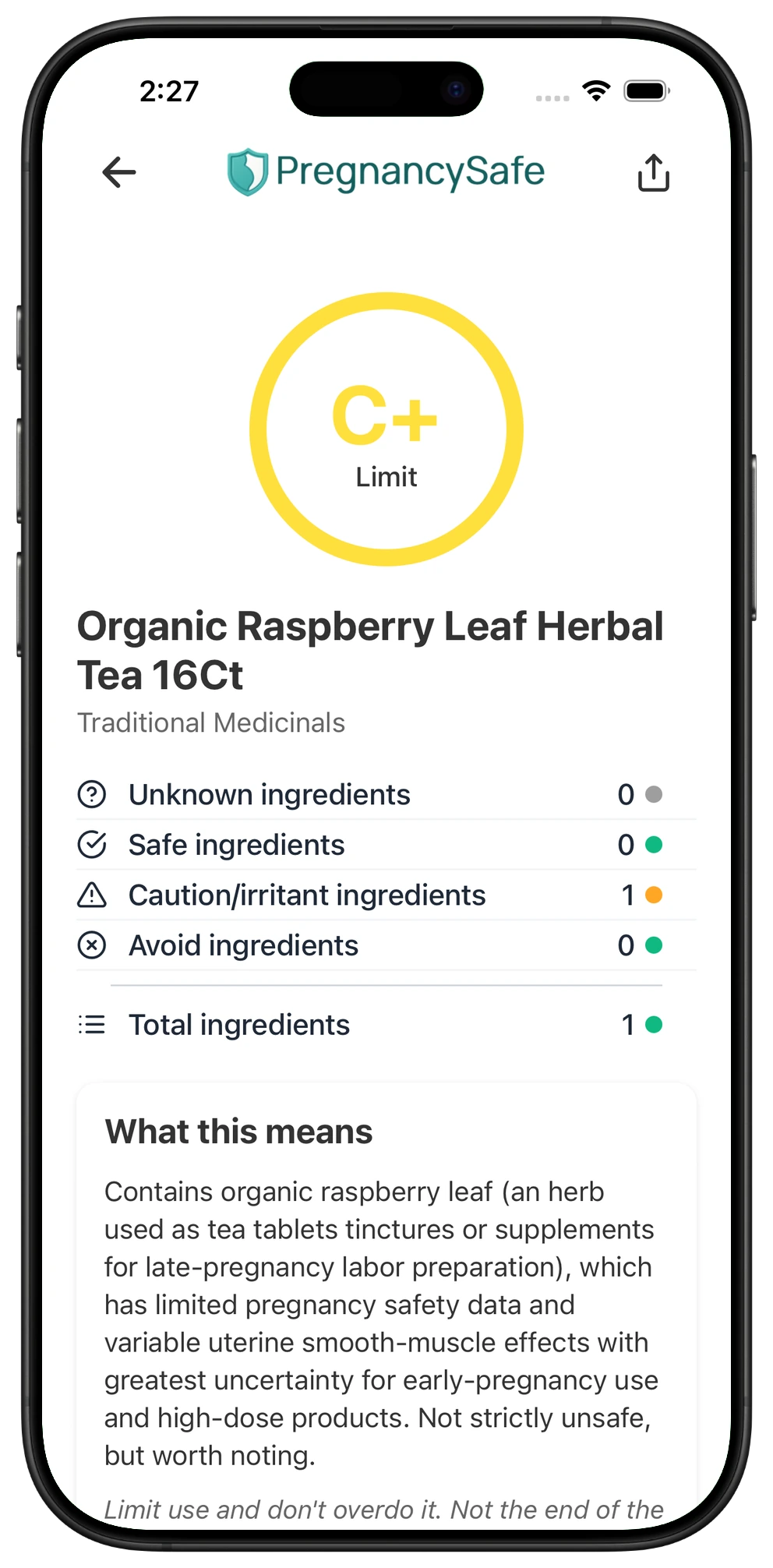
Raspberry leaf tea, tablets, tinctures, and supplements warrant caution during pregnancy because human safety evidence is limited. Early pregnancy use and high dose or concentrated products carry extra uncertainty; use for late pregnancy labor preparation is not clearly proven beneficial.
Timing matters: a small trial began at 32 weeks, so its reassuring findings do not establish safety in early pregnancy.
A small randomized trial starting at 32 weeks reported no maternal or infant adverse effects, but human pregnancy evidence remains limited and reviews find weak evidence of benefit.
Pregnancy Safe is 100% independent and research driven. No companies pay to promote or sponsor products.
Stressless Pregnancy
Check your exact product with raspberry leaf in the app

What Is Raspberry Leaf?
You may also see it listed as: raspberry leaves, red raspberry leaf, Rubi idaei folium, Rubus idaeus leaf
Raspberry leaf is the leaf of the red raspberry plant, Rubus idaeus. It is traditionally used for women's reproductive health, especially late pregnancy labor preparation, and comes as herbal tea, tablets, tinctures, and supplements. You may also find it in blended teas, tonics, and multivitamins.
What Other Ingredients Should You Look Out for in Products With Raspberry Leaf?
A product's full ingredient list determines whether it's pregnancy-safe or not. These ingredients also appear in some of the raspberry leaf products we analyzed and may deserve a closer look.
Chamomile
CautionLook for chamomile in raspberry leaf tea blends and check the species and preparation: pregnancy evidence differs between German chamomile flower infusion, Roman chamomile, and extracts. Occasional tea is lower concern than regular medicinal dosing, and allergy matters if you are sensitive to ragweed or related plants.
Flagged in 1 product (100%) in this analysis.
Does the Form or Amount of Raspberry Leaf Matter During Pregnancy?
The limited late pregnancy findings should not be extended to early pregnancy or high dose and concentrated preparations. Tea, tablets, and tinctures cannot be assumed to have equivalent exposures or safety evidence. Reviews describe variable effects on uterine smooth muscle, not a reliable labor preparation effect.
What Products Contain Raspberry Leaf?
Pregnancy Safe has looked at 14 products that have raspberry leaf as an ingredient. The category and grade breakdowns below use 1 product whose name mentions Raspberry Leaf or another name for it.
What Types of Products Contain Raspberry Leaf?
Products You May Have That Contain Raspberry Leaf
| Grade | Product | Brand | Type |
|---|---|---|---|
| C | Shewell Raspberry Leaf Wellness Tea | Celestial Seasonings | Tea |
| C | New Chapter One Daily Every Woman'S Multivitamin 48 Tablets | New Chapter | Multivitamin |
| C | Cytoimmune | Cellcore Biosciences | Unknown |
| D- | Fitness Whole Food Bar | Ecotrek Fitness | Nutrition Bar |
| D- | Whole Food Bar | Ecotrek Fitness Llc | Nutrition Bar |
| D+ | Hibiscus Renewal Apple Cider Vinegar Health Tonic, Hibiscus Renewal | Fire Brew | Health Tonic |
| C | Herbal Tea : Raspberry | First Street | Herbal Tea |
| C+ | Goldthread Tonic, Plant Based, Green Minerals | Goldthread | Tonic |
How Do Products Containing Raspberry Leaf Score?
It can be helpful to see how products containing raspberry leaf generally score during pregnancy. This does not tell you whether your exact product is safe, but it gives you a general idea of what we found. In this breakdown of 1 product, 100% receive a C grade. A C grade means the complete formula has some pregnancy considerations, so use it sparingly and consider a higher scoring alternative when one is available.
Frequently Asked Questions About Raspberry Leaf During Pregnancy
When should I start drinking raspberry leaf tea?
The available evidence does not establish a recommended starting week. A small trial began at 32 weeks, but that study timing is not a recommendation to start then or proof that starting at 36 or 37 weeks is safe or useful.
What about raspberry leaf in the first trimester?
Early pregnancy use carries extra uncertainty. The small trial beginning at 32 weeks does not answer first trimester safety questions, and reviews describe variable effects on uterine smooth muscle.
How much raspberry leaf tea can I drink during pregnancy?
The available evidence does not establish a safe number of cups or a daily dose. High dose and concentrated products carry extra uncertainty, so more should not be assumed to work better.
Does raspberry leaf soften the cervix or induce labor?
The available evidence does not establish either effect. Variable effects on uterine smooth muscle do not demonstrate reliable cervical softening or labor induction in pregnant people.
Does raspberry leaf make labor shorter or reduce interventions?
A small randomized trial did not clearly shorten first stage labor. A 2024 observational study found fewer interventions to strengthen or speed up labor, but its findings were not generalizable and do not establish a reliable benefit.
Are raspberry leaf tablets or tinctures equivalent to tea?
They are different preparations of the same herb, not interchangeable exposures. The limited pregnancy findings do not establish equal safety across forms, and high dose or concentrated products carry extra uncertainty.
How Do We Score Products for Pregnancy Safety?
We analyze each product's ingredients and category to flag known risks and provide cautionary notices for general category safety concerns.
A - Safe
Excellent choice! All ingredients are considered safe during pregnancy.
What to do: Use with confidence.
B - Likely Safe
Pretty much safe with very minimal risk. Some ingredients may have limited pregnancy studies, but no significant safety concerns have been identified.
What to do: Use with confidence.
C - Limit
Contains ingredients with some pregnancy considerations. Research shows these ingredients may have limited safety data, potential for minor hormonal effects, or require caution based on animal studies.
What to do: Use sparingly and consider safer alternatives when available.
D - Caution
Similar to C grade but contains multiple cautionary ingredients. The combination increases overall concern.
What to do: Try to avoid if that makes you feel better. If you've already used it, no need to panic.
F - Avoid
Contains an ingredient Pregnancy Safe recommends avoiding during pregnancy. This may reflect an established risk or a precaution based on limited evidence; check the ingredient guidance and exposure context.
What to do: Do not use during pregnancy. If you've already used it, don't worry - contact your OBGYN if concerned.
Sources
- https://cot.food.gov.uk/print/pdf/node/12376
- https://health-products.canada.ca/lnhpd-bdpsnh/info?licence=80012819
- https://mothertobaby.org/fact-sheets/herbal-products-pregnancy/
- https://pubmed.ncbi.nlm.nih.gov/11370690/
- https://pubmed.ncbi.nlm.nih.gov/33563275/
- https://pubmed.ncbi.nlm.nih.gov/38649906/
- https://www.ema.europa.eu/en/documents/herbal-report/final-assessment-report-rubus-idaeus-l-folium_en.pdf
- https://www.nccih.nih.gov/health/chamomile
- https://www.ema.europa.eu/en/documents/herbal-monograph/final-european-union-herbal-monograph-matricaria-recutita-l-flos-first-version_en.pdf
- https://www.ema.europa.eu/en/documents/herbal-monograph/final-community-herbal-monograph-chamaemelum-nobile-l-all-flos_en.pdf
- https://pubmed.ncbi.nlm.nih.gov/22516883/
- https://pubmed.ncbi.nlm.nih.gov/20872924/
- https://www.ncbi.nlm.nih.gov/books/NBK501808/
- https://www.ecfr.gov/current/title-21/chapter-I/subchapter-B/part-182/subpart-A/section-182.10