Is Moringa Safe During Pregnancy?
Updated September 11, 2026
The Answer
Moringa supplements and concentrated oral extracts warrant caution during pregnancy; routine supplementation should be clinician directed. Leaves used as food may be lower concern than medicinal extracts. Moringa seed oil or leaf extract in ordinary cosmetic use on intact skin appears low concern, but direct topical pregnancy studies are lacking.
How you use moringa changes the answer: the low concern assessment for ordinary cosmetic use on intact skin does not apply to swallowed teas, powders, capsules, or extracts.
Human pregnancy evidence mostly consists of small nutrition or anemia studies of leaf products; these do not establish fetal safety across preparations, while reviews and animal findings raise preparation specific concerns.
Already used it? If you have already taken a moringa supplement, share the label and amount used with your prenatal clinician. The plant part, preparation, and product quality matter when discussing ongoing use.
Pregnancy Safe is 100% independent and research driven. No companies pay to promote or sponsor products.
Stressless Pregnancy
Check your exact product with moringa in the app

What Is Moringa?
You may also see it listed as: moringa oleifera, drumstick tree, horseradish tree, malunggay, kelor
Moringa oleifera is a nutrient rich tree whose leaves, pods, and seeds are used in foods and supplements. You may encounter dried leaf powder, capsules, teas, nutrition bars, and drink blends, including products marketed for lactation. Seed oil and leaf extract also help moisturize and condition skin and hair.
What Other Ingredients Should You Look Out for in Products With Moringa?
A product's full ingredient list determines whether it's pregnancy-safe or not. These ingredients also appear in some of the moringa products we analyzed and may deserve a closer look.
Caffeine
CautionLook for “caffeine tea extract” in moringa tea blends and check the caffeine amount per serving. ACOG recommends keeping total pregnancy caffeine below 200 mg per day, counting drinks, foods, supplements, and medicines together.
Flagged in 5 products (6.6%) in this analysis.
Spirulina
CautionLook for “spirulina” or “spirulina powder” in moringa drinks, bars, and powder blends; poorly tested algae ingredients can carry contamination concerns. Check for product quality testing, and discuss supplement use with your prenatal clinician as FDA advises for blue green algae supplements.
Flagged in 4 products (5.3%) in this analysis.
Hibiscus
CautionLook for “hibiscus” or “hibiscus flowers” in moringa tea blends; pregnancy evidence is very limited, and hibiscus can lower blood pressure. Discuss medicinal tea use with your clinician, especially if you have low blood pressure or take blood pressure medication.
Flagged in 3 products (3.9%) in this analysis.
Chamomile
CautionIf a moringa tea lists “chamomile,” check the species and whether it is an infusion or extract, because pregnancy evidence differs by preparation. Occasional tea is lower concern than regular medicinal dosing; sensitivity to ragweed or related plants is also relevant.
Flagged in 1 product (1.3%) in this analysis.
Chlorella
CautionLook for “chlorella powder” in moringa superfood blends; small pregnancy studies do not establish routine supplement benefit or safety across pregnancy. Check product quality testing because microalgae supplements can vary in composition and may contain contaminants.
Flagged in 1 product (1.3%) in this analysis.
Fennel
CautionLook for “sweet fennel” in moringa tea blends and check whether the product is intended for concentrated medicinal use. Culinary amounts are low concern, but concentrated medicinal tea warrants clinician review because pregnancy safety data are limited and hormonal or uterine effects are a concern.
Flagged in 1 product (1.3%) in this analysis.
Does the Form or Amount of Moringa Matter During Pregnancy?
For ingested moringa, food like leaf use may be lower concern than medicinal extracts, but leaf research does not establish fetal safety for concentrated extracts, seeds, roots, or high dose supplements. For skin and hair use, the low concern assessment covers ordinary seed oil or leaf extract cosmetics on intact skin. Uncertainty is greater with concentrated products, large area or broken skin use, and less studied preparations such as seed extracts, hydrolyzed seed extract, or hydrogenated derivatives.
What Products Contain Moringa?
Pregnancy Safe has looked at 175 products that have moringa as an ingredient. The category and grade breakdowns below use 76 products whose names mention Moringa or another name for it.
What Types of Products Contain Moringa?
Products You May Have That Contain Moringa
| Grade | Product | Brand | Type |
|---|---|---|---|
| C | Organic Moringa Aswagandha Tea (Ayurvedic) | Herbal Cup | Tea |
| C | Cashew Matcha & Moringa Bar, Cashew Matcha & Moringa | — | Nutrition Bar |
| C+ | Mango Moringa | — | Juice |
| C | Matcha Moringa Plant Protein Drink, Matcha Moringa | — | Plant Protein Drink |
| C+ | Moringa Coconut Latte Organic Instant Beverage Mix | — | Instant Beverage Mix |
| C+ | Moringa Superfood Dark Chocolate Bar | — | Chocolate Bar |
| C | Moringa 1000 Mg | Absorb Health | Dietary Supplement |
| C+ | Just Pure Organic Moringa 500 Mg | Angry Supplements | Dietary Supplement |
How Do Products Containing Moringa Score?
It can be helpful to see how products containing moringa generally score during pregnancy. This does not tell you whether your exact product is safe, but it gives you a general idea of what we found. In this breakdown of 76 products, 96% receive a C grade. A C grade means the complete formula has some pregnancy considerations, so use it sparingly and consider a higher scoring alternative when one is available.
Frequently Asked Questions About Moringa During Pregnancy
How much moringa can I take during pregnancy?
The available evidence does not establish a general pregnancy dose. Food like leaf use differs from concentrated extracts or high dose supplements, so routine supplementation should be clinician directed rather than based on the amount printed on a product label.
Can moringa cause miscarriage?
The available evidence does not establish that moringa causes miscarriage in humans. Reviews and animal findings raise concerns about particular preparations, but those findings should not be treated as proof that all moringa use causes pregnancy harm.
Does the advice change in the first, second, or third trimester?
The available evidence does not support a trimester specific moringa recommendation. Preparation and exposure remain important, and there are no direct studies of topical moringa exposure during pregnancy or by trimester.
Are moringa drumstick pods the same as leaves for pregnancy safety?
No. Pods and leaves are different plant parts. Most human pregnancy research concerns leaf products, so the potentially lower concern for food like leaf use should not be extended to pods as a proven safety conclusion.
Is moringa tea safer than capsules?
Tea is not automatically safer because it is a drink. The plant part and preparation matter, and the evidence does not establish that every tea is lower concern than every capsule. Check whether the product contains leaves or a concentrated extract.
Can I use moringa oil on my skin or hair?
Moringa seed oil in ordinary cosmetic use on intact skin appears low concern. This assessment draws on a cosmetic safety review and small nonpregnant volunteer studies, not direct pregnancy studies, and does not establish the safety of the complete formula.
How Do We Score Products for Pregnancy Safety?
We analyze each product's ingredients and category to flag known risks and provide cautionary notices for general category safety concerns.
A - Safe
Excellent choice! All ingredients are considered safe during pregnancy.
What to do: Use with confidence.
B - Likely Safe
Pretty much safe with very minimal risk. Some ingredients may have limited pregnancy studies, but no significant safety concerns have been identified.
What to do: Use with confidence.
C - Limit
Contains ingredients with some pregnancy considerations. Research shows these ingredients may have limited safety data, potential for minor hormonal effects, or require caution based on animal studies.
What to do: Use sparingly and consider safer alternatives when available.
D - Caution
Similar to C grade but contains multiple cautionary ingredients. The combination increases overall concern.
What to do: Try to avoid if that makes you feel better. If you've already used it, no need to panic.
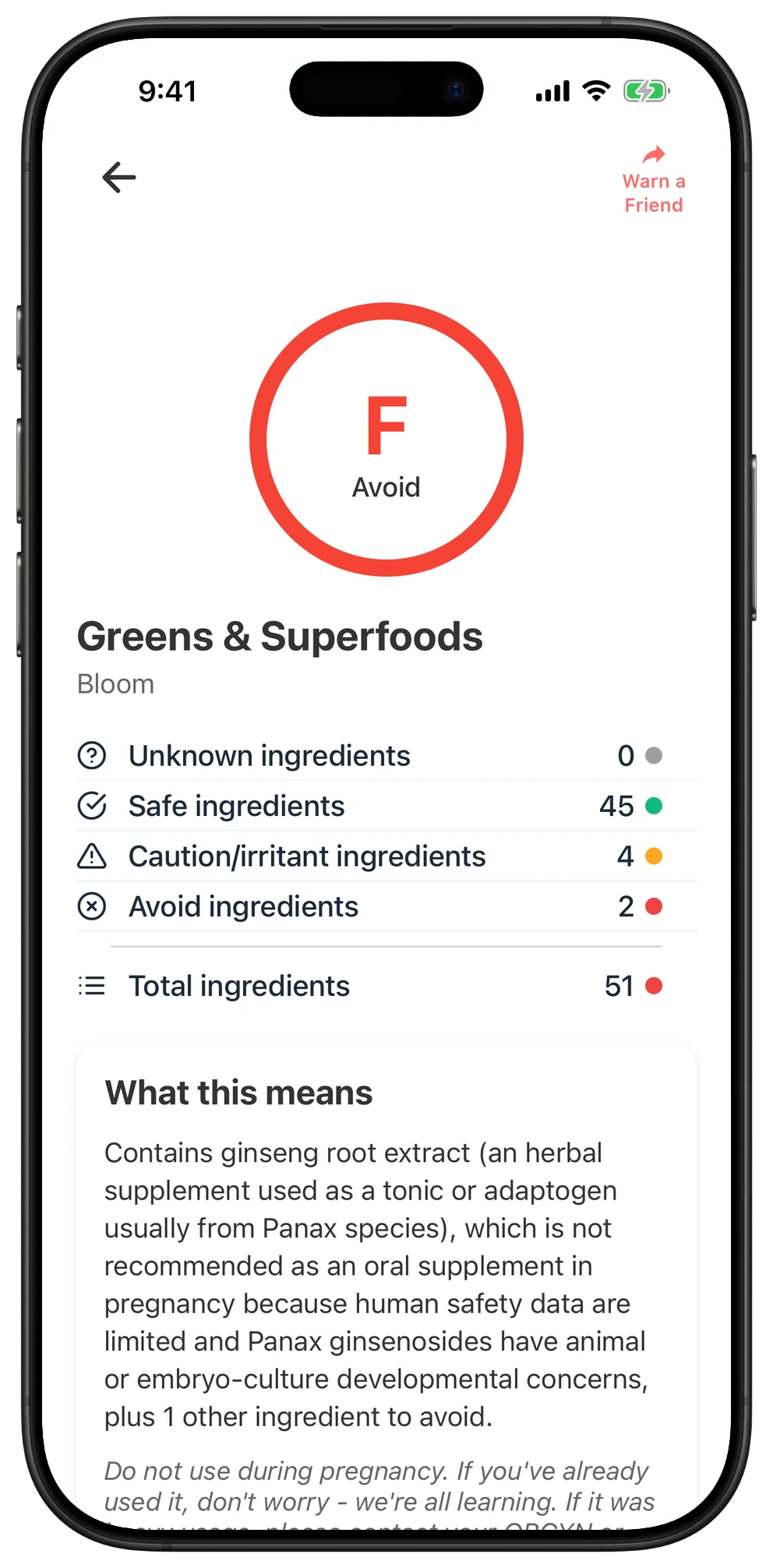
F - Avoid
Contains an ingredient Pregnancy Safe recommends avoiding during pregnancy. This may reflect an established risk or a precaution based on limited evidence; check the ingredient guidance and exposure context.
What to do: Do not use during pregnancy. If you've already used it, don't worry - contact your OBGYN if concerned.
Sources
- https://academicjournals.org/journal/AJPP/article-full-text-pdf/1E8502E29441.pdf
- https://journals.sagepub.com/doi/pdf/10.1177/1091581817740569
- https://mdpi-res.com/d_attachment/cosmetics/cosmetics-08-00002/article_deploy/cosmetics-08-00002-v2.pdf
- https://pmc.ncbi.nlm.nih.gov/articles/PMC10301989/
- https://pmc.ncbi.nlm.nih.gov/articles/PMC10363345/
- https://pmc.ncbi.nlm.nih.gov/articles/PMC6017530/
- https://pmc.ncbi.nlm.nih.gov/articles/PMC8129764/
- https://pmc.ncbi.nlm.nih.gov/articles/PMC8958002/
- https://pmc.ncbi.nlm.nih.gov/articles/PMC9916933/
- https://www.ncbi.nlm.nih.gov/books/NBK501899/
- https://www.acog.org/clinical/clinical-guidance/committee-opinion/articles/2010/08/moderate-caffeine-consumption-during-pregnancy
- https://www.acog.org/womens-health/experts-and-stories/ask-acog/how-much-coffee-can-i-drink-while-pregnant
- https://www.ncbi.nlm.nih.gov/books/NBK582613/
- https://www.who.int/tools/elena/interventions/caffeine-pregnancy
- https://www.fda.gov/consumers/consumer-updates/spilling-beans-how-much-caffeine-too-much
- https://pubmed.ncbi.nlm.nih.gov/25179792/
- https://pubmed.ncbi.nlm.nih.gov/25238871/
- https://www.fda.gov/food/natural-toxins-food/blue-green-algae-products-and-microcystins
- https://www.ncbi.nlm.nih.gov/books/NBK548312/
- https://www.ncbi.nlm.nih.gov/books/NBK501849/
- https://pubmed.ncbi.nlm.nih.gov/21793723/
- https://journal.ugm.ac.id/v3/InaJBCS/article/view/23573
- https://doi.org/10.4236/ojog.2017.71016
- https://pubmed.ncbi.nlm.nih.gov/37317149/
- https://pubmed.ncbi.nlm.nih.gov/37368655/
- https://pubmed.ncbi.nlm.nih.gov/23036452/
- https://pubmed.ncbi.nlm.nih.gov/21842336/
- https://mothertobaby.org/fact-sheets/herbal-products-pregnancy/
- https://www.ncbi.nlm.nih.gov/books/NBK501882/
- https://pubmed.ncbi.nlm.nih.gov/19434218/
- https://pubmed.ncbi.nlm.nih.gov/18066103/
- https://pmc.ncbi.nlm.nih.gov/articles/PMC9086798/
- https://www.nccih.nih.gov/health/hypertension-high-blood-pressure
- https://www.ffhdj.com/index.php/ffhd/article/view/1768
- https://www.nccih.nih.gov/health/chamomile
- https://www.ema.europa.eu/en/documents/herbal-monograph/final-european-union-herbal-monograph-matricaria-recutita-l-flos-first-version_en.pdf
- https://www.ema.europa.eu/en/documents/herbal-monograph/final-community-herbal-monograph-chamaemelum-nobile-l-all-flos_en.pdf
- https://pubmed.ncbi.nlm.nih.gov/22516883/
- https://pubmed.ncbi.nlm.nih.gov/20872924/
- https://www.ncbi.nlm.nih.gov/books/NBK501808/
- https://www.ecfr.gov/current/title-21/chapter-I/subchapter-B/part-182/subpart-A/section-182.10
- https://www.ncbi.nlm.nih.gov/books/NBK501822/
- https://pmc.ncbi.nlm.nih.gov/articles/PMC10804112/
- https://pubmed.ncbi.nlm.nih.gov/20013055/
- https://pubmed.ncbi.nlm.nih.gov/17472477/
- https://pubmed.ncbi.nlm.nih.gov/15985279/
- https://pubmed.ncbi.nlm.nih.gov/24635025/
- https://www.fda.gov/food/information-consumers-using-dietary-supplements/questions-and-answers-dietary-supplements
- https://ods.od.nih.gov/factsheets/Pregnancy-HealthProfessional/
- https://pmc.ncbi.nlm.nih.gov/articles/PMC7551278/
- https://hfpappexternal.fda.gov/scripts/fdcc/index.cfm?id=FENNELCOMMON&set=FoodSubstances
- https://www.ema.europa.eu/en/documents/herbal-monograph/final-european-union-herbal-monograph-foeniculum-vulgare-miller-subsp-vulgare-var-dulce-mill-batt-trab-fructus-revision-1_en.pdf
- https://webprod.hc-sc.gc.ca/nhpid-bdipsn/dbImages/mono_fennel-sweet_english.pdf
- https://www.swissmedic.ch/swissmedic/en/home/news/mitteilungen/fencheltee-fuer-schwangere-kinder-unter-4-jahren.html
- https://www.efsa.europa.eu/en/news/have-your-say-estragole-fennel-seed-preparations
- https://www.ncbi.nlm.nih.gov/books/NBK501793/
- https://pubmed.ncbi.nlm.nih.gov/30969204/
- https://pubmed.ncbi.nlm.nih.gov/32733750/
- https://pubmed.ncbi.nlm.nih.gov/23275017/
- https://www.utep.edu/herbal-safety/populations/herbs-to-avoid-during-pregnancy.html