Is Flaxseed Safe During Pregnancy?
Updated September 11, 2026
The Answer
Small amounts of flaxseed in prepared foods are generally low concern during pregnancy, but human pregnancy evidence is limited and not conclusive. This does not extend to raw seeds, concentrated flaxseed oil, lignan extracts, or high dose supplements, which need more caution.
The key distinction is ordinary food level use versus raw seeds or concentrated flax preparations not simply whether the label says flaxseed.
Human pregnancy data are limited and mixed for some flax preparations, so the evidence does not support treating ordinary dietary flaxseed and concentrated preparations as equivalent exposures.
Already used it? If you have already eaten flaxseed, check the form and amount: normal food amounts are generally low concern. If you used raw seeds, concentrated oil, lignan extracts, or a high dose supplement, share the label and amount with your prenatal clinician for an individualized assessment.
Pregnancy Safe is 100% independent and research driven. No companies pay to promote or sponsor products.
Stressless Pregnancy
Check your exact product with flaxseed in the app

What Is Flaxseed?
You may also see it listed as: flax seed, flax seeds, flaxseeds, linseed, linseeds
Flaxseed is the seed of Linum usitatissimum, valued for its fiber, alpha linolenic acid a plant omega-3 fatty acid and lignans. It adds nutrition, texture, and a nutty flavor to foods such as bread, granola, oatmeal, and crackers. You may find it as whole seeds, ground or milled flaxseed, flaxseed meal, or oil.
What Other Ingredients Should You Look Out for in Products With Flaxseed?
A product's full ingredient list determines whether it's pregnancy-safe or not. These ingredients also appear in some of the flaxseed products we analyzed and may deserve a closer look.
Fennel
CautionLook for “fennel seed” in flax granola; ordinary culinary amounts are generally low concern. Check whether it is simply a seasoning rather than a concentrated medicinal preparation, where limited pregnancy data and hormonal or uterine concerns matter.
Flagged in 3 products (1%) in this analysis.
Fenugreek
Caution“Fenugreek” in granola should be distinguished from medicinal dose fenugreek: normal food seasoning is generally lower concern. Check the amount and whether the product is marketed as a supplement, since medicinal doses are not recommended during pregnancy because of limited data and reproductive toxicity signals.
Flagged in 3 products (1%) in this analysis.
Butylated Hydroxytoluene
Caution“BHT” is an antioxidant preservative that can appear in snack packs. Check how frequently you eat foods containing it: limiting avoidable high intake is reasonable, while the reproductive concerns come from high dose oral animal studies, not established harm from occasional food exposure.
Flagged in 1 product (0.3%) in this analysis.
Seaweed
Caution“Dehydrated nori” in a fish burger is a lower iodine seaweed, not the same exposure as concentrated kelp supplements. Check portion size and frequency: occasional modest nori portions differ from sustained high iodine seaweed intake.
Flagged in 1 product (0.3%) in this analysis.
Sodium Nitrite
CautionLook for “sodium nitrite,” a curing preservative, in snack packs containing processed meat; occasional regulated food exposure differs from frequent intake. Separately, check whether the pack contains deli meats or dry sausages, which need heating until steaming hot during pregnancy because of Listeria risk.
Flagged in 1 product (0.3%) in this analysis.
Does the Form or Amount of Flaxseed Matter During Pregnancy?
Small food amounts should be assessed differently from concentrated flaxseed oil, lignan extracts, and high dose supplements. Raw seeds also warrant separate caution. Human pregnancy data are limited and mixed for some preparations; these higher caution uses may affect bleeding, blood pressure, or blood sugar, and product quality can matter. The available evidence does not establish a numerical pregnancy serving limit.
What Products Contain Flaxseed?
Pregnancy Safe has looked at 3,781 products that have flaxseed as an ingredient. The category and grade breakdowns below use 314 products whose names mention Flaxseed or another name for it.
What Types of Products Contain Flaxseed?
Products You May Have That Contain Flaxseed
| Grade | Product | Brand | Type |
|---|---|---|---|
| B+ | Whole Trilogy Health Seeds Flax - Chia - Hemp | Badia | Health Seeds |
| B+ | Better Oats 100 Calories Apples & Cinnamon Instant Oatmeal With Flax Seeds 10 Pouches | Betteroats | Instant Oatmeal |
| B+ | Ceres Organic Ground Flaxseed 250 G | Ceres Organics | Ground Seed |
| B+ | Flax & Quinoa | Country Harvest | Bread |
| B+ | Nature'S Path Organic Pumpkin Seed & Flax Granola 35.3 Oz | Nature'S Path | Granola |
| B+ | Nature'S Path Pumpkin Seed + Flax Granola – 24.7Oz | Nature'S Path | Granola |
| B+ | Nature'S Path Organic Pumpkin Seed Plus Flax Granola 11Oz Box | Nature'S Path Organic | Granola |
| B+ | Pumpkin Seed + Flax Granola | Nature'S Path Organic | Granola |
How Do Products Containing Flaxseed Score?
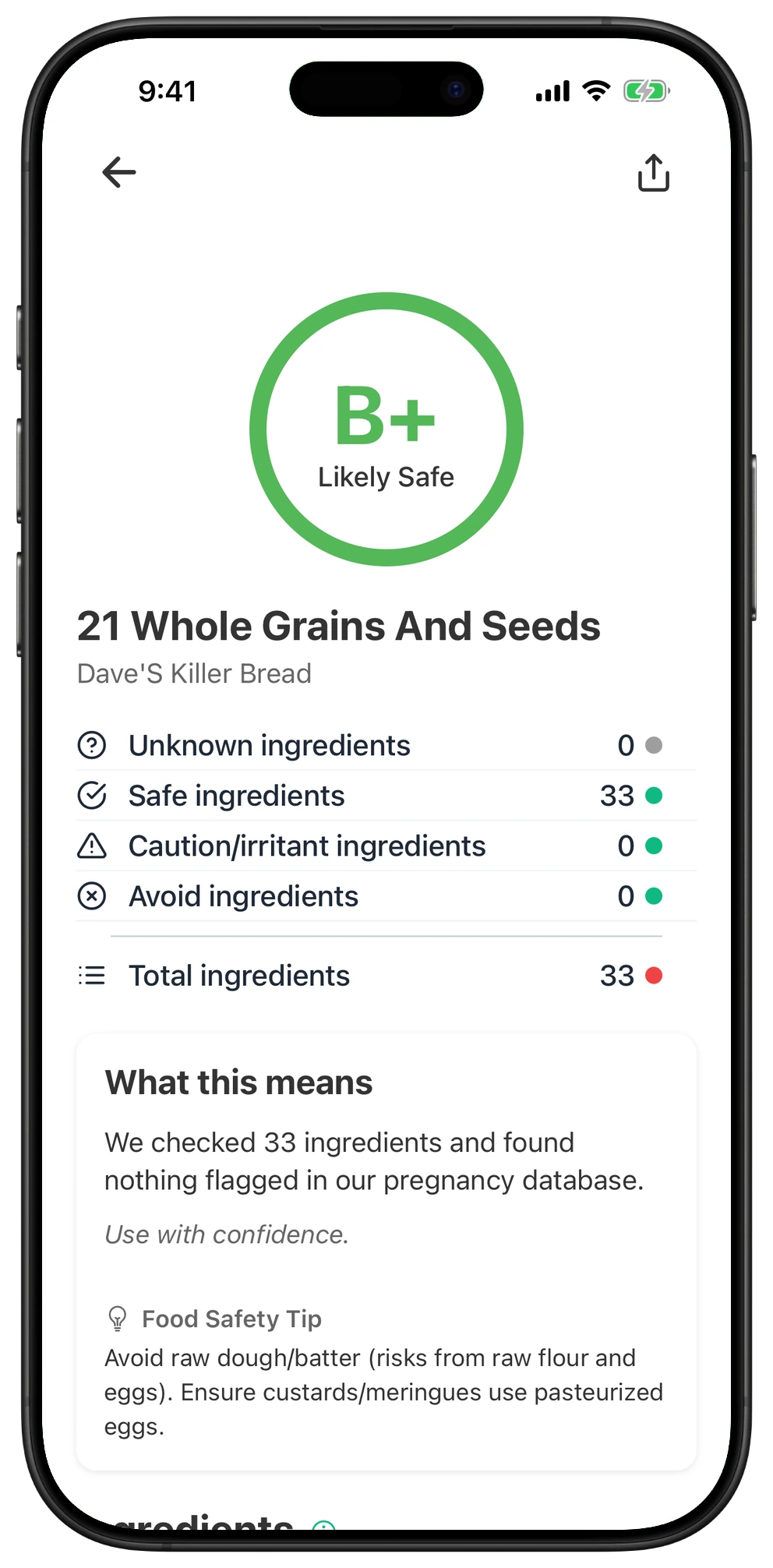
It can be helpful to see how products containing flaxseed generally score during pregnancy. This does not tell you whether your exact product is safe, but it gives you a general idea of what we found. In this breakdown of 314 products, 97% receive a B grade. A B grade means the complete formula is likely safe, with minimal identified risk.
Frequently Asked Questions About Flaxseed During Pregnancy
How much flaxseed can I eat while pregnant?
Normal food amounts are generally low concern, but the available evidence does not establish a pregnancy specific limit in grams or tablespoons. Do not treat this as approval for high dose supplements or raw seeds.
Does flaxseed oil have the same pregnancy guidance as flaxseed in food?
No. Concentrated flaxseed oil is a separate caution context with more limited pregnancy data. The likely safe conclusion for normal food amounts should not be extended to oil supplements.
Are raw flaxseeds covered by the food amount reassurance?
No. Raw seeds are specifically identified as a higher caution preparation. Their pregnancy guidance should not be inferred from flaxseed used in ordinary prepared foods.
Is flaxseed meal different from milled flaxseed?
Both describe ground forms of flaxseed, commonly used in baking and other foods. Being ground does not by itself settle the pregnancy question; the amount and whether the preparation is raw or supplement strength still matter.
What nutrients does flaxseed provide?
Flaxseed provides fiber, the plant omega-3 fatty acid alpha linolenic acid, and lignans. These explain its use as a nutritious food ingredient, but do not establish a benefit from taking concentrated flax supplements during pregnancy.
What potential side effects matter during pregnancy?
The main cautions concern raw seeds, concentrated oils, lignan extracts, and high dose supplements, which may affect bleeding, blood pressure, or blood sugar. These concerns should not be presented as established effects of small amounts of flaxseed in food.
How Do We Score Products for Pregnancy Safety?
We analyze each product's ingredients and category to flag known risks and provide cautionary notices for general category safety concerns.
A - Safe
Excellent choice! All ingredients are considered safe during pregnancy.
What to do: Use with confidence.
B - Likely Safe
Pretty much safe with very minimal risk. Some ingredients may have limited pregnancy studies, but no significant safety concerns have been identified.
What to do: Use with confidence.
C - Limit
Contains ingredients with some pregnancy considerations. Research shows these ingredients may have limited safety data, potential for minor hormonal effects, or require caution based on animal studies.
What to do: Use sparingly and consider safer alternatives when available.
D - Caution
Similar to C grade but contains multiple cautionary ingredients. The combination increases overall concern.
What to do: Try to avoid if that makes you feel better. If you've already used it, no need to panic.
F - Avoid
Contains an ingredient Pregnancy Safe recommends avoiding during pregnancy. This may reflect an established risk or a precaution based on limited evidence; check the ingredient guidance and exposure context.
What to do: Do not use during pregnancy. If you've already used it, don't worry - contact your OBGYN if concerned.
Sources
- https://pmc.ncbi.nlm.nih.gov/articles/PMC3615982/
- https://pubmed.ncbi.nlm.nih.gov/16579802/
- https://webprod.hc-sc.gc.ca/nhpid-bdipsn/dbImages/858
- https://www.ncbi.nlm.nih.gov/books/NBK501895/
- https://www.nccih.nih.gov/health/flaxseed-and-flaxseed-oil
- https://hfpappexternal.fda.gov/scripts/fdcc/index.cfm?id=FENNELCOMMON&set=FoodSubstances
- https://www.ema.europa.eu/en/documents/herbal-monograph/final-european-union-herbal-monograph-foeniculum-vulgare-miller-subsp-vulgare-var-dulce-mill-batt-trab-fructus-revision-1_en.pdf
- https://webprod.hc-sc.gc.ca/nhpid-bdipsn/dbImages/mono_fennel-sweet_english.pdf
- https://www.swissmedic.ch/swissmedic/en/home/news/mitteilungen/fencheltee-fuer-schwangere-kinder-unter-4-jahren.html
- https://www.efsa.europa.eu/en/news/have-your-say-estragole-fennel-seed-preparations
- https://www.ncbi.nlm.nih.gov/books/NBK501793/
- https://pubmed.ncbi.nlm.nih.gov/30969204/
- https://pubmed.ncbi.nlm.nih.gov/32733750/
- https://pubmed.ncbi.nlm.nih.gov/23275017/
- https://www.utep.edu/herbal-safety/populations/herbs-to-avoid-during-pregnancy.html
- https://www.nccih.nih.gov/health/fenugreek
- https://www.ncbi.nlm.nih.gov/books/NBK501779/
- https://www.ema.europa.eu/en/documents/herbal-report/assessment-report-trigonella-foenum-graecum-l-semen-revision-1_en.pdf
- https://www.ema.europa.eu/en/documents/herbal-monograph/european-union-herbal-monograph-trigonella-foenum-graecum-l-semen-revision-1_en.pdf
- https://webprod.hc-sc.gc.ca/nhpid-bdipsn/dbImages/mono_fenugreek--oral_english.pdf
- https://pubmed.ncbi.nlm.nih.gov/32421208/
- https://pubmed.ncbi.nlm.nih.gov/27498339/
- https://pubmed.ncbi.nlm.nih.gov/33722213/
- https://health.ec.europa.eu/system/files/2022-08/sccs_o_257.pdf
- https://pubmed.ncbi.nlm.nih.gov/37751543/
- https://pubmed.ncbi.nlm.nih.gov/12396675/
- https://pmc.ncbi.nlm.nih.gov/articles/PMC13151845/
- https://www.ecfr.gov/current/title-21/chapter-I/subchapter-B/part-172/subpart-B/section-172.115
- https://www.ecfr.gov/current/title-21/chapter-I/subchapter-B/part-182/subpart-D/section-182.3173
- https://www.fda.gov/news-events/press-announcements/fda-finalizes-food-chemical-safety-post-market-assessment-program-launches-reassessment-bht-ada
- https://journals.sagepub.com/doi/10.1177/10507256261445624
- https://ods.od.nih.gov/factsheets/Iodine-HealthProfessional/
- https://www.foodstandards.gov.au/consumer/nutrition/pregnancy/iodine-and-pregnancy
- https://www.foodstandards.gov.au/consumer/prevention-of-foodborne-illness/arseniciodine
- https://inspection.canada.ca/en/food-safety-consumers/fact-sheets/specific-products-and-risks/chemical-hazards/inorganic-arsenic
- https://pubmed.ncbi.nlm.nih.gov/35947162/
- https://pubmed.ncbi.nlm.nih.gov/20919974/
- https://pubmed.ncbi.nlm.nih.gov/30632947/
- https://pmc.ncbi.nlm.nih.gov/articles/PMC8077470/
- https://hfpappexternal.fda.gov/scripts/fdcc/index.cfm?id=SODIUMNITRITE&set=FoodSubstances
- https://www.ecfr.gov/current/title-9/section-424.21
- https://www.ecfr.gov/current/title-21/section-172.175
- https://www.efsa.europa.eu/en/press/news/170615
- https://www.inchem.org/documents/jecfa/jecmono/v50je07.htm
- https://pubmed.ncbi.nlm.nih.gov/41248583/
- https://www.cdc.gov/food-safety/foods/pregnant-women.html
- https://publications.iarc.who.int/Book-And-Report-Series/Iarc-Monographs-On-The-Identification-Of-Carcinogenic-Hazards-To-Humans/Red-Meat-And-Processed-Meat-2018
- https://dailymed.nlm.nih.gov/dailymed/drugInfo.cfm?setid=52f01c6e-172a-47a9-98a6-9eab7651a032
- https://www.atsdr.cdc.gov/toxprofiles/tp204.pdf