Is Prosciutto Safe During Pregnancy? (Updated 2026 Guide)
Updated September 9, 2026
The Answer
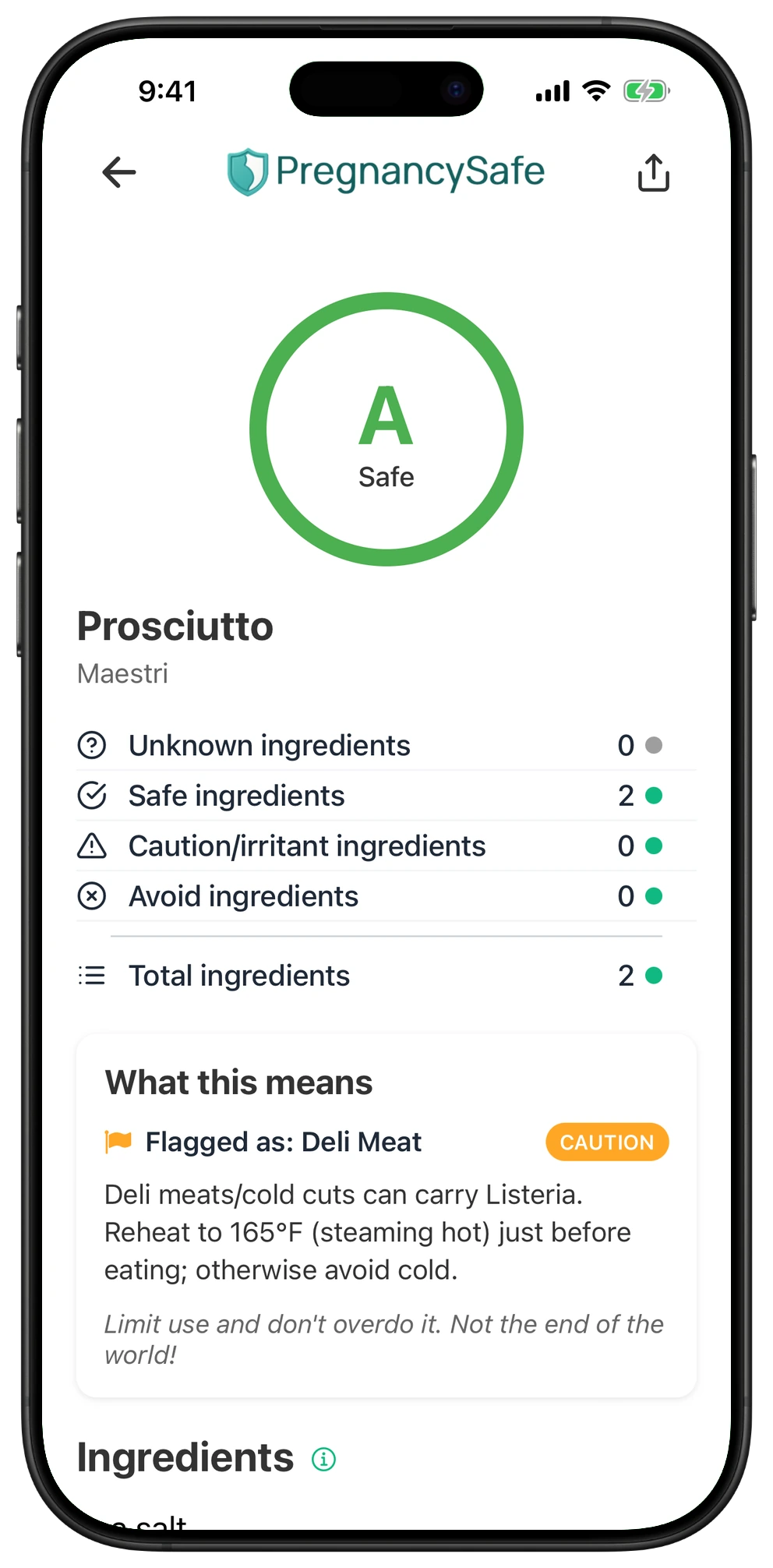
You can eat prosciutto during pregnancy if you heat it to 165°F or until steaming hot just before eating. Avoid eating it cold: dry curing does not remove the need for this Listeria precaution.
The main pregnancy concern is Listeria in ready to eat cured meat, not whether the ingredient list is short or earns a high grade. Heat prosciutto thoroughly, prevent cross contamination, refrigerate as directed and eat promptly after heating. Sodium nitrate and sodium nitrite warrant attention to frequent processed meat intake, but ordinary food additive exposure is not established to harm the fetus.
Pregnancy Safe is 100% independent and research driven. No companies pay to promote or sponsor products.
Stress Less This Pregnancy
Check your exact prosciutto in the app

✓ What's Safe
- • Heat prosciutto to 165°F or until steaming hot throughout, just before eating.
- • Choose dishes where the prosciutto itself is thoroughly heated, rather than added cold at serving.
- • Read the actual package for refrigeration and storage instructions, including directions after opening.
- • Use clean utensils and a clean plate for heated prosciutto to avoid cross contamination.
- • Keep prosciutto occasional rather than making cured and processed meats a daily staple.
✗ What to Avoid
- • Cold prosciutto on charcuterie boards, in sandwiches or wrapped around fruit.
- • Prosciutto added to pizza or pasta after cooking unless it is separately heated until steaming hot.
- • Relying on dry curing, smoking or a ready to eat label instead of heating.
- • Treating organic, uncured or nitrate free labels as protection against Listeria.
- • Eating prosciutto when its storage history is unclear or required refrigeration has not been maintained.
Most Common Ingredients in Prosciutto Products
We analyzed 35 prosciutto products. Here are the most common ingredients, ranked by how often they appear:
Ingredients to Watch Out For in Prosciutto
These are the most common flagged ingredients across 35 prosciutto products we analyzed.
sodium nitrate
Caution
Sodium nitrate is a chemical compound commonly used as a preservative and curing agent in processed meats and as a fertilizer in agriculture.
Is context dependent because vegetable sources are generally compatible with pregnancy while contaminated well water above nitrate/nitrite limits can cause methemoglobinemia and has observational links to adverse birth outcomes.
Flagged in 2 of 35 products (6%)
sodium nitrite
Caution
Sodium nitrite is a chemical compound commonly used as a preservative and color fixative in processed meats.
Is regulated at low food additive levels, but frequent cured or processed meat intake has limited observational pregnancy concerns; cyanide antidote and contaminated water exposures are separate issues.
Flagged in 1 of 35 products (3%)
white wine
Avoid
White wine is a crisp, pale yellow alcoholic beverage made from fermented white grapes, often used to enhance the flavor of dishes or enjoyed on its own.
Has no established safe amount in pregnancy and is linked to fetal alcohol spectrum disorders and other adverse pregnancy outcomes.
Flagged in 1 of 35 products (3%)
Prosciutto Products We've Analyzed
Our catalog contains ratings for 35 prosciutto products. These are database grades, not independent safety certifications.
Catalog ingredient grades do not measure current-label completeness, pathogens, preparation, caffeine or clinical pregnancy suitability. These counts include unreviewed records and are not a percentage of independently verified safe products.
Pregnancy Safe Prosciutto Products
Popular options from our catalog, prioritizing A and B ingredient grades, with C grade options used to fill remaining places. Within each group, products are ordered by searches in Pregnancy Safe, not retail sales. Read the cautions and guidance above; grades do not verify a complete current label or guarantee pregnancy safety.
| Grade | Product | Brand |
|---|---|---|
| A | Prosciutto | Maestri |
| A | Smoked Prosciutto, Smoked | Fiorucci |
| A | Prosciutto | — |
| A | Prosciutto | Naturalissima,Campofrio Food Group America |
| A | Prosciutto | Fiorucci |
Your Questions Answered
Does dry curing make prosciutto safe to eat cold during pregnancy?
No dry curing is not a substitute for the recommended heating step during pregnancy. Prosciutto is a cured meat, and ready to eat cured meats can carry Listeria. Heat it to 165°F or until steaming hot just before eating instead of serving it cold.
Can I eat prosciutto on pizza while pregnant?
Yes, if the prosciutto itself reaches 165°F or becomes steaming hot throughout. A hot pizza is not enough if cold prosciutto is added after it leaves the oven. Ask for it to be heated with the pizza or heated separately, then eat promptly.
Is organic or nitrate free prosciutto a safer choice?
Those labels do not remove the risk of Listeria or change the heating advice. An uncured label also does not automatically mean there are no nitrates or nitrites; celery powder can be a source. Read the full label, but prioritize thorough heating and proper storage over front of pack claims.
Should I avoid sodium nitrate and sodium nitrite in prosciutto?
Keep cured meats occasional rather than assuming any amount of these ingredients proves a product harmful. Pregnancy specific evidence about processed meat nitrate and nitrite exposure is limited and largely observational; ordinary regulated food additive exposure is not established to harm the fetus. Evidence about high exposure from contaminated drinking water does not establish the risk from a serving of prosciutto. Whether these preservatives are present or absent, the heating precaution still applies.
Does an A grade mean prosciutto is safe during pregnancy?
No. Our catalog contains 35 prosciutto products, including 33 with an A ingredient grade, but those grades do not assess pathogens, handling or pregnancy suitability. The counts include unreviewed records and are not counts of independently verified safe products. Check your actual package and follow the heating precautions regardless of grade.
What if white wine appears in the ingredients?
White wine on an ingredient list does not tell you how much alcohol remains in the finished prosciutto. Pregnancy guidance advises avoiding beverage alcohol, but that evidence should not be treated as proof that a food containing wine delivers the same exposure as drinking it. If you want to avoid this uncertainty, choose a version without wine listed. It still needs the same heating and handling precautions.
How to Interpret These Ratings
Our ingredient and category rules generate letter grades from the information recorded in the catalog. Missing ingredients and broad category assignments can affect the result. These grades do not measure your dose, confirm a complete current label, or test a product for contamination.
A high grade is not a guarantee of pregnancy safety. A low grade is not, by itself, proof of harm from every use. Follow the product-specific guidance above, check the actual package, and ask your prenatal clinician about supplements, treatment decisions or uncertain exposures.
People Also Checked
References
- https://www.cdc.gov/listeria/outbreaks/delimeats-7-24/index.html
- https://www.cdc.gov/food-safety/foods/pregnant-women.html
- https://www.cdc.gov/listeria/prevention/index.html
- https://www.fda.gov/food/people-risk-foodborne-illness/cooking-food-safety-moms-be
- https://www.epa.gov/ground-water-and-drinking-water/national-primary-drinking-water-regulations
- https://www.epa.gov/children/private-wells-and-drinking-water-safety-and-infants
- https://archive.cdc.gov/www_atsdr_cdc_gov/csem/nitrate-nitrite/who_risk.html
- https://doh.wa.gov/community-and-environment/drinking-water/contaminants/nitrate
- https://pubmed.ncbi.nlm.nih.gov/41248583/
- https://pmc.ncbi.nlm.nih.gov/articles/PMC9834225/
- https://www.efsa.europa.eu/en/efsajournal/pub/689
- https://www.food.gov.uk/safety-hygiene/nitrates-and-nitrites-the-science-explained
- https://www.ecfr.gov/current/title-21/chapter-I/subchapter-B/part-172/subpart-B/section-172.175
- https://hfpappexternal.fda.gov/scripts/fdcc/index.cfm?id=SODIUMNITRITE&set=FoodSubstances
- https://www.ecfr.gov/current/title-9/section-424.21
- https://www.ecfr.gov/current/title-21/section-172.175
- https://www.efsa.europa.eu/en/press/news/170615
- https://www.inchem.org/documents/jecfa/jecmono/v50je07.htm
- https://publications.iarc.who.int/Book-And-Report-Series/Iarc-Monographs-On-The-Identification-Of-Carcinogenic-Hazards-To-Humans/Red-Meat-And-Processed-Meat-2018
- https://dailymed.nlm.nih.gov/dailymed/drugInfo.cfm?setid=52f01c6e-172a-47a9-98a6-9eab7651a032
- https://www.atsdr.cdc.gov/toxprofiles/tp204.pdf
- https://www.cdc.gov/alcohol-pregnancy/about/index.html
- https://www.cdc.gov/fasd/about/index.html
- https://www.acog.org/womens-health/infographics/alcohol-and-pregnancy
- https://www.niaaa.nih.gov/publications/brochures-and-fact-sheets/alcohol-and-your-pregnancy
- https://mothertobaby.org/fact-sheets/alcohol-pregnancy/
- https://pubmed.ncbi.nlm.nih.gov/26482673/
- https://pmc.ncbi.nlm.nih.gov/articles/PMC9543418/