Is Cooked Ham Safe During Pregnancy? (Updated 2026 Guide)
Updated September 9, 2026
The Answer
Yes cooked ham can fit into pregnancy meals when properly prepared and handled; heat refrigerated deli ham to 165°F or steaming hot before eating. Our catalog contains mostly C+ ingredient scores, but those scores do not measure contamination or determine whether your serving is safe.
For refrigerated cooked deli ham, the main pregnancy consideration is Listeria, so being labeled cooked does not replace reheating and careful refrigeration. Sodium nitrite and other curing ingredients raise separate questions about frequent processed meat intake, but limited observational pregnancy evidence does not establish harm from an occasional serving. Follow the exact preparation instructions, keep ham refrigerated as directed, and prevent cross contamination.
Pregnancy Safe is 100% independent and research driven. No companies pay to promote or sponsor products.
Stress Less This Pregnancy
Check your exact cooked ham in the app

✓ What's Safe
- • Check whether the package says fully cooked, ready to eat, or requires cooking, and follow its preparation instructions.
- • Heat refrigerated deli ham to 165°F or steaming hot before eating, even if it was cooked during production.
- • Choose a hot ham meal where the ham itself is thoroughly heated, not just the bread or surrounding ingredients.
- • Follow the package's refrigeration and after opening storage instructions.
- • Use clean utensils and surfaces, keeping cooked ham separate from raw meat.
- • Vary your protein choices rather than making cured ham an everyday staple.
✗ What to Avoid
- • Cold refrigerated deli ham straight from the package or deli counter without reheating.
- • A merely warm ham sandwich when the ham has not reached 165°F or become steaming hot.
- • Treating uncured, natural, or celery extract wording as protection against Listeria or nitrate/nitrite exposure.
- • Eating ham that has not been stored according to its refrigeration instructions.
- • Returning heated ham to a plate or utensil contaminated by raw meat.
- • Using an ingredient grade or a short ingredient list as a substitute for safe preparation and handling.
Most Common Ingredients in Cooked Ham Products
We analyzed 136 cooked ham products. Here are the most common ingredients, ranked by how often they appear:
Ingredients to Watch Out For in Cooked Ham
These are the most common flagged ingredients across 136 cooked ham products we analyzed.
sodium nitrite
Caution
Sodium nitrite is a chemical compound commonly used as a preservative and color fixative in processed meats.
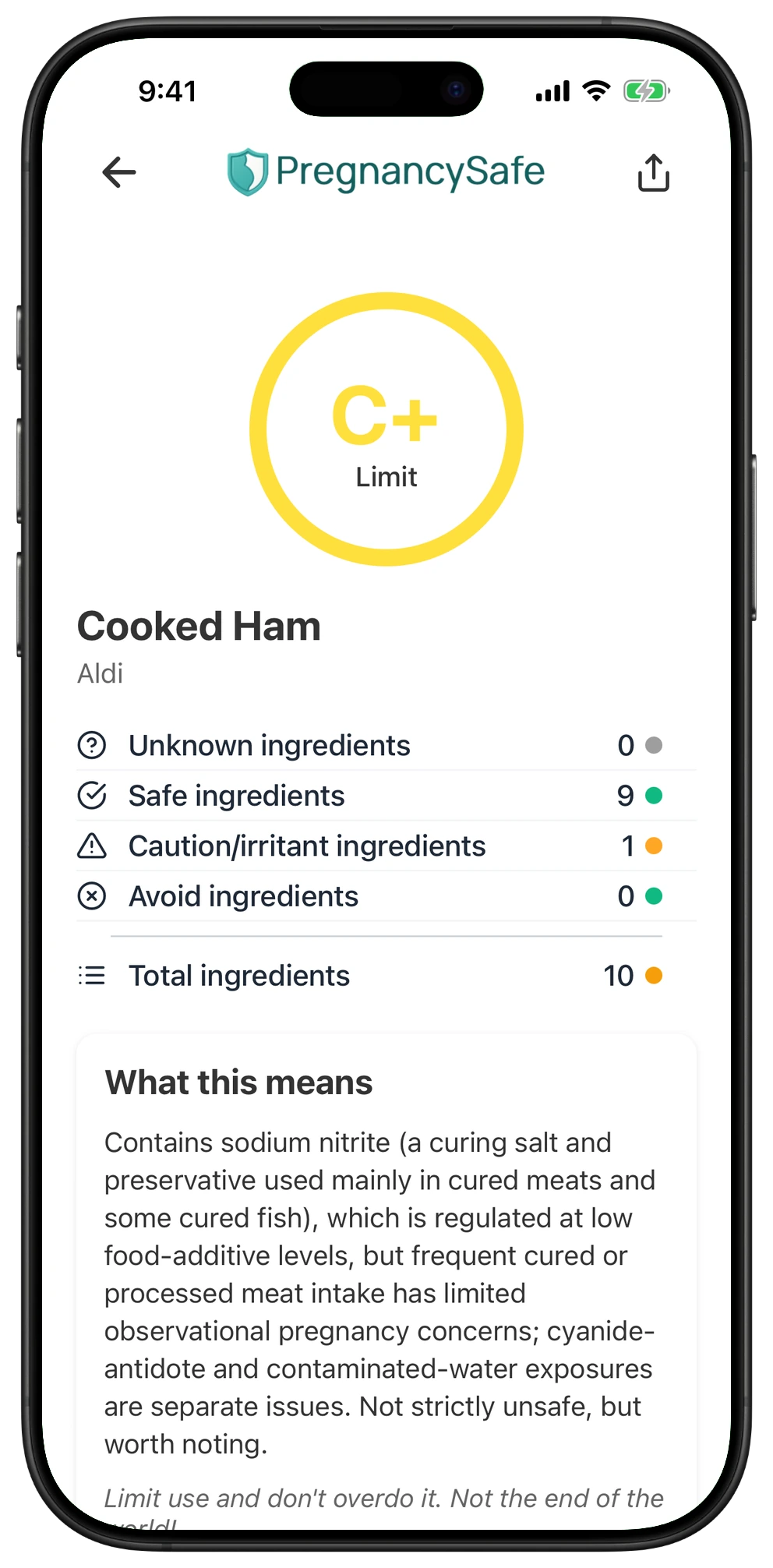
Is regulated at low food additive levels, but frequent cured or processed meat intake has limited observational pregnancy concerns; cyanide antidote and contaminated water exposures are separate issues.
Flagged in 124 of 136 products (91%)
sodium erythorbate and sodium nitrite
Caution
Sodium erythorbate and sodium nitrite are preservatives commonly used in processed meats to enhance color, flavor, and shelf life while preventing bacterial growth.
Is regulated at low food additive levels, but frequent cured or processed meat intake has limited observational pregnancy concerns; cyanide antidote and contaminated water exposures are separate issues.
Flagged in 3 of 136 products (2%)
sodium nitrate
Caution
Sodium nitrate is a chemical compound commonly used as a preservative and curing agent in processed meats and as a fertilizer in agriculture.
Is context dependent because vegetable sources are generally compatible with pregnancy while contaminated well water above nitrate/nitrite limits can cause methemoglobinemia and has observational links to adverse birth outcomes.
Flagged in 3 of 136 products (2%)
artificial color red 40
Caution
Artificial Color Red 40 is a synthetic dye commonly used to impart a vibrant red hue to foods, beverages, and candies.
Has limited human pregnancy data and is allowed at regulated food additive levels, but child neurobehavior concerns and high dose animal findings make frequent high dye intake worth limiting.
Flagged in 1 of 136 products (1%)
high fructose corn syrup
Caution
High fructose corn syrup is a sweet, liquid sweetener made from corn starch, commonly used in processed foods and beverages.
Is not a known teratogen at occasional food amounts, but high added sugar intake can displace nutrients and raise gestational diabetes and metabolic concerns.
Flagged in 1 of 136 products (1%)
potassium nitrate
Caution
Potassium nitrate is a crystalline salt commonly used as a fertilizer, food preservative, and oxidizing agent in explosives.
Is context dependent because vegetable sources are generally compatible with pregnancy while contaminated well water above nitrate/nitrite limits can cause methemoglobinemia and has observational links to adverse birth outcomes.
Flagged in 1 of 136 products (1%)
sodium nitrite and seasoning salt
Caution
Is regulated at low food additive levels, but frequent cured or processed meat intake has limited observational pregnancy concerns; cyanide antidote and contaminated water exposures are separate issues.
Flagged in 1 of 136 products (1%)
sodium nitrite coated with sugar
Caution
Is regulated at low food additive levels, but frequent cured or processed meat intake has limited observational pregnancy concerns; cyanide antidote and contaminated water exposures are separate issues.
Flagged in 1 of 136 products (1%)
Cooked Ham Products We've Analyzed
Our catalog contains ratings for 136 cooked ham products. These are database grades, not independent safety certifications.
Grades are ingredient scores, not clinical verdicts or measurements of pathogens, dose, preparation or current package contents. Cohorts include unreviewed catalog records and counts are not independently verified safe-product totals.
Pregnancy Safe Cooked Ham Products
Popular options from our catalog, prioritizing A and B ingredient grades, with C grade options used to fill remaining places. Within each group, products are ordered by searches in Pregnancy Safe, not retail sales. Read the cautions and guidance above; grades do not verify a complete current label or guarantee pregnancy safety.
| Grade | Product | Brand |
|---|---|---|
| B+ | Cooked Ham Trimmings | Bm Foods Ltd |
| B+ | Gourmet Lite Uncured Cooked Ham | Dietz & Watson |
| B+ | Premium Deli Style Cooked Ham | Gwaltney |
| A | Jambon Cuit Supérieur | Franprix |
| C+ | Cooked Ham Catalog caution flags: sodium nitrite. Read the category guidance above. | Aldi |
Your Questions Answered
Can I eat a cooked ham when pregnant?
Yes, with attention to its form and preparation. For refrigerated deli ham, heat it to 165°F or steaming hot before eating, even when the label says fully cooked. A ham that requires cooking needs its exact preparation instructions followed. Freshly cooked hot ham and cold deli slices are different exposures.
How does ham affect my baby during pregnancy?
The main practical concern with refrigerated deli ham is possible Listeria contamination, rather than ham being inherently harmful. Reheating and careful handling address that food safety concern. Pregnancy research on frequent processed meat nitrite exposure is limited and largely observational, so it does not establish that an occasional serving harms your baby. An ingredient score cannot predict the effect of a particular meal.
Can I eat cooked ham in a sandwich or on pizza?
Choose a preparation that heats the ham itself to 165°F or steaming hot. Toasted bread or melted cheese does not necessarily mean the ham is hot enough. The same applies to pizza: ham added after baking has not necessarily received the needed heating. Keep ingredients refrigerated as directed before preparation and avoid cross contamination.
Is uncured or nitrate free cooked ham safer during pregnancy?
Those label claims do not remove the need to reheat refrigerated deli ham. Natural and celery extract wording also does not eliminate nitrate/nitrite considerations. Read the full ingredient list, but do not use curing claims as evidence that a product is free of Listeria. Handling and heating remain the practical priorities.
Should I avoid sodium nitrite in cooked ham?
Sodium nitrite is a regulated curing ingredient, and its presence alone does not mean a serving is harmful during pregnancy. Limited observational evidence supports caution about frequent processed meat intake, not equating occasional food exposure with high dose exposure. Varying your protein choices is more useful than treating every nitrite containing ham as forbidden. Reheating addresses the separate Listeria concern; it does not replace considering how often you eat processed meat.
Does an A grade mean cooked ham is safe to eat cold?
No an ingredient grade does not measure pathogens, storage conditions, or preparation. Our catalog contains 136 cooked ham products, including one with an A ingredient score, but that is not a count of independently verified safe products. Incomplete product information is also not proof that a ham is harmful. Follow refrigerated deli ham reheating guidance regardless of grade.
How to Interpret These Ratings
Our ingredient and category rules generate letter grades from the information recorded in the catalog. Missing ingredients and broad category assignments can affect the result. These grades do not measure your dose, confirm a complete current label, or test a product for contamination.
A high grade is not a guarantee of pregnancy safety. A low grade is not, by itself, proof of harm from every use. Follow the product-specific guidance above, check the actual package, and ask your prenatal clinician about supplements, treatment decisions or uncertain exposures.
People Also Checked
See our full guide to ham during pregnancy.
References
- https://www.cdc.gov/listeria/prevention/index.html
- https://www.fda.gov/food/people-risk-foodborne-illness/cooking-food-safety-moms-be
- https://hfpappexternal.fda.gov/scripts/fdcc/index.cfm?id=SODIUMNITRITE&set=FoodSubstances
- https://www.ecfr.gov/current/title-9/section-424.21
- https://www.ecfr.gov/current/title-21/section-172.175
- https://www.efsa.europa.eu/en/press/news/170615
- https://www.inchem.org/documents/jecfa/jecmono/v50je07.htm
- https://pubmed.ncbi.nlm.nih.gov/41248583/
- https://www.cdc.gov/food-safety/foods/pregnant-women.html
- https://publications.iarc.who.int/Book-And-Report-Series/Iarc-Monographs-On-The-Identification-Of-Carcinogenic-Hazards-To-Humans/Red-Meat-And-Processed-Meat-2018
- https://dailymed.nlm.nih.gov/dailymed/drugInfo.cfm?setid=52f01c6e-172a-47a9-98a6-9eab7651a032
- https://www.atsdr.cdc.gov/toxprofiles/tp204.pdf
- https://www.epa.gov/ground-water-and-drinking-water/national-primary-drinking-water-regulations
- https://www.epa.gov/children/private-wells-and-drinking-water-safety-and-infants
- https://archive.cdc.gov/www_atsdr_cdc_gov/csem/nitrate-nitrite/who_risk.html
- https://doh.wa.gov/community-and-environment/drinking-water/contaminants/nitrate
- https://pmc.ncbi.nlm.nih.gov/articles/PMC9834225/
- https://www.efsa.europa.eu/en/efsajournal/pub/689
- https://www.food.gov.uk/safety-hygiene/nitrates-and-nitrites-the-science-explained
- https://www.ecfr.gov/current/title-21/chapter-I/subchapter-B/part-172/subpart-B/section-172.175
- https://www.hfpappexternal.fda.gov/scripts/fdcc/index.cfm?id=FDCRed40&set=ColorAdditives
- https://www.ecfr.gov/current/title-21/chapter-I/subchapter-A/part-74/subpart-A/section-74.340
- https://www.fda.gov/food/color-additives-information-consumers/tracking-food-industry-pledges-remove-petroleum-based-food-dyes
- https://www.efsa.europa.eu/en/efsajournal/pub/1327
- https://www.efsa.europa.eu/en/efsajournal/pub/4007
- https://apps.who.int/food-additives-contaminants-jecfa-database/Home/Chemical/2361
- https://oehha.ca.gov/risk-assessment/report/health-effects-assessment-potential-neurobehavioral-effects-synthetic-food-dyes-children
- https://pubmed.ncbi.nlm.nih.gov/6636206/
- https://pubmed.ncbi.nlm.nih.gov/2613118/
- https://pubmed.ncbi.nlm.nih.gov/7940558/
- https://cdn.realfood.gov/DGA.pdf
- https://www.dietaryguidelines.gov/sites/default/files/2021-12/DGA_Pregnancy_FactSheet-508c.pdf
- https://www.acog.org/womens-health/faqs/healthy-eating-during-pregnancy
- https://www.cdc.gov/nutrition/php/data-research/added-sugars.html
- https://www.cdc.gov/diabetes/about/gestational-diabetes.html
- https://www.who.int/publications/i/item/9789241549028
- https://nesr.usda.gov/2025-dietary-guidelines-advisory-committee-systematic-reviews/dietary-patterns_gestational-diabetes