Best Pregnancy Safe Mouthwash (Updated 2026 Guide)
Updated September 9, 2026
The Answer
Mouthwash can be part of your pregnancy oral care routine: choose an alcohol free rinse suited to your dental needs, follow its directions and spit it out. Our catalog contains 500 records, including 189 graded A, but ingredient grades are not clinical pregnancy safety verdicts.
The main considerations are the exact formulation, its purpose and avoiding swallowing not simply whether an ingredient carries a caution flag. Concerns about swallowed alcohol, dietary sweeteners or concentrated methyl salicylate do not establish the same risk from a directed rinse and spit exposure. Keep brushing with fluoride toothpaste and flossing, and ask your dentist about medicated rinses rather than delaying care for pain or infection.
Pregnancy Safe is 100% independent and research driven. No companies pay to promote or sponsor products.
Stress Less This Pregnancy
Check your exact mouthwash in the app

✓ What's Safe
- • Choose an alcohol free formulation to reduce unwanted alcohol exposure and irritation.
- • Read the exact Drug Facts panel for active ingredients, concentrations and intended use; do not rely on a retailer's generic description.
- • Match the rinse to your goal: an anticavity fluoride rinse and an antigingivitis rinse serve different purposes.
- • Check the labeled amount, rinsing time and frequency, and use only a product you can reliably spit out.
- • Confirm that the product is labeled as mouthwash, not a swallowed herbal extract or supplement, even if it says alcohol free.
- • Ask your dentist which medicated or prescription formulation fits your needs during pregnancy.
✗ What to Avoid
- • Avoid swallowing mouthwash, including alcohol free versions; rinse and spit use is different from drinking its ingredients.
- • Avoid choosing an alcohol containing rinse when an appropriate alcohol free option meets your needs, especially if alcohol causes irritation.
- • Avoid concentrated hydrogen peroxide or repeated whitening treatments without dental advice; these are not interchangeable with routine oral rinses.
- • Avoid adding concentrated methyl salicylate or wintergreen oil to homemade rinses; concentrated exposure is different from a formulated mouthwash.
- • Avoid treating swallowed aloe barbadensis leaf juice supplements or whole leaf preparations as mouthwash alternatives.
- • Avoid rejecting a needed rinse solely because it contains sodium saccharin, blue 1 or red 40; dietary and high dose findings do not establish harm from directed rinse and spit use.
Most Common Ingredients in Mouthwash Products
We analyzed 500 mouthwash products. Here are the most common ingredients, ranked by how often they appear:
Ingredients to Watch Out For in Mouthwash
These are the most common flagged ingredients across 500 mouthwash products we analyzed.
sodium saccharin
Caution
Sodium saccharin is a synthetic, calorie free sweetener commonly used to enhance the sweetness of foods and beverages.
Crosses the placenta and has limited pregnancy outcome data so frequent or high intake is best treated cautiously.
Sodium saccharin sweetens mouthwash. Its pregnancy caution concerns swallowed exposure, placental transfer and uncertainty with frequent or high intake; it does not establish harm from brief rinsing followed by spitting. Its presence alone is not a reason to reject an otherwise appropriate rinse.
Flagged in 132 of 500 products (26%)
alcohol
Caution
Alcohol is a volatile, colorless liquid commonly used as a solvent, disinfectant, or intoxicating beverage.
No amount of Alcohol is considered safe. Avoid alcohol beverages entirely. Be extremely careful when using in cooking or even with small percentages.
Alcohol can act as a solvent in mouthwash and may cause irritation. Rinsing and spitting is not equivalent to drinking alcohol, so beverage related pregnancy warnings should not be applied as proof of harm from directed rinsing. Choose alcohol free when practical and do not swallow.
Flagged in 62 of 500 products (12%)
methyl salicylate
Caution
Methyl salicylate is an aromatic compound commonly used as a flavoring agent and topical analgesic, known for its minty scent and cooling sensation.
Has limited direct pregnancy data and can contribute to systemic salicylate exposure, so medicinal strength rubs, liniments, wintergreen oil, ingestion, heat, occlusion, broken skin, or large area use are avoided in pregnancy unless clinician directed.
Methyl salicylate provides a wintergreen flavor and can be part of an antiseptic mouthwash formulation. Concerns about systemic salicylate exposure from ingestion or concentrated medicinal products do not establish the same risk from directed rinse and spit use. Do not swallow the rinse or add concentrated wintergreen oil.
Flagged in 54 of 500 products (11%)
blue 1
Caution
Blue 1 is a synthetic blue dye commonly used to add vibrant color to foods, beverages, and cosmetics.
Has limited human pregnancy data; regulated food use is not shown to cause fetal harm, but high dose animal neurobehavior findings and child sensitivity concerns support minimizing frequent exposure.
Blue 1, also called Brilliant Blue FCF, colors mouthwash. Pregnancy specific evidence is limited, and findings involving dietary exposure, children or high dose animals do not demonstrate fetal harm from a rinse that is spat out. A dye free option is a preference, not a proven pregnancy safety requirement.
Flagged in 53 of 500 products (11%)
green 3
Caution
Green 3 is a synthetic food coloring additive used to impart a vibrant green hue to various culinary products.
Has limited human pregnancy data; regulated food color exposures are below JECFA's ADI, but high dose animal findings and current FDA phase out efforts support limiting frequent heavily dyed foods when easy.
Green 3, also called Fast Green FCF, adds green or blue green color. Human pregnancy data are lacking, and oral animal studies do not directly establish risk from brief mouthwash use followed by spitting. You can choose a dye free formulation without treating this colorant as evidence that a rinse is harmful.
Flagged in 33 of 500 products (7%)
methylparaben
Caution
Methylparaben is a synthetic preservative commonly used in cosmetics and personal care products to inhibit microbial growth and extend shelf life.
Has mixed human pregnancy biomonitoring signals and weak endocrine activity, while regulated cosmetic levels are generally considered low concern.
Methylparaben preserves mouthwash against microbial growth. It is a short chain paraben with weak endocrine activity; mixed pregnancy biomonitoring associations do not prove harm from mouthwash use. Cosmetic safety assessments are not direct evidence for every oral rinse formulation, so follow the exact label and spit out the rinse.
Flagged in 20 of 500 products (4%)
propylparaben
Caution
Propylparaben is a synthetic preservative commonly used in cosmetics and personal care products to inhibit microbial growth and extend shelf life.
Has mixed pregnancy biomonitoring signals and weak endocrine activity, but regulated cosmetic concentrations are considered low concern by FDA, SCCS and CIR.
Propylparaben is a longer chain preservative with greater endocrine concern than methylparaben in experimental evidence. Human pregnancy findings are mixed and do not establish a causal risk from directed mouthwash use. Choosing a formulation without it is an optional precaution, not evidence that a rinse containing it is contraindicated.
Flagged in 19 of 500 products (4%)
aloe barbadensis leaf juice
Caution
Aloe barbadensis leaf juice is a soothing, hydrating extract derived from the aloe vera plant's leaves, commonly used in skincare for its moisturizing and healing properties.
Is low concern on skin but oral latex, whole leaf, laxative, supplement, or juice forms may stimulate uterine contractions and cause laxative related fluid or electrolyte imbalance.
Aloe barbadensis leaf juice is an aloe derived ingredient used in some mouthwashes. Pregnancy concerns focus on swallowed aloe preparations, especially latex and whole leaf products with laxative effects; the label name alone does not establish that composition or dose. Neither skin use reassurance nor oral supplement warnings directly settle rinse and spit safety.
Flagged in 17 of 500 products (3%)
How Do Mouthwash Products Stack Up?
Our catalog contains ratings for 500 mouthwash products. These are database grades, not independent safety certifications.
Catalog ingredient scores are not clinical pregnancy verdicts or independent current-label/contaminant checks. Unreviewed, mixed-route or incompletely sourced records can affect counts. Follow exact product form, active ingredients, exposure and directions rather than choosing solely by grade.
Best Pregnancy Safe Mouthwash
Popular options from our catalog, prioritizing A and B ingredient grades, with C grade options used to fill remaining places. Within each group, products are ordered by searches in Pregnancy Safe, not retail sales. Read the cautions and guidance above; grades do not verify a complete current label or guarantee pregnancy safety.
| Grade | Product | Brand |
|---|---|---|
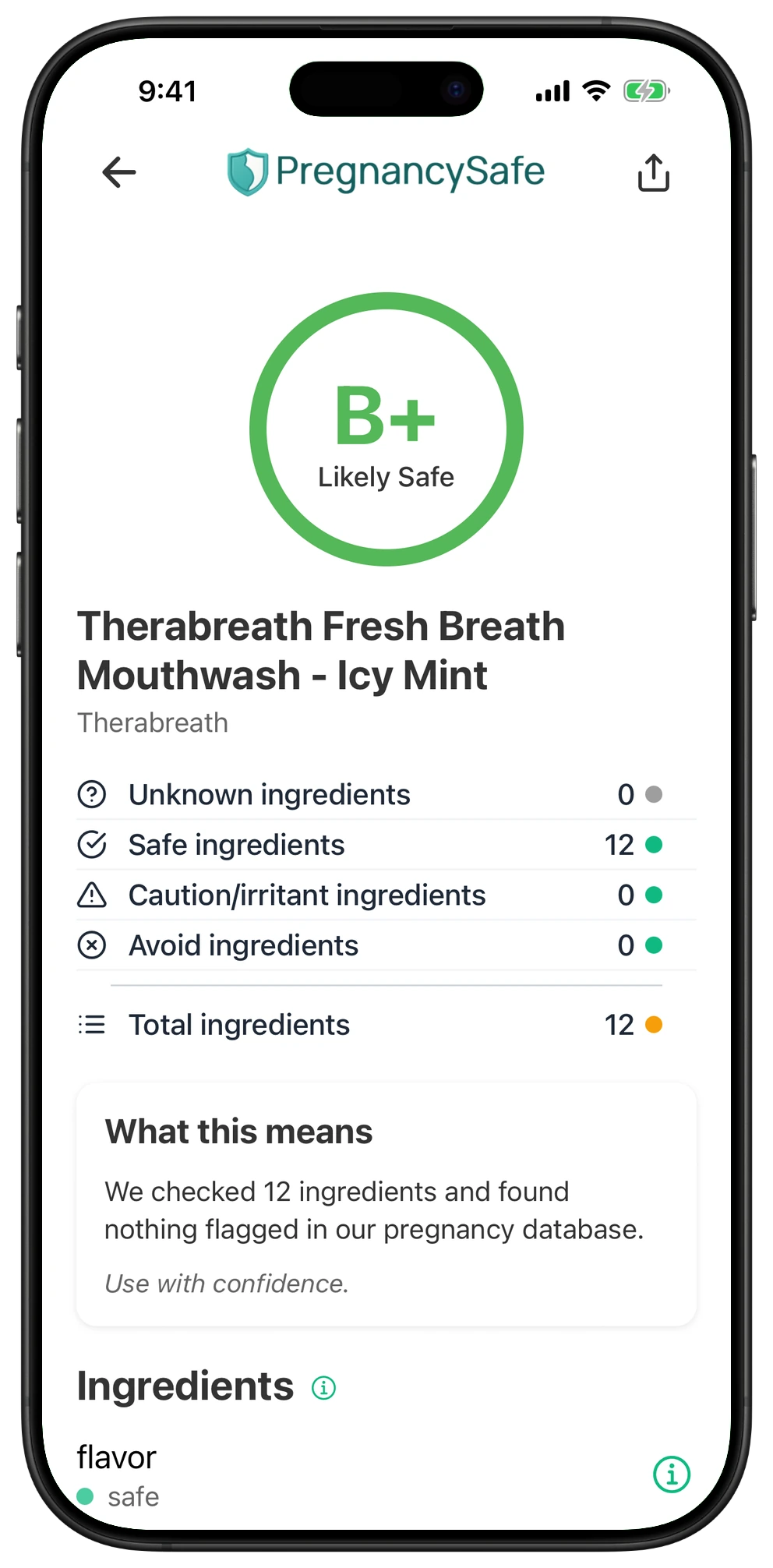
| B+ | Therabreath Fresh Breath Mouthwash - Icy Mint | Therabreath |
| A | Therabreath Healthy Mouthwash Rinse Mint | Therabreath |
| B+ | Therabreath Anticavity Fluoride Mouthwash - Sparkle Mint | Therabreath |
| B+ | Therabreath Whitening Mint Mouthwash - Dazzling Mint | Therabreath |
| B+ | Therabreath Fresh Breath Mouthwash - Mild Mint | Therabreath |
Your Questions Answered
Is mouthwash safe to use during pregnancy?
Mouthwash can be an adjunct to your pregnancy dental routine when you follow the exact product directions and spit it out. Choose the formulation for your dental needs rather than assuming all rinses are equivalent. Alcohol free options can reduce unwanted exposure and irritation. Mouthwash does not replace fluoride brushing, flossing or dental treatment.
Are alcohol based mouthwashes the same risk as drinking alcohol?
No brief rinsing followed by spitting is a different exposure from drinking alcohol. Guidance to avoid alcoholic beverages should not be turned into a claim that directed mouthwash use causes the same harm. An alcohol free rinse is a practical way to avoid this ingredient and may be more comfortable if your mouth feels irritated. Do not swallow either type.
Should I choose fluoride mouthwash or a gum health rinse?
Choose according to the dental problem you are addressing. A fluoride anticavity rinse is not interchangeable with an antigingivitis rinse containing cetylpyridinium chloride. Check the active ingredient and purpose on the exact Drug Facts panel, even when similarly named bottles look alike. Your dentist can help decide whether you need either type.
Can I use whitening mouthwash while pregnant?
Whitening has separate elective use considerations from routine cavity or gum care. Hydrogen peroxide concentration, frequency and contact time matter, and stronger or repeated bleaching can irritate oral tissues. Limited pregnancy specific evidence does not establish fetal harm from a small, directed oral care exposure, but it also does not justify treating every whitening regimen as equivalent. Ask your dentist before starting elective whitening, and never substitute concentrated peroxide for mouthwash.
Does an A grade mean a mouthwash is verified safe for pregnancy?
No. Our catalog contains 189 A graded records, but these are ingredient scores, not counts of independently verified pregnancy safe mouthwashes. Records may include other product forms or incomplete information, neither of which proves harm. Check the exact label, intended route and directions; a low grade alone also does not mean a dentist recommended rinse is contraindicated.
Can mouthwash replace dental care for bleeding gums or tooth pain?
No mouthwash is an adjunct, not a replacement for brushing, flossing or professional evaluation. Routine dental care remains important and is safe throughout pregnancy. Do not delay treatment for pain or infection because you are pregnant. Ask your dentist whether a medicated rinse is appropriate rather than trying to manage the problem with mouthwash alone.
How to Interpret These Ratings
Our ingredient and category rules generate letter grades from the information recorded in the catalog. Missing ingredients and broad category assignments can affect the result. These grades do not measure your dose, confirm a complete current label, or test a product for contamination.
A high grade is not a guarantee of pregnancy safety. A low grade is not, by itself, proof of harm from every use. Follow the product-specific guidance above, check the actual package, and ask your prenatal clinician about supplements, treatment decisions or uncertain exposures.
People Also Checked
References
- https://www.ada.org/resources/ada-library/oral-health-topics/pregnancy
- https://www.ada.org/resources/ada-library/oral-health-topics/mouthrinse-mouthwash
- https://www.fda.gov/food/food-additives-petitions/aspartame-and-other-sweeteners-food
- https://apps.who.int/food-additives-contaminants-jecfa-database/Home/Chemical/3164
- https://www.efsa.europa.eu/en/news/saccharin-safety-threshold-increased
- https://pubmed.ncbi.nlm.nih.gov/34500483/
- https://pubmed.ncbi.nlm.nih.gov/3756841/
- https://pubmed.ncbi.nlm.nih.gov/32275895/
- https://www.acog.org/womens-health/experts-and-stories/ask-acog/are-diet-drinks-a-good-choice
- https://pubmed.ncbi.nlm.nih.gov/22777177/
- https://health.ec.europa.eu/system/files/2022-08/sccs_o_255.pdf
- https://www.accessdata.fda.gov/drugsatfda_docs/omuf/monographs/OTC%20Monograph_M017-External%20Analgesic%20Drug%20Products%20for%20OTC%20Human%20Use%2005.02.2023.pdf
- https://dailymed.nlm.nih.gov/dailymed/drugInfo.cfm?setid=1ce438e4-595c-482f-9d35-529b65b01503
- https://www.fda.gov/files/drugs/published/N22-029S012-Methyl-salicylate-Clinical-2-PREA.pdf
- https://www.fda.gov/drugs/drug-safety-and-availability/fda-recommends-avoiding-use-nsaids-pregnancy-20-weeks-or-later-because-they-can-result-low-amniotic
- https://mothertobaby.org/fact-sheets/regular-strength-aspirin/
- https://pubmed.ncbi.nlm.nih.gov/16355417/
- https://medlineplus.gov/ency/article/002683.htm
- https://www.vumc.org/poison-control/toxicology-question-week/june-25-2018-how-much-muscle-rub-too-much
- https://www.hfpappexternal.fda.gov/scripts/fdcc/index.cfm?id=FDCBlue1&set=ColorAdditives
- https://www.ecfr.gov/current/title-21/chapter-I/subchapter-A/part-74
- https://www.fda.gov/food/color-additives-information-consumers/tracking-food-industry-pledges-remove-petroleum-based-food-dyes
- https://efsa.onlinelibrary.wiley.com/doi/10.2903/j.efsa.2010.1853
- https://apps.who.int/food-additives-contaminants-jecfa-database/Home/Chemical/3309
- https://pubmed.ncbi.nlm.nih.gov/23208798/
- https://pubmed.ncbi.nlm.nih.gov/24257113/
- https://oehha.ca.gov/risk-assessment/report/health-effects-assessment-potential-neurobehavioral-effects-synthetic-food-dyes-children
- https://www.hfpappexternal.fda.gov/scripts/fdcc/index.cfm?id=FDCGreen3&set=ColorAdditives
- https://www.ecfr.gov/current/title-21/part-74/section-74.203
- https://apps.who.int/food-additives-contaminants-jecfa-database/Home/Chemical/1356
- https://www.inchem.org/documents/jecfa/jecmono/v75je01.pdf
- https://www.federalregister.gov/documents/2013/11/08/2013-26760/fdandc-green-no-3-exemption-from-the-requirement-of-a-tolerance
- https://pubmed.ncbi.nlm.nih.gov/5975245/
- https://pubmed.ncbi.nlm.nih.gov/27092991/
- https://pubmed.ncbi.nlm.nih.gov/40962213/
- https://www.fda.gov/cosmetics/cosmetic-ingredients/parabens-cosmetics
- https://health.ec.europa.eu/system/files/2023-12/sccs_o_276_final.pdf
- https://pubmed.ncbi.nlm.nih.gov/19101832/
- https://pubmed.ncbi.nlm.nih.gov/32283359/
- https://pubmed.ncbi.nlm.nih.gov/33477047/
- https://pubmed.ncbi.nlm.nih.gov/36709902/
- https://pubmed.ncbi.nlm.nih.gov/40117576/
- https://pubmed.ncbi.nlm.nih.gov/27156397/
- https://health.ec.europa.eu/publications/propylparaben_en
- https://journals.sagepub.com/doi/10.1177/1091581820925001
- https://pubmed.ncbi.nlm.nih.gov/32279061/
- https://pubmed.ncbi.nlm.nih.gov/30412856/
- https://pubmed.ncbi.nlm.nih.gov/32521303/
- https://pubmed.ncbi.nlm.nih.gov/35487354/
- https://pubmed.ncbi.nlm.nih.gov/16097138/
- https://www.nccih.nih.gov/health/aloe-vera
- https://webprod.hc-sc.gc.ca/nhpid-bdipsn/dbImages/mono_aloe--oral_english.pdf
- https://www.ema.europa.eu/en/documents/herbal-monograph/final-european-union-herbal-monograph-aloe-barbadensis-mill-and-aloe-various-species-mainly-aloe-ferox-mill-and-its-hybrids-folii-succus-siccatus_en.pdf
- https://www.utep.edu/herbal-safety/populations/herbs-to-avoid-during-pregnancy.html
- https://www.federalregister.gov/documents/2002/05/09/02-11510/status-of-certain-additional-over-the-counter-drug-category-ii-and-iii-active-ingredients
- https://pubmed.ncbi.nlm.nih.gov/33164294/
- https://pubmed.ncbi.nlm.nih.gov/28139161/
- https://journals.sagepub.com/doi/10.1080/10915810701351186
- https://pmc.ncbi.nlm.nih.gov/articles/PMC8884185/
- https://pmc.ncbi.nlm.nih.gov/articles/PMC3114665/
- https://journals.sagepub.com/doi/10.1177/10915818241237790
- https://wwwn.cdc.gov/TSP/MMG/MMGDetails.aspx?mmgid=304&toxid=55
- https://www.gov.uk/government/publications/hydrogen-peroxide-properties-incident-management-and-toxicology/hydrogen-peroxide-general-information
- https://dailymed.nlm.nih.gov/dailymed/lookup.cfm?setid=2c48f58a-a2d1-4a28-8dbf-a9d2c620bca6
- https://ec.europa.eu/health/ph_risk/committees/04_sccp/docs/sccp_o_122.pdf
- https://pubmed.ncbi.nlm.nih.gov/38914633/
- https://www.hfpappexternal.fda.gov/scripts/fdcc/index.cfm?id=FDCRed40&set=ColorAdditives
- https://www.ecfr.gov/current/title-21/chapter-I/subchapter-A/part-74/subpart-A/section-74.340
- https://www.efsa.europa.eu/en/efsajournal/pub/1327
- https://www.efsa.europa.eu/en/efsajournal/pub/4007
- https://apps.who.int/food-additives-contaminants-jecfa-database/Home/Chemical/2361
- https://pubmed.ncbi.nlm.nih.gov/6636206/
- https://pubmed.ncbi.nlm.nih.gov/2613118/
- https://pubmed.ncbi.nlm.nih.gov/7940558/