Is Hot Chocolate Safe During Pregnancy? (Updated 2026 Guide)
Updated September 9, 2026
The Answer
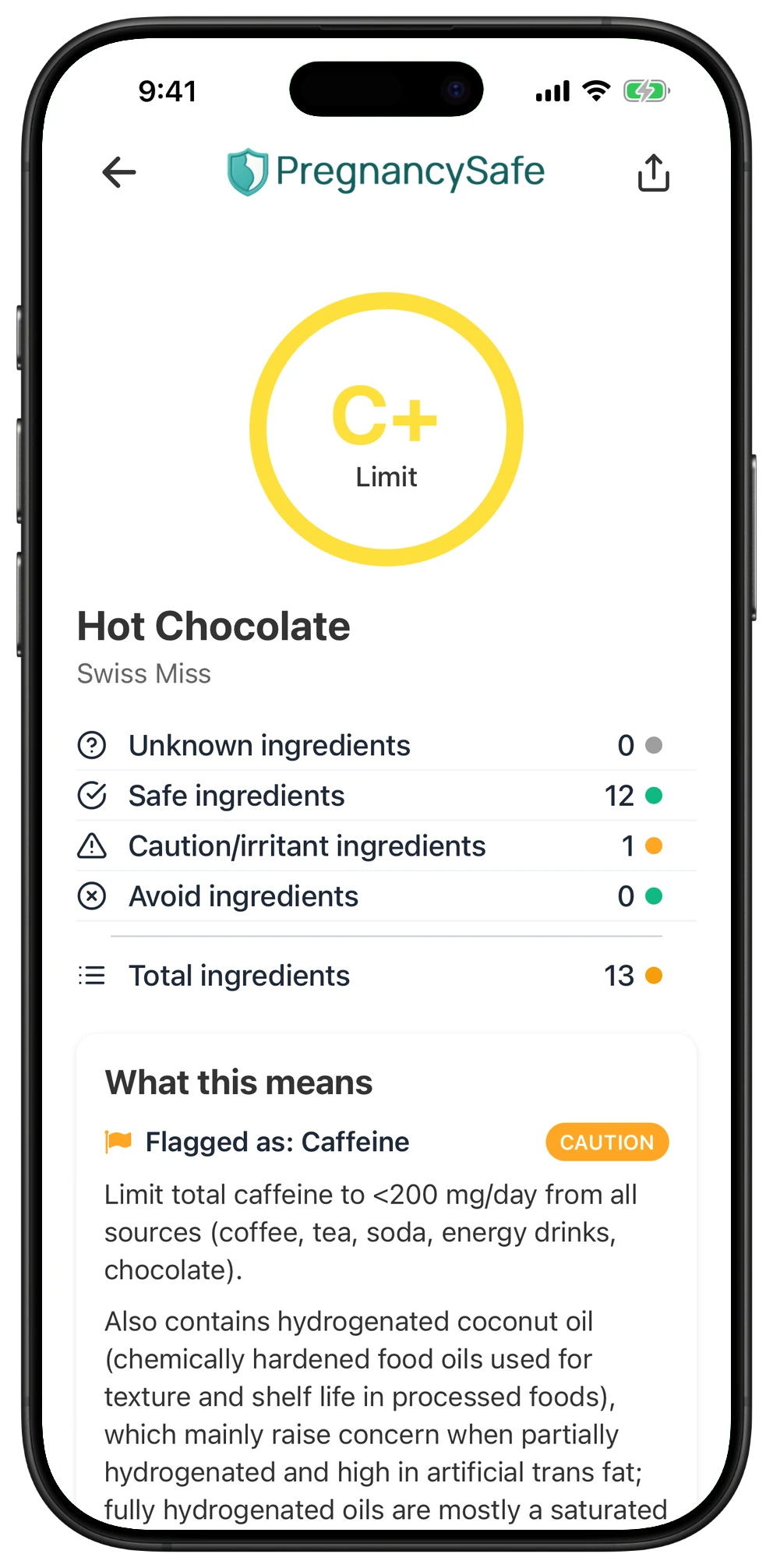
Yes, you can drink hot chocolate during pregnancy, but count its caffeine toward a daily total below 200 mg from all sources. Use pasteurized milk and check your serving size, especially when the drink includes added coffee or espresso.
Cocoa contains caffeine, and the amount you drink depends on the recipe, strength and serving size not its ingredient grade. Prepare milk containing drinks with pasteurized milk, and treat sugar or high fructose corn syrup as nutrition considerations rather than pregnancy toxins. Partially hydrogenated oils warrant avoidance because of industrial trans fat; food dye concerns involve limited pregnancy evidence, not established fetal harm from occasional ordinary food exposure.
Pregnancy Safe is 100% independent and research driven. No companies pay to promote or sponsor products.
Stress Less This Pregnancy
Check your exact hot chocolate in the app

✓ What's Safe
- • Use pasteurized milk when making hot chocolate, and ask cafés which milk they use.
- • Check caffeine information for the exact drink and size; include cocoa and any added espresso in your daily total below 200 mg.
- • Measure the powder or chocolate you use rather than assuming every mug contains one serving.
- • Compare added sugar per prepared serving, including syrups, marshmallows and other toppings.
- • Read the current package label and preparation instructions, even when you have bought the same version before.
✗ What to Avoid
- • Avoid hot chocolate made with unpasteurized milk.
- • Avoid adding espresso or coffee without accounting for its caffeine alongside the cocoa.
- • Avoid assuming a large mug, a decaf ingredient or an A grade means the finished drink contains little or no caffeine.
- • Avoid partially hydrogenated oils; if hydrogenated coconut oil is listed without clarification, do not assume it is partially hydrogenated. Fully hydrogenated oil mainly raises a saturated fat consideration.
- • Limit frequent oversized, heavily sweetened servings, whether the sweetener is sugar, corn syrup or high fructose corn syrup.
- • Do not assume concentrated cocoa extract supplements have the same pregnancy guidance as ordinary hot chocolate.
Most Common Ingredients in Hot Chocolate Products
We analyzed 145 hot chocolate products. Here are the most common ingredients, ranked by how often they appear:
Ingredients to Watch Out For in Hot Chocolate
These are the most common flagged ingredients across 145 hot chocolate products we analyzed.
hydrogenated coconut oil
Caution
Hydrogenated coconut oil is a processed form of coconut oil that has been chemically altered to become solid at room temperature, often used in baking and processed foods.
Mainly raise concern when partially hydrogenated and high in artificial trans fat; fully hydrogenated oils are mostly a saturated fat limit rather than the same trans fat issue.
Flagged in 14 of 145 products (10%)
Caution
Red 40 is a synthetic food dye commonly used to add vibrant red color to candies, beverages, and processed foods.
Has limited human pregnancy data and is allowed at regulated food additive levels, but child neurobehavior concerns and high dose animal findings make frequent high dye intake worth limiting.
Flagged in 14 of 145 products (10%)
blue 1
Caution
Blue 1 is a synthetic blue dye commonly used to add vibrant color to foods, beverages, and cosmetics.
Has limited human pregnancy data; regulated food use is not shown to cause fetal harm, but high dose animal neurobehavior findings and child sensitivity concerns support minimizing frequent exposure.
Flagged in 13 of 145 products (9%)
red 40 lake
Caution
Red 40 Lake is a synthetic colorant used to impart a vibrant red hue to food, beverages, and cosmetics.
Has limited human pregnancy data and is allowed at regulated food additive levels, but child neurobehavior concerns and high dose animal findings make frequent high dye intake worth limiting.
Flagged in 10 of 145 products (7%)
yellow 5
Caution
Yellow 5 is a synthetic food dye used to impart a bright yellow color to various processed foods and beverages.
Has limited human pregnancy data, rare hypersensitivity labeling concerns, and animal/children's neurobehavior signals despite regulated dietary use under ADI based limits.
Flagged in 8 of 145 products (6%)
yellow 5 lake
Caution
Yellow 5 Lake is a synthetic, orange colored dye used to add vibrant color to foods, beverages, and cosmetics.
Has limited human pregnancy data, rare hypersensitivity labeling concerns, and animal/children's neurobehavior signals despite regulated dietary use under ADI based limits.
Flagged in 8 of 145 products (6%)
red 3
Caution
Red 3 is a synthetic red dye commonly used to add vibrant color to food and beverages.
Has limited human pregnancy outcome data and is being phased out of U.S. foods and ingested drugs after high dose male rat thyroid tumor findings.
Flagged in 7 of 145 products (5%)
high fructose corn syrup
Caution
High fructose corn syrup is a sweet, liquid sweetener made from corn starch, commonly used in processed foods and beverages.
Is not a known teratogen at occasional food amounts, but high added sugar intake can displace nutrients and raise gestational diabetes and metabolic concerns.
Flagged in 3 of 145 products (2%)
Hot Chocolate Products We've Analyzed
Our catalog contains ratings for 145 hot chocolate products. These are database grades, not independent safety certifications.
Catalog ingredient grades do not measure current-label completeness, pathogens, preparation, caffeine or clinical pregnancy suitability. These counts include unreviewed records and are not a percentage of independently verified safe products.
Pregnancy Safe Hot Chocolate Products
Popular options from our catalog, prioritizing A and B ingredient grades, with C grade options used to fill remaining places. Within each group, products are ordered by searches in Pregnancy Safe, not retail sales. Read the cautions and guidance above; grades do not verify a complete current label or guarantee pregnancy safety.
| Grade | Product | Brand |
|---|---|---|
| A | Mexican Hot Chocolate | Cafe Mate |
| A | Cookies And Cream Flavour Hot Chocolate | Whittard |
| A | Galaxy Instant Hot Chocolate | Galaxy |
| A | Cadbury Instant Hot Choc Blend | Cadbury |
| A | Hot Chocolate With Espresso Shot - Large | Dunkin |
Your Questions Answered
Can I eat hot chocolate when pregnant?
Yes whether you mean drinking prepared hot chocolate or eating the chocolate used to make it, count caffeine from cocoa toward your daily total below 200 mg. The amount depends on the portion and formulation, so there is no universal safe number of mugs or chocolate pieces. Use pasteurized milk for milk containing drinks and consider added sugar when choosing portions.
Can you drink packaged instant hot chocolate while pregnant?
Packaged instant hot chocolate can fit into pregnancy eating, but check the exact version rather than relying on a brand name. Follow its preparation instructions, use pasteurized milk if adding dairy, and check available caffeine information. Include toppings and the milk you add when assessing the prepared drink's sugar and carbohydrate content.
How much hot chocolate can I drink during pregnancy?
There is no fixed cup limit that works for every hot chocolate. Keep total caffeine below 200 mg daily, counting coffee, tea, soda, chocolate and any espresso added to your drink. Check the manufacturer's or café's information for your exact serving; an unknown caffeine amount should not be treated as zero.
Can I make homemade hot chocolate during pregnancy?
Yes, homemade hot chocolate lets you control the amount of cocoa, sugar and toppings. Use pasteurized milk and measure ingredients so you know the portion you are making. Homemade does not mean caffeine free, and ordinary cocoa in food should not be treated as interchangeable with concentrated extract supplements.
Does chocolate liquor mean hot chocolate contains alcohol?
No chocolate liquor means cocoa mass, not beverage alcohol. Its presence on an ingredient label does not mean the drink is alcoholic. It also does not mean the drink is caffeine free, so continue to account for cocoa when planning your daily caffeine intake.
Should I avoid food dyes in hot chocolate toppings?
Choosing plain toppings is a practical way to reduce frequent exposure to red 40, blue 1 or yellow 5. Human pregnancy evidence is limited, and findings in children or high dose animal studies do not establish fetal harm from occasional regulated food exposure. Red 3 has a separate concern based on high dose male rat thyroid tumors, not a proven pregnancy effect. These distinctions support limiting unnecessary dye intake without treating an occasional decorated drink as evidence of harm.
Does an A grade mean a hot chocolate is verified safe for pregnancy?
No. Our catalog contains 145 hot chocolate products, including 61 with an A ingredient grade, but those grades do not measure caffeine, preparation safety, pathogens or current label completeness. The counts include unreviewed records and are not a tally of independently verified pregnancy safe drinks. Likewise, a lower grade or an incomplete record does not by itself prove a product is harmful.
How to Interpret These Ratings
Our ingredient and category rules generate letter grades from the information recorded in the catalog. Missing ingredients and broad category assignments can affect the result. These grades do not measure your dose, confirm a complete current label, or test a product for contamination.
A high grade is not a guarantee of pregnancy safety. A low grade is not, by itself, proof of harm from every use. Follow the product-specific guidance above, check the actual package, and ask your prenatal clinician about supplements, treatment decisions or uncertain exposures.
People Also Checked
References
- https://www.acog.org/womens-health/experts-and-stories/ask-acog/how-much-coffee-can-i-drink-while-pregnant
- https://www.acog.org/clinical/clinical-guidance/committee-opinion/articles/2010/08/moderate-caffeine-consumption-during-pregnancy
- https://www.nhs.uk/pregnancy/keeping-well/foods-to-avoid/
- https://www.fda.gov/food/food-additives-petitions/trans-fat
- https://www.fda.gov/food/hfp-constituent-updates/fda-completes-final-administrative-actions-partially-hydrogenated-oils-foods
- https://www.federalregister.gov/documents/2013/11/08/2013-26854/tentative-determination-regarding-partially-hydrogenated-oils-request-for-comments-and-for
- https://www.who.int/news-room/fact-sheets/detail/trans-fat
- https://cdn.realfood.gov/DGA.pdf
- https://www.fda.gov/food/people-risk-foodborne-illness/dietary-advice-and-during-pregnancy
- https://www.rcpi.ie/Portals/0/Document%20Repository/Institute%20of%20Obstetricians%20and%20Gynaecologists/National%20Clinical%20Guidelines/IOG_National%20Clinical%20Guidelines_Nutrition%20in%20pregnancy%20Guideline_2019.pdf
- https://pmc.ncbi.nlm.nih.gov/articles/PMC8027310/
- https://pmc.ncbi.nlm.nih.gov/articles/PMC3192475/
- https://www.hfpappexternal.fda.gov/scripts/fdcc/index.cfm?id=FDCRed40&set=ColorAdditives
- https://www.ecfr.gov/current/title-21/chapter-I/subchapter-A/part-74/subpart-A/section-74.340
- https://www.fda.gov/food/color-additives-information-consumers/tracking-food-industry-pledges-remove-petroleum-based-food-dyes
- https://www.efsa.europa.eu/en/efsajournal/pub/1327
- https://www.efsa.europa.eu/en/efsajournal/pub/4007
- https://apps.who.int/food-additives-contaminants-jecfa-database/Home/Chemical/2361
- https://oehha.ca.gov/risk-assessment/report/health-effects-assessment-potential-neurobehavioral-effects-synthetic-food-dyes-children
- https://pubmed.ncbi.nlm.nih.gov/6636206/
- https://pubmed.ncbi.nlm.nih.gov/2613118/
- https://pubmed.ncbi.nlm.nih.gov/7940558/
- https://www.hfpappexternal.fda.gov/scripts/fdcc/index.cfm?id=FDCBlue1&set=ColorAdditives
- https://www.ecfr.gov/current/title-21/chapter-I/subchapter-A/part-74
- https://efsa.onlinelibrary.wiley.com/doi/10.2903/j.efsa.2010.1853
- https://apps.who.int/food-additives-contaminants-jecfa-database/Home/Chemical/3309
- https://pubmed.ncbi.nlm.nih.gov/23208798/
- https://pubmed.ncbi.nlm.nih.gov/24257113/
- https://hfpappexternal.fda.gov/scripts/fdcc/index.cfm?id=FDCYellow5&set=ColorAdditives
- https://www.ecfr.gov/current/title-21/chapter-I/subchapter-A/part-74#74.705
- https://www.fda.gov/food/nutrition-food-labeling-and-critical-foods/food-allergies
- https://apps.who.int/food-additives-contaminants-jecfa-database/Home/Chemical/3885
- https://efsa.onlinelibrary.wiley.com/doi/10.2903/j.efsa.2009.1331
- https://pubmed.ncbi.nlm.nih.gov/1628860/
- https://pmc.ncbi.nlm.nih.gov/articles/PMC7023231/
- https://pmc.ncbi.nlm.nih.gov/articles/PMC6354951/
- https://www.fda.gov/industry/color-additives/fdc-red-no-3
- https://www.federalregister.gov/documents/2025/01/16/2025-00830/color-additive-petition-from-center-for-science-in-the-public-interest-et-al-request-to-revoke-color
- https://efsa.onlinelibrary.wiley.com/doi/10.2903/j.efsa.2011.1854
- https://pubmed.ncbi.nlm.nih.gov/2824305/
- https://pubmed.ncbi.nlm.nih.gov/2177442/
- https://pubmed.ncbi.nlm.nih.gov/8296313/
- https://pubmed.ncbi.nlm.nih.gov/8386132/
- https://pmc.ncbi.nlm.nih.gov/articles/PMC9368057/
- https://www.dietaryguidelines.gov/sites/default/files/2021-12/DGA_Pregnancy_FactSheet-508c.pdf
- https://www.acog.org/womens-health/faqs/healthy-eating-during-pregnancy
- https://www.cdc.gov/nutrition/php/data-research/added-sugars.html
- https://www.cdc.gov/diabetes/about/gestational-diabetes.html
- https://www.who.int/publications/i/item/9789241549028
- https://nesr.usda.gov/2025-dietary-guidelines-advisory-committee-systematic-reviews/dietary-patterns_gestational-diabetes