Is Dark Chocolate Safe During Pregnancy? (Updated 2026 Guide)
Updated September 9, 2026
The Answer
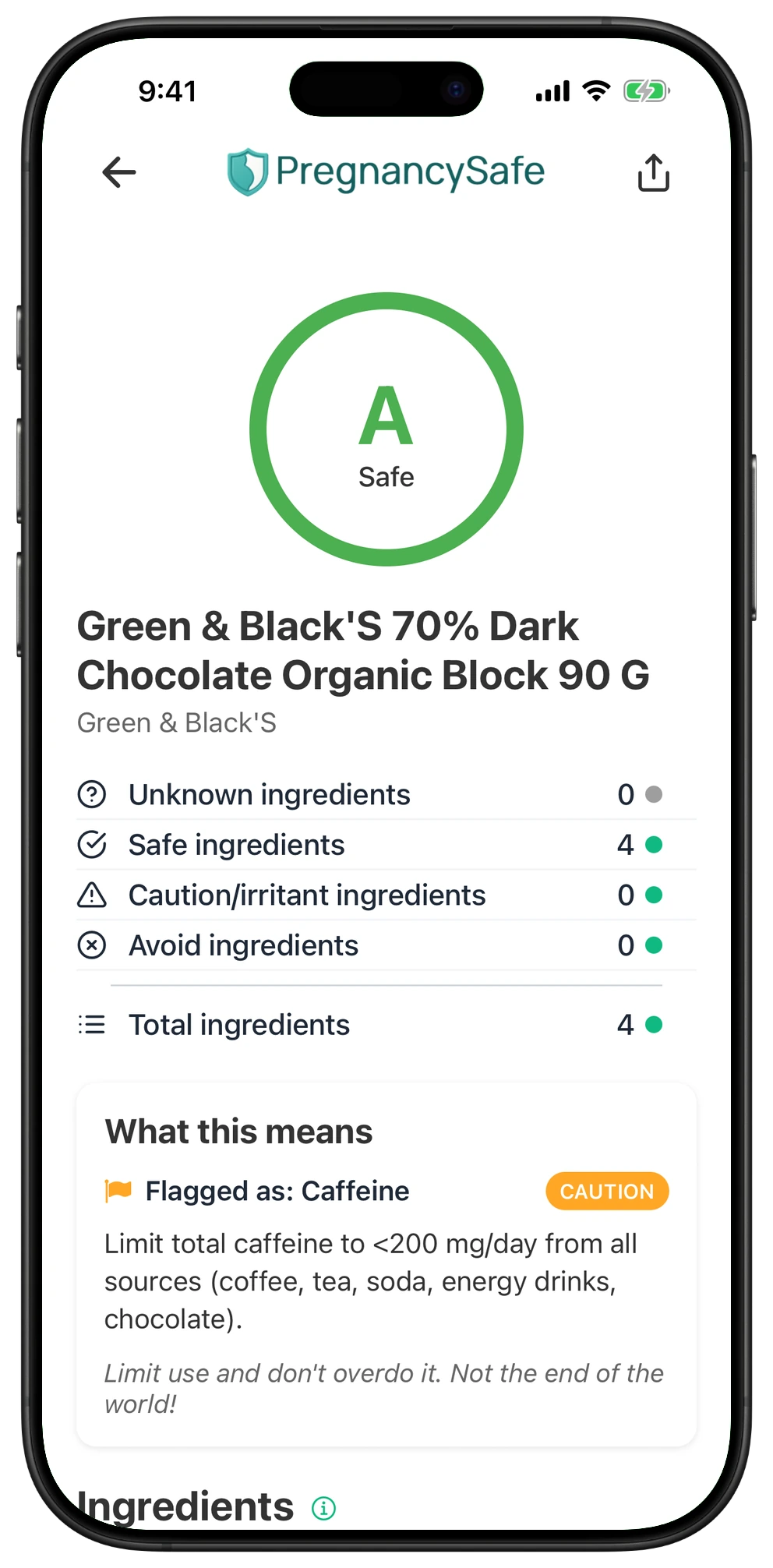
Yes, you can eat ordinary dark chocolate during pregnancy in modest portions, while keeping total caffeine below 200 mg a day from all sources. Avoid CBD infused varieties and alcoholic fillings; cocoa percentage alone cannot tell you the caffeine dose.
The main pregnancy consideration is caffeine: your portion of dark chocolate counts alongside coffee, tea, soda and other sources toward a daily total below 200 mg. Avoid added CBD, including cannabidiol isolate, and choose chocolates without alcoholic fillings; trace alcohol used in flavoring is a different exposure from beverage alcohol. Added sugars, including high fructose corn syrup, are a nutrition consideration rather than a pregnancy toxin at occasional food amounts.
Pregnancy Safe is 100% independent and research driven. No companies pay to promote or sponsor products.
Stress Less This Pregnancy
Check your exact dark chocolate in the app

✓ What's Safe
- • Choose a modest portion and check the serving weight rather than assuming every chocolate square is the same size.
- • Look for caffeine information for the exact chocolate and serving, or ask the manufacturer; include it in your daily caffeine total.
- • Read the current package's full ingredient list, including fillings, for CBD and added alcohol.
- • Compare added sugars using equal serving weights, and choose an amount that fits your overall diet.
- • Choose ordinary food chocolate rather than treating concentrated cocoa extracts or supplements as equivalent.
✗ What to Avoid
- • Avoid CBD infused chocolate, including products listing cannabidiol isolate, even if described as THC free.
- • Avoid liqueur or other alcoholic fillings; if ethyl alcohol is listed, clarify its use rather than assuming a trace flavoring and an alcoholic filling are equivalent.
- • Avoid portions that bring your total daily caffeine to 200 mg or more, including caffeine from drinks.
- • Avoid assuming a higher cocoa percentage or an A grade establishes a measured caffeine level or low heavy metal exposure.
- • Avoid frequent large portions high in added sugars, including high fructose corn syrup; occasional exposure is not a pregnancy poisoning concern.
Most Common Ingredients in Dark Chocolate Products
We analyzed 176 dark chocolate products. Here are the most common ingredients, ranked by how often they appear:
Ingredients to Watch Out For in Dark Chocolate
These are the most common flagged ingredients across 176 dark chocolate products we analyzed.
cannabidiol isolate
Avoid
Cannabidiol isolate is a pure, crystalline form of CBD that contains no THC or other cannabinoids.
Should be avoided in pregnancy because CBD specific human data are limited, FDA and CDC advise against use, and products may contain THC or contaminants; prescription Epidiolex requires clinician directed benefit risk review.
Flagged in 2 of 176 products (1%)
ethyl alcohol
Avoid
Ethyl alcohol is a colorless, volatile, and flammable organic compound commonly used as a solvent, disinfectant, and in alcoholic beverages.
Has no established safe amount in pregnancy and is linked to fetal alcohol spectrum disorders and other adverse pregnancy outcomes.
Flagged in 1 of 176 products (1%)
high fructose corn syrup
Caution
High fructose corn syrup is a sweet, liquid sweetener made from corn starch, commonly used in processed foods and beverages.
Is not a known teratogen at occasional food amounts, but high added sugar intake can displace nutrients and raise gestational diabetes and metabolic concerns.
Flagged in 1 of 176 products (1%)
Dark Chocolate Products We've Analyzed
Our catalog contains ratings for 176 dark chocolate products. These are database grades, not independent safety certifications.
Catalog ingredient grades do not measure current-label completeness, pathogens, preparation, caffeine or clinical pregnancy suitability. These counts include unreviewed records and are not a percentage of independently verified safe products.
Pregnancy Safe Dark Chocolate Products
Popular options from our catalog, prioritizing A and B ingredient grades, with C grade options used to fill remaining places. Within each group, products are ordered by searches in Pregnancy Safe, not retail sales. Read the cautions and guidance above; grades do not verify a complete current label or guarantee pregnancy safety.
| Grade | Product | Brand |
|---|---|---|
| A | Green & Black'S 70% Dark Chocolate Organic Block | Green & Black'S |
| A | Excellence 70% Cocoa Dark Chocolate | Lindt |
| A | 72% Dark Chocolate | Trader Joe'S |
| A | Single Origin Organic Dark Chocolate | Trader Joe'S |
| A | 64% Cocoa Peru Origin Belgian Dark Chocolate | — |
Your Questions Answered
How much dark chocolate can I eat during pregnancy?
There is no single portion that fits every bar and every day's caffeine intake. Keep total caffeine below 200 mg a day, counting chocolate alongside coffee, tea, soda and other sources. Check caffeine information for the exact product when available, and choose a modest portion rather than assuming a fixed number of squares is always suitable.
Which chocolate is not good for pregnancy?
Avoid CBD infused chocolate and chocolate with alcoholic fillings. CBD specific human pregnancy evidence is limited, and FDA and CDC advise avoiding CBD during pregnancy, including products marketed as THC free. Ordinary dark chocolate mainly calls for attention to caffeine and portions, not blanket avoidance. High added sugar content is a dietary consideration, not proof that an occasional serving is harmful.
Which dark chocolate is good for pregnancy?
Choose ordinary dark chocolate without added CBD or alcoholic fillings, and check the current label. Look for a portion that fits your caffeine intake and dietary needs. Neither cocoa percentage nor an ingredient grade establishes pregnancy safety or a measured caffeine or heavy metal dose. A listed product is not a safety guarantee for your current package.
Is 85% dark chocolate safer than 70% during pregnancy?
Cocoa percentage alone does not establish which chocolate is more suitable during pregnancy. It cannot give you a measured caffeine, lead or cadmium dose. Compare the actual serving size, added sugars and any available product specific caffeine information rather than choosing by percentage alone.
Should I worry about lead and cadmium in dark chocolate?
You cannot determine a chocolate's lead or cadmium level from its cocoa percentage or ingredient grade. Those details do not establish that every dark chocolate contains harmful amounts, either. No lot testing was performed for this comparison, so it cannot identify low metal products or quantify your exposure.
Can I eat dark chocolate if I have gestational diabetes?
Ask your care team how a portion fits your individualized carbohydrate plan rather than assuming all dark chocolate is off limits. Check total carbohydrate and serving size, not just cocoa percentage or a no added sugar claim. High fructose corn syrup is an added sugar, but replacing it with another sugar does not remove the need to account for carbohydrates. The caffeine limit still applies.
Does an A grade mean dark chocolate is verified safe during pregnancy?
No. Our catalog contains 176 dark chocolate products, including 171 with an A ingredient grade, but these are not counts of independently verified safe products. Grades do not measure caffeine, pathogens, preparation, current label completeness or clinical pregnancy suitability. Read your actual package and follow the caffeine and ingredient precautions regardless of grade.
How to Interpret These Ratings
Our ingredient and category rules generate letter grades from the information recorded in the catalog. Missing ingredients and broad category assignments can affect the result. These grades do not measure your dose, confirm a complete current label, or test a product for contamination.
A high grade is not a guarantee of pregnancy safety. A low grade is not, by itself, proof of harm from every use. Follow the product-specific guidance above, check the actual package, and ask your prenatal clinician about supplements, treatment decisions or uncertain exposures.
People Also Checked
References
- https://www.acog.org/womens-health/experts-and-stories/ask-acog/how-much-coffee-can-i-drink-while-pregnant
- https://www.acog.org/clinical/clinical-guidance/committee-opinion/articles/2010/08/moderate-caffeine-consumption-during-pregnancy
- https://www.nhs.uk/pregnancy/keeping-well/foods-to-avoid/
- https://www.fda.gov/consumers/consumer-updates/what-you-should-know-about-using-cannabis-including-cbd-when-pregnant-or-breastfeeding
- https://www.cdc.gov/cannabis/about/about-cbd.html
- https://www.cdc.gov/cannabis/health-effects/pregnancy.html
- https://mothertobaby.org/fact-sheets/marijuana-pregnancy/
- https://www.acog.org/clinical/clinical-guidance/clinical-consensus/articles/2025/10/cannabis-use-during-pregnancy-and-lactation
- https://www.accessdata.fda.gov/drugsatfda_docs/label/2024/210365s021lbl.pdf
- https://pmc.ncbi.nlm.nih.gov/articles/PMC12053797/
- https://www.fda.gov/consumers/consumer-updates/what-you-need-know-and-what-were-working-find-out-about-products-containing-cannabis-or-cannabis
- https://pubmed.ncbi.nlm.nih.gov/40454463/
- https://www.cdc.gov/alcohol-pregnancy/about/index.html
- https://www.cdc.gov/fasd/about/index.html
- https://www.acog.org/womens-health/infographics/alcohol-and-pregnancy
- https://www.niaaa.nih.gov/publications/brochures-and-fact-sheets/alcohol-and-your-pregnancy
- https://mothertobaby.org/fact-sheets/alcohol-pregnancy/
- https://pubmed.ncbi.nlm.nih.gov/26482673/
- https://pmc.ncbi.nlm.nih.gov/articles/PMC9543418/
- https://cdn.realfood.gov/DGA.pdf
- https://www.dietaryguidelines.gov/sites/default/files/2021-12/DGA_Pregnancy_FactSheet-508c.pdf
- https://www.acog.org/womens-health/faqs/healthy-eating-during-pregnancy
- https://www.cdc.gov/nutrition/php/data-research/added-sugars.html
- https://www.cdc.gov/diabetes/about/gestational-diabetes.html
- https://www.who.int/publications/i/item/9789241549028
- https://nesr.usda.gov/2025-dietary-guidelines-advisory-committee-systematic-reviews/dietary-patterns_gestational-diabetes