Is Crab Cakes Safe During Pregnancy? (Updated 2026 Guide)
Updated September 9, 2026
The Answer
Yes you can eat crab cakes during pregnancy when they are fully cooked and properly stored; even mixtures made with cooked crab may contain raw egg or other raw seafood. Our catalog contains 80 products with ingredient grades ranging from A to F, but those scores do not establish whether a meal is safely prepared.
Thorough cooking and safe handling are the main considerations: lower mercury does not eliminate foodborne illness risk, and a browned crust or seasoning color cannot confirm doneness. Follow package cooking instructions, refrigerate leftovers and reheat them to 165°F. Check allergens and recipe ingredients, but do not equate white wine in a cooked recipe with drinking wine or apply high dose supplement concerns to ordinary seasoning amounts.
Pregnancy Safe is 100% independent and research driven. No companies pay to promote or sponsor products.
Stress Less This Pregnancy
Check your exact crab cakes in the app

✓ What's Safe
- • Choose crab cakes with clear cooking and storage instructions, and check whether the package describes them as raw or fully cooked.
- • Use a food thermometer to check the center against the package's cooking instructions rather than judging by the crust.
- • At restaurants, ask for crab cakes cooked fully throughout and ask about ingredients if the recipe is unclear.
- • Refrigerate leftovers promptly and reheat them to 165°F before eating.
- • Read the current package for crab, wheat, egg, mustard and any other allergens you need to avoid.
- • Choose a recipe without added wine if you want to avoid uncertainty about residual alcohol.
✗ What to Avoid
- • Raw or undercooked crab cakes, including uncooked mixtures made with previously cooked crab.
- • Relying on golden breading, paprika color or cooking time alone to decide whether the center is done.
- • Crab cakes with uncertain refrigeration or handling, including leftovers left unrefrigerated.
- • Assuming a frozen crab cake is ready to eat without checking its preparation instructions.
- • Assuming all white wine or alcohol disappears during cooking; choose a wine free recipe when the amount and preparation are unclear.
- • Using an A grade as a substitute for checking cooking instructions, storage conditions or allergens.
Most Common Ingredients in Crab Cakes Products
We analyzed 80 crab cakes products. Here are the most common ingredients, ranked by how often they appear:
Ingredients to Watch Out For in Crab Cakes
These are the most common flagged ingredients across 80 crab cakes products we analyzed.
white wine
Avoid
White wine is a crisp, pale yellow alcoholic beverage made from fermented white grapes, often used to enhance the flavor of dishes or enjoyed on its own.
Has no established safe amount in pregnancy and is linked to fetal alcohol spectrum disorders and other adverse pregnancy outcomes.
Flagged in 15 of 80 products (19%)
high fructose corn syrup
Caution
High fructose corn syrup is a sweet, liquid sweetener made from corn starch, commonly used in processed foods and beverages.
Is not a known teratogen at occasional food amounts, but high added sugar intake can displace nutrients and raise gestational diabetes and metabolic concerns.
Flagged in 14 of 80 products (18%)
leavening sodium aluminum phosphate
Caution
Sodium aluminum phosphate is a leavening agent commonly used in baking to produce carbon dioxide and help baked goods rise.
Has developmental concern at higher chronic exposures, but regulated vaccine adjuvants and occasional clinician directed antacid use should be considered separately.
Flagged in 10 of 80 products (13%)
chili pepper extract
Caution
Chili pepper extract is a concentrated form of capsaicin rich compound derived from chili peppers, known for its spicy flavor and potential health benefits.
Has limited pregnancy data for concentrated extracts, supplements, and prescription strength topical products, while ordinary culinary peppers are handled separately.
Flagged in 7 of 80 products (9%)
partially hydrogenated soybean oil
Caution
Partially hydrogenated soybean oil is a processed fat commonly used in foods to improve texture and shelf life, but it contains trans fats linked to health risks.
Mainly raise concern when partially hydrogenated and high in artificial trans fat; fully hydrogenated oils are mostly a saturated fat limit rather than the same trans fat issue.
Flagged in 4 of 80 products (5%)
alcohol
Caution
Alcohol is a volatile, colorless liquid commonly used as a solvent, disinfectant, or intoxicating beverage.
No amount of Alcohol is considered safe. Avoid alcohol beverages entirely. Be extremely careful when using in cooking or even with small percentages.
Flagged in 3 of 80 products (4%)
hydrogenated cottonseed oil
Caution
Hydrogenated cottonseed oil is a processed vegetable oil made from cottonseed oil that has been chemically altered to become solid at room temperature, often used in processed foods.
Mainly raise concern when partially hydrogenated and high in artificial trans fat; fully hydrogenated oils are mostly a saturated fat limit rather than the same trans fat issue.
Flagged in 3 of 80 products (4%)
partially hydrogenated vegetable oil soybean and or cottonseed
Caution
Mainly raise concern when partially hydrogenated and high in artificial trans fat; fully hydrogenated oils are mostly a saturated fat limit rather than the same trans fat issue.
Flagged in 3 of 80 products (4%)
Crab Cakes Products We've Analyzed
Our catalog contains ratings for 80 crab cakes products. These are database grades, not independent safety certifications.
Grades are ingredient scores, not clinical verdicts or measurements of pathogens, dose, preparation or current package contents. Cohorts include unreviewed catalog records and counts are not independently verified safe-product totals.
Pregnancy Safe Crab Cakes Products
Popular options from our catalog, prioritizing A and B ingredient grades, with C grade options used to fill remaining places. Within each group, products are ordered by searches in Pregnancy Safe, not retail sales. Read the cautions and guidance above; grades do not verify a complete current label or guarantee pregnancy safety.
| Grade | Product | Brand |
|---|---|---|
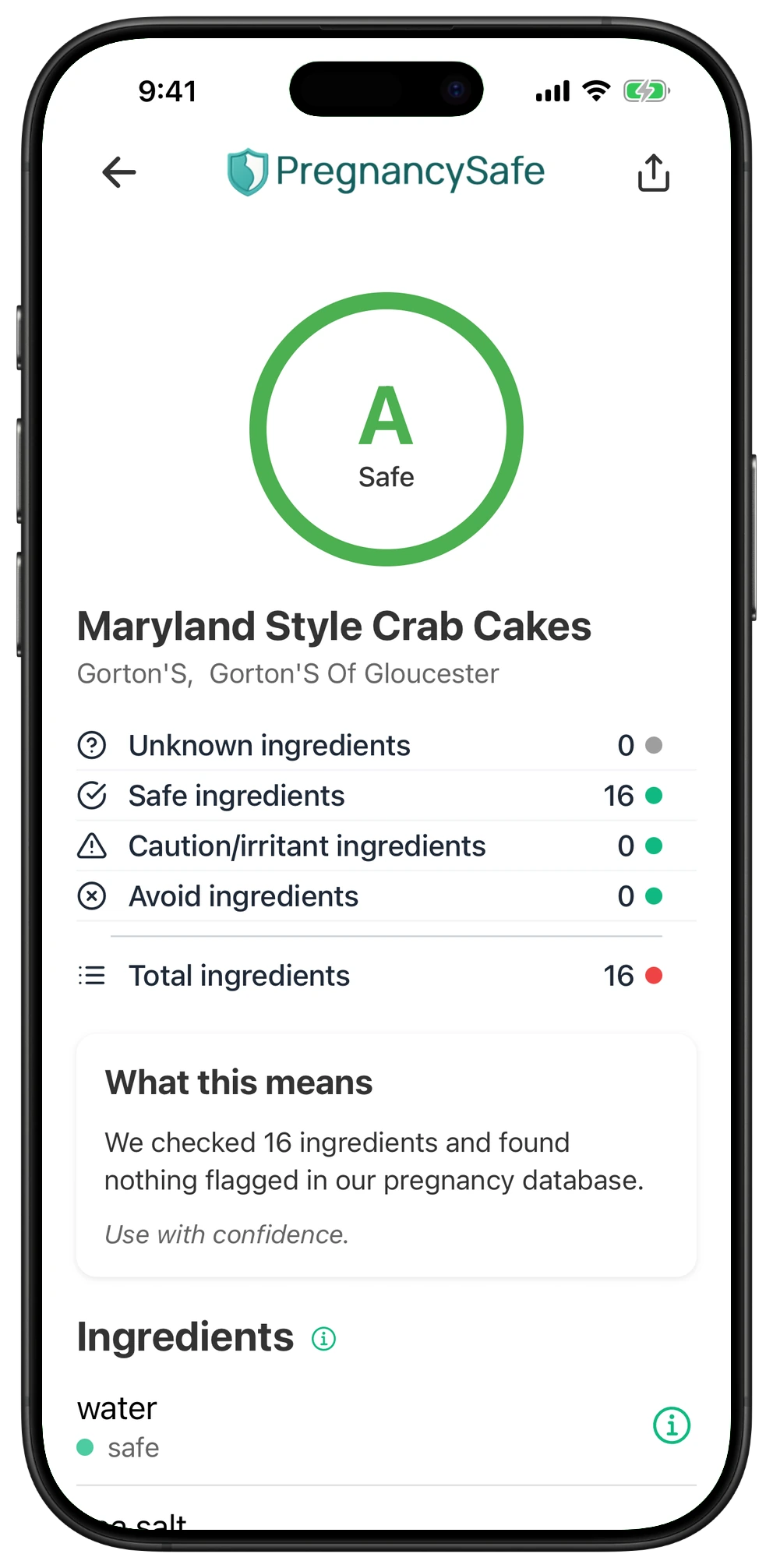
| A | Maryland Style Crab Cakes | Gorton'S, Gorton'S Of Gloucester |
| A | Maryland Style Mini Crab Cakes, Maryland Style | Private Selection |
| A | Maryland Style Crab Cakes, Maryland Style | Private Selection |
| A | Eastern Shore Crab Cake | 3 Fish |
| A | Jonah Crab Cakes | Pete'S Seafood |
Your Questions Answered
Can I eat crabcakes while pregnant?
Yes, when they are fully cooked and properly handled. Previously cooked crab does not make an uncooked crab cake mixture ready to eat, because it may also contain raw egg or other seafood. Follow the package instructions and check doneness with a food thermometer rather than relying on appearance.
Can I eat crab cakes at a restaurant?
You can choose restaurant crab cakes that are cooked fully throughout and handled safely. Ask whether they are freshly cooked and request thorough cooking. If you have allergies or want to avoid added wine, ask about the mixture and accompanying sauce rather than relying on the menu description.
How should I cook frozen crab cakes and reheat leftovers?
Follow the exact package instructions, including whether to cook from frozen or thaw first. A browned exterior does not establish that the center is cooked, especially when the mixture contains egg or raw seafood. Refrigerate leftovers promptly and reheat them to 165°F. Do not rely on reheating to make up for uncertain storage.
Should I avoid crab cakes made with white wine?
A recipe without added wine is the simplest way to avoid uncertainty about residual alcohol. Pregnancy guidance recommends avoiding alcoholic drinks, but a wine ingredient listing does not tell you how much alcohol remains in a cooked serving. The amount used, cooking method and portion matter, so the listing alone does not establish an exposure equivalent to drinking wine. Do not assume that cooking removes all alcohol.
Do ingredient warnings mean spicy or seasoned crab cakes are unsafe?
Not automatically: the ingredient's amount and form matter. Ordinary culinary peppers, normal fenugreek seasoning and condiment amounts of horseradish should not be treated as equivalent to concentrated extracts or medicinal oral doses. Limited pregnancy evidence for concentrated chili pepper extract does not establish harm from the amount used to flavor a crab cake. Likewise, high exposure aluminum findings do not establish that sodium aluminum phosphate in a serving causes pregnancy harm.
Does an A grade mean a crab cake is verified safe during pregnancy?
No. Our catalog contains 23 A grade records among 80 products, but those are ingredient scores, not independently verified safe product totals. Grades do not measure pathogens, cooking, dose, storage or current package contents, and an F grade is not automatically a clinical verdict that a product is unsafe. Check the current label and preparation instructions; incomplete records are not proof of harm.
How to Interpret These Ratings
Our ingredient and category rules generate letter grades from the information recorded in the catalog. Missing ingredients and broad category assignments can affect the result. These grades do not measure your dose, confirm a complete current label, or test a product for contamination.
A high grade is not a guarantee of pregnancy safety. A low grade is not, by itself, proof of harm from every use. Follow the product-specific guidance above, check the actual package, and ask your prenatal clinician about supplements, treatment decisions or uncertain exposures.
People Also Checked
References
- https://www.fda.gov/food/consumers/advice-about-eating-fish
- https://www.fda.gov/food/people-risk-foodborne-illness/cooking-food-safety-moms-be
- https://www.cdc.gov/alcohol-pregnancy/about/index.html
- https://www.cdc.gov/fasd/about/index.html
- https://www.acog.org/womens-health/infographics/alcohol-and-pregnancy
- https://www.niaaa.nih.gov/publications/brochures-and-fact-sheets/alcohol-and-your-pregnancy
- https://mothertobaby.org/fact-sheets/alcohol-pregnancy/
- https://pubmed.ncbi.nlm.nih.gov/26482673/
- https://pmc.ncbi.nlm.nih.gov/articles/PMC9543418/
- https://cdn.realfood.gov/DGA.pdf
- https://www.dietaryguidelines.gov/sites/default/files/2021-12/DGA_Pregnancy_FactSheet-508c.pdf
- https://www.acog.org/womens-health/faqs/healthy-eating-during-pregnancy
- https://www.cdc.gov/nutrition/php/data-research/added-sugars.html
- https://www.cdc.gov/diabetes/about/gestational-diabetes.html
- https://www.who.int/publications/i/item/9789241549028
- https://nesr.usda.gov/2025-dietary-guidelines-advisory-committee-systematic-reviews/dietary-patterns_gestational-diabetes
- https://wwwn.cdc.gov/TSP/ToxProfiles/ToxProfiles.aspx?id=191&tid=34
- https://pmc.ncbi.nlm.nih.gov/articles/PMC9681673/
- https://pmc.ncbi.nlm.nih.gov/articles/PMC10809980/
- https://www.cdc.gov/vaccine-safety/about/adjuvants.html
- https://www.fda.gov/vaccines-blood-biologics/safety-availability-biologics/common-ingredients-fda-approved-vaccines
- https://www.acog.org/womens-health/infographics/vaccines-during-pregnancy
- https://mothertobaby.org/fact-sheets/capsaicin/
- https://www.accessdata.fda.gov/drugsatfda_docs/label/2023/022395s023lbl.pdf
- https://www.ema.europa.eu/en/documents/product-information/qutenza-epar-product-information_en.pdf
- https://pubmed.ncbi.nlm.nih.gov/16717036/
- https://pubmed.ncbi.nlm.nih.gov/37271593/
- https://www.fda.gov/food/food-additives-petitions/trans-fat
- https://www.fda.gov/food/hfp-constituent-updates/fda-completes-final-administrative-actions-partially-hydrogenated-oils-foods
- https://www.federalregister.gov/documents/2013/11/08/2013-26854/tentative-determination-regarding-partially-hydrogenated-oils-request-for-comments-and-for
- https://www.who.int/news-room/fact-sheets/detail/trans-fat
- https://www.fda.gov/food/people-risk-foodborne-illness/dietary-advice-and-during-pregnancy
- https://www.rcpi.ie/Portals/0/Document%20Repository/Institute%20of%20Obstetricians%20and%20Gynaecologists/National%20Clinical%20Guidelines/IOG_National%20Clinical%20Guidelines_Nutrition%20in%20pregnancy%20Guideline_2019.pdf
- https://pmc.ncbi.nlm.nih.gov/articles/PMC8027310/
- https://pmc.ncbi.nlm.nih.gov/articles/PMC3192475/
- https://www.nccih.nih.gov/health/fenugreek
- https://www.ncbi.nlm.nih.gov/books/NBK501779/
- https://www.ema.europa.eu/en/documents/herbal-report/assessment-report-trigonella-foenum-graecum-l-semen-revision-1_en.pdf
- https://www.ema.europa.eu/en/documents/herbal-monograph/european-union-herbal-monograph-trigonella-foenum-graecum-l-semen-revision-1_en.pdf
- https://webprod.hc-sc.gc.ca/nhpid-bdipsn/dbImages/mono_fenugreek--oral_english.pdf
- https://pubmed.ncbi.nlm.nih.gov/32421208/
- https://pubmed.ncbi.nlm.nih.gov/27498339/
- https://pubmed.ncbi.nlm.nih.gov/33722213/
- https://webprod.hc-sc.gc.ca/nhpid-bdipsn/atReq?atid=horseradish.raifort&lang=eng
- https://inchem.org/documents/jecfa/jeceval/jec_71.htm
- https://hfpappexternal.fda.gov/scripts/fdcc/index.cfm?id=ALLYLISOTHIOCYANATE&set=FoodSubstances
- https://pmc.ncbi.nlm.nih.gov/articles/PMC13085108/
- https://pubmed.ncbi.nlm.nih.gov/22129740/
- https://www.drugs.com/npp/horseradish.html