Constipation During Pregnancy: Relief and When to Get Help
The Answer
Constipation means hard or difficult stools, going less often than usual, or feeling incompletely emptied. Pregnancy hormone changes can contribute.
Start with fiber, fluids and movement. If these don’t help, ask your care team about treatment.
Seek urgent care for constipation with rectal bleeding or blood in stool; severe abdominal pain, cramping or bloating; vomiting; or unexplained weight loss.
About 21% of women who checked in with Pregnancy Safe at week 6 reported constipation.[7] You’re not alone in experiencing this.
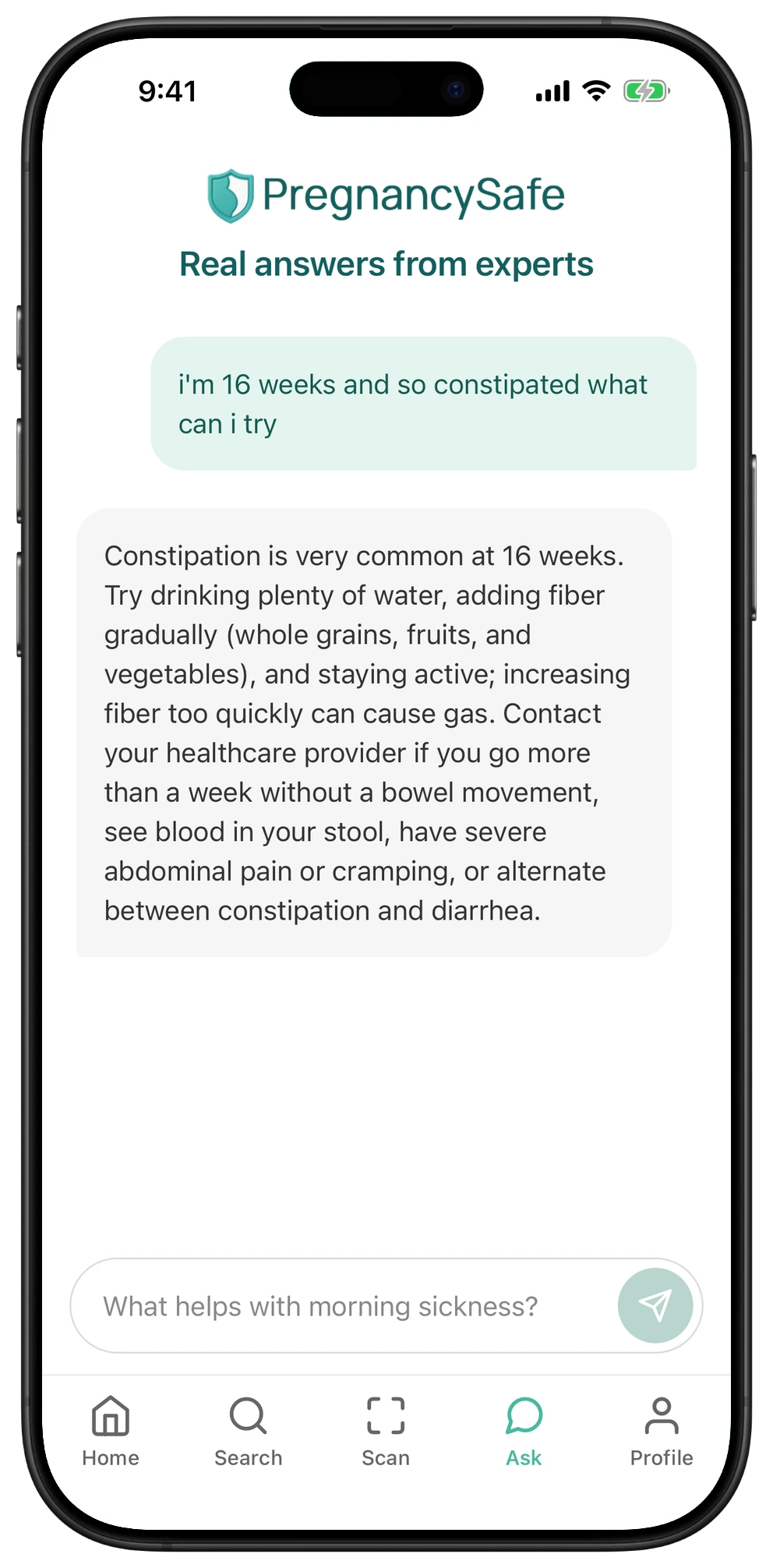
Stress Less This Pregnancy
Get personalized expert answers 24/7

How Common Is Constipation During Pregnancy?
Percent of women checking in each week who reported this symptom. Weeks meeting our reporting cutoff: 4–14. Missing weeks are not zero; this is not an individual symptom timeline.
Between weeks 13 and 27, 166 of 803 women who checked in with Pregnancy Safe reported constipation (20.7%). Each woman is counted once across that span.
These check ins reflect app reporting, not clinical prevalence or an individual symptom trajectory. Not logging constipation does not mean someone had no constipation.
When constipation needs medical attention
Constipation can cause abdominal discomfort and painful stools, but don’t assume severe abdominal symptoms are ordinary constipation: the warning symptoms above need urgent care. Otherwise, contact your doctor for severe or persistent constipation, prolonged straining, a blocked feeling, unsuccessful lifestyle changes, or concerns.
- Describe bowel frequency, stool texture and other symptoms.
- List medicines, supplements and relief measures tried.
For example: ‘My stools are hard, and I keep straining despite adding fiber and water. I take prenatal iron. What treatment should I try?’
When it starts, how long it lasts and what it means
Constipation can start early as pregnancy hormones change, but there is no exact onset week for everyone. It can occur in any trimester; pressure from the growing uterus can make it more troublesome in the third trimester.
It may last through pregnancy and often improves after birth, though it can continue postpartum. Ask for treatment if it persists rather than waiting for delivery.
Constipation alone cannot confirm pregnancy a pregnancy test is more useful. Early onset also does not tell you how a pregnancy is progressing.
Why pregnancy can make bowel movements harder
Pregnancy can slow bowel movement in several ways: progesterone relaxes bowel muscles, the growing uterus adds pressure, and iron in supplements can contribute.
Changes in fiber, fluids, activity and daily routine are possible reasons symptoms come and go. That is a possible explanation, not a proven early pregnancy pattern. Fluctuations alone cannot tell you whether a pregnancy is healthy.
Review medicines and supplements with your care team rather than stopping them yourself. They can help decide whether a change is appropriate.
What you can try now, including high-fiber foods
You can begin these steps now, but they do not promise an immediate bowel movement. There isn’t enough information here to give a reliable treatment start to relief time.
- Choose fiber rich foods such as apples, raspberries, lentils, split peas and whole wheat pasta.
- Increase fiber gradually rather than all at once. Compare packaged food labels for higher fiber choices, and drink water as you increase fiber.
- Try regular movement, such as walking, when appropriate for your pregnancy.
If symptoms persist, ask about treatment options rather than simply continuing to wait.
Passing hard stools without repeated straining
For easier toilet habits, go when you feel the urge and try after meals. Use a footstool, lean forward with your back straight, and relax your abdominal muscles.
Straining does not affect the fetus, but repeated straining can contribute to hemorrhoids and anal fissures. Seek treatment when stools remain difficult to pass rather than repeatedly forcing them.
A blocked feeling or prolonged straining needs care team help; accompanying warning symptoms need urgent care.
Fiber supplements and laxatives to discuss with your care team
When lifestyle changes aren’t enough, a pharmacist, midwife or doctor can help select treatment. Options have different roles and are not universally suitable. Common treatment categories include:
- Bulk forming fiber supplements, including ispaghula and methylcellulose, are often tried first. These are supplemental treatments, distinct from choosing higher fiber foods.
- Osmotic laxatives, including lactulose and macrogols, increase water in stool and are usually considered next.
- Docusate softens stool.
- Stimulant laxatives help the bowel move stool along and are generally considered after earlier options haven’t helped.
For MiraLAX specifically, the pregnancy guidance used here does not establish a product specific recommendation. Confirm the exact product with your clinician or pharmacist before using it.
Do not use castor oil or mineral oil as self directed remedies; discuss them with your provider.
What if constipation changes to diarrhea?
What if constipation changes to diarrhea or keeps alternating?
Laxatives can cause diarrhea, but that does not explain every alternating pattern. Loose stools alone do not prove constipation has resolved. Discuss a changed bowel pattern and any laxative use with your care team so they can assess what is happening. If you also have the warning symptoms listed above, seek urgent care.
References
- Pregnancy Constipation
- What can help with constipation during pregnancy?
- Treating constipation during pregnancy
- Constipation during pregnancy
- Pregnancy Constipation: Why It Happens and How To Find Relief
- Constipation
- Pregnancy Safe app check-ins.
98 of 468 women reported constipation in week 6 (20.9%). 166 of 803 women reported constipation in weeks 13–27, counted once across that span (20.7%). Production analytics snapshot: Nov 11, 2026 (UTC). Pregnancy week is estimated from the recorded due date. Each check-in profile is counted once per week or once across a combined span. Rates require at least 30 reporting and 30 not reporting. Combined spans are not directly comparable to weekly rates. Not logging a symptom does not mean it was absent. These are self-selected app reports, not prevalence in all pregnancies, individual progression, or a clinical safety assessment. Related-symptom percentages use women who reported the main symptom on at least one eligible check-in across pregnancy weeks 1–42, through the same snapshot. Each pair counts a woman once only when both symptoms appeared on the same check-in. The displayed digestive symptoms are selected examples, not the most common symptoms overall. Rows overlap and must not be added together. More frequent check-ins give more opportunities to report a pair. These figures do not establish causation or greater risk compared with women without the main symptom. The same 30 reporting / 30 not reporting thresholds apply.