Is Naturium Azelaic Topical Acid 10% Safe During Pregnancy? (Updated 2026 Guide)
Updated September 9, 2026
Naturium Azelaic Topical Acid 10%
Naturium
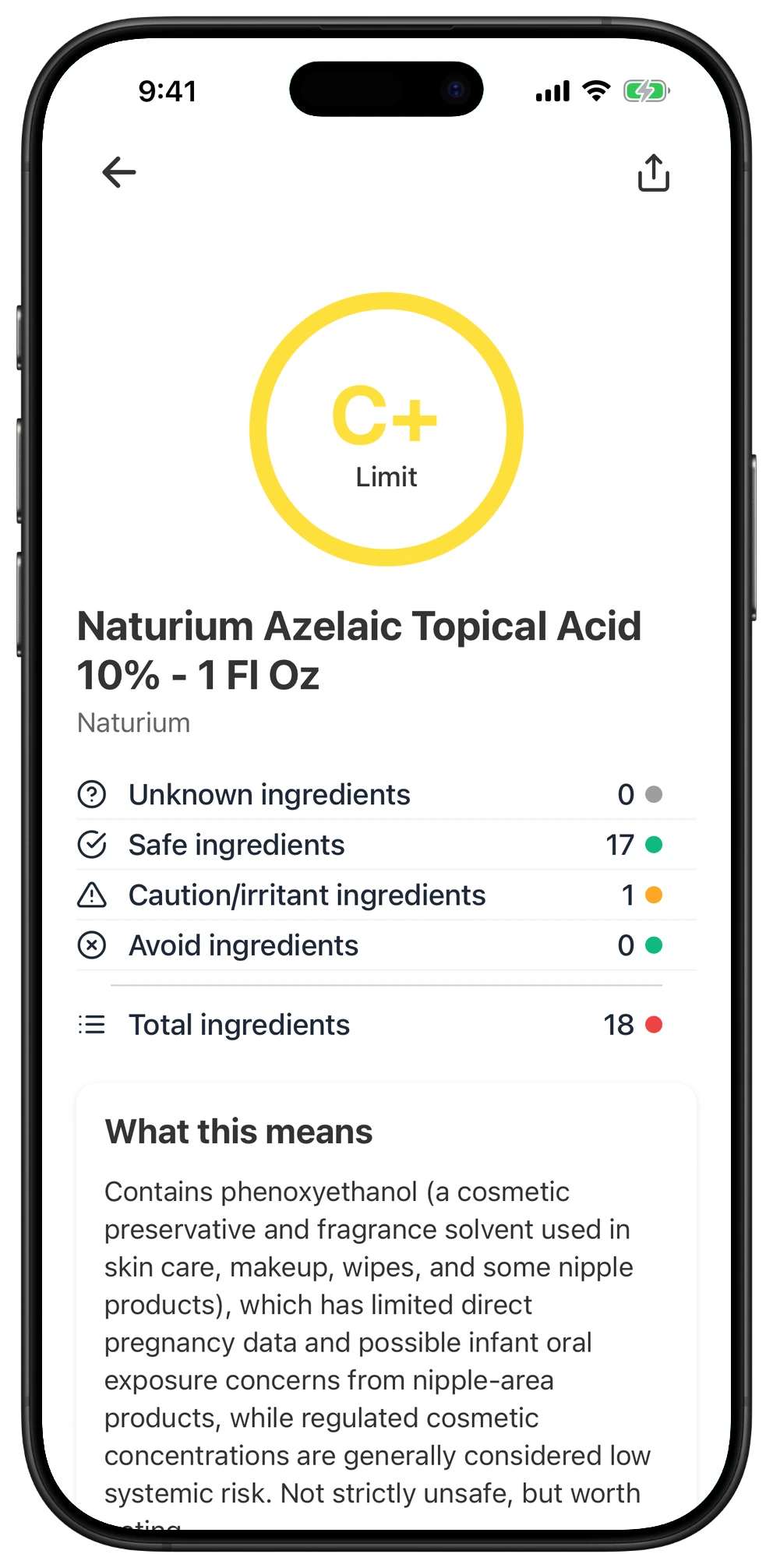
Naturium Azelaic Topical Acid 10% receives a C+ pregnancy grade, making it a use with caution option rather than an unrestricted recommendation. Phenoxyethanol is the main caution because direct pregnancy evidence is limited, although regulated cosmetic concentrations are generally considered low systemic risk; this is not evidence that ordinary facial use harms your baby.
You can use this, but maybe don't make it your everyday go to. Not the end of the world if you've used it. Consult your OBGYN or midwife if you have concerns.
Pregnancy Safe is 100% independent and research driven. No companies pay to promote or sponsor products.
Stress Less This Pregnancy
Check your azelaic acid in the app

What Ingredients Are in Naturium Azelaic Topical Acid 10%?
Naturium Azelaic Topical Acid 10% has 18 ingredients. We flagged 1 ingredient to use with caution.
CAUTION
Phenoxyethanol is a preservative commonly used in cosmetics and skincare products to prevent microbial growth and extend shelf life. Phenoxyethanol warrants caution because direct pregnancy data are limited, although regulated topical cosmetic levels are generally low systemic risk and nipple area ingestion is a separate concern.
propanediol
LIKELY SAFE
Propanediol is a versatile, plant derived humectant and solvent commonly used in skincare and cosmetic formulations to retain moisture and improve product texture. Propanediol is rated likely safe for ordinary topical use, but the supporting pregnancy assessment concerns propylene glycol rather than establishing ingredient specific evidence.
sodium benzoate
LIKELY SAFE
Sodium benzoate is a preservative commonly used to inhibit microbial growth in food and beverage products. Sodium benzoate is generally low concern at regulated topical cosmetic levels during pregnancy, and beverage specific benzene concerns do not establish a risk from this serum.
tocopherol
LIKELY SAFE
Tocopherol is a form of vitamin E commonly used as an antioxidant in skincare and cosmetic products. Tocopherol is low concern in pregnancy with normal topical use and expected minimal systemic exposure; high dose oral vitamin E findings do not apply directly.
citric acid
SAFE
Citric acid is a natural organic acid commonly used as a preservative and flavor enhancer in food and beverages. Citric acid is generally compatible with pregnancy at ordinary topical cosmetic levels, although stronger or lower pH formulas can irritate skin.
ethyl ascorbic acid
SAFE
The pregnancy assessment draws on topical ascorbic acid evidence, which is indirect for ethyl ascorbic acid specifically.
glycerin
SAFE
Glycerin is a colorless, odorless, and sweet tasting humectant commonly used in skincare products to attract and retain moisture in the skin. Glycerin is generally compatible with pregnancy in ordinary topical cosmetics, where systemic exposure is expected to be low.
SAFE
Niacinamide is a versatile skincare ingredient known for its ability to improve skin elasticity, enhance the barrier function, and reduce the appearance of blemishes and uneven skin tone. Niacinamide is generally considered compatible with pregnancy at normal topical cosmetic concentrations, unlike the separate exposure from high dose oral supplements.
potassium azeloyl diglycinate
SAFE
Its topical pregnancy assessment relies on evidence about other potassium salts, not direct evidence for potassium azeloyl diglycinate.
potassium chloride
SAFE
Potassium chloride is a mineral salt commonly used as a potassium supplement and a salt substitute in food. The pregnancy evidence for potassium chloride concerns food and supplementation, so it does not directly assess this serum's topical exposure.
potassium sorbate
SAFE
Potassium sorbate is a widely used food preservative that inhibits mold, yeast, and bacteria growth to extend shelf life. Its topical pregnancy assessment relies on potassium citrate and gluconate evidence, which is indirect for potassium sorbate specifically.
sodium hyaluronate
SAFE
Sodium hyaluronate is a powerful hydrating agent that helps retain moisture in the skin, promoting plumpness and elasticity. Sodium hyaluronate is generally compatible with pregnancy in topical moisturizers because systemic exposure is expected to be low.
water
SAFE
Water is a clear, tasteless, and essential liquid that sustains all known forms of life. Water is not a pregnancy concern when applied topically, although the finished formula's other ingredients and microbial quality still matter.
caprylyl glycol
SAFE
Caprylyl glycol is a versatile moisturizing agent and skin conditioner commonly used in skincare products for its humectant and antimicrobial properties. Caprylyl glycol is unflagged in this formula, but that does not establish pregnancy safety for topical use.
chlorphenesin
SAFE
Chlorphenesin is a synthetic preservative and muscle relaxant commonly used in cosmetics and topical products to inhibit microbial growth. Chlorphenesin is unflagged here, but a nursing warning involving it with phenoxyethanol concerned infant ingestion from nipple cream, not ordinary facial use during pregnancy.
coffea arabica seed extract
SAFE
Coffea arabica seed extract is a natural ingredient derived from coffee beans, known for its antioxidant properties and skin revitalizing benefits. Coffea arabica seed extract is unflagged here, but its antioxidant role does not establish pregnancy safety for topical use.
phenylpropanol
SAFE
Phenylpropanol is a fragrant aromatic alcohol commonly used in perfumes and flavorings for its sweet, floral scent. Phenylpropanol is unflagged in this formula, but pregnancy specific evidence for topical exposure is not established in its assessment.
polyacrylate crosspolymer 6
SAFE
Polyacrylate crosspolymer 6 is unflagged here, but no ingredient specific pregnancy evidence is available in its assessment.
Answering Your Questions
How much Naturium Azelaic Topical Acid 10% is safe during pregnancy?
If you choose to use it, follow the label amount and apply a thin layer only to the intended area of intact skin. Avoid broken or irritated skin and unusually extensive application; there is no established pregnancy specific amount for this formula.
Can you use Naturium Azelaic Topical Acid 10% daily while pregnant?
Follow the label rather than increasing applications to speed up results. Introduce it gradually and reduce use or stop if stinging, dryness, or irritation develops; a pregnancy specific safe frequency has not been established.
Why did Naturium Azelaic Topical Acid 10% receive a C+ grade?
The C+ comes from ingredient based scoring, not a clinical test of the finished serum. Phenoxyethanol carries a caution rating, while propanediol, sodium benzoate, and tocopherol are rated likely safe for ordinary topical exposure; ingredients without a flag are not necessarily individually reviewed for pregnancy safety.
Can I use 10% azelaic acid while pregnant?
The percentage in a product name is not enough to establish pregnancy safety you need to consider the actual ingredient and the whole formula. This product lists potassium azeloyl diglycinate, and its ingredient assessment does not establish equivalence to a formula containing 10% pure azelaic acid; its overall grade remains C+.
Can I use this serum while breastfeeding?
The pregnancy grade does not establish breastfeeding safety for the finished formula. If you use it on your face, keep treated skin away from your baby's mouth and do not apply it to nipples or areas your baby may lick: the phenoxyethanol warning involving a nipple cream concerned infant ingestion, not ordinary facial use.
What alternatives should I consider during pregnancy?
Look for a simpler formula with an ingredient specific pregnancy review rather than assuming every azelaic product has the same assessment. If you mainly need hydration, a basic glycerin or sodium hyaluronate moisturizer may meet your needs; for acne or pigmentation treatment, ask your clinician to help select an appropriate formula.
Can I combine it with niacinamide or vitamin C?
This formula already contains niacinamide and ethyl ascorbic acid, a vitamin C derivative. Topical niacinamide is generally considered compatible with pregnancy, but the vitamin C assessment is less direct for this exact derivative; adding more acidic products may also increase irritation.
Does the phenoxyethanol mean I need to avoid this product completely?
No the caution rating is not an avoid flag for occasional use of properly regulated cosmetics at allowed concentrations. Direct pregnancy studies are limited, but high dose animal findings and infant ingestion concerns from nipple products should not be treated as evidence of harm from ordinary topical facial use.
Are Other Naturium Products Safe During Pregnancy?
We looked at 12 other Naturium products. 0 are pregnancy safe (A or B grade), while 12 need a closer look.
| Grade | Product | Type |
|---|---|---|
| C+ | Naturium The Smoother Glycolic Acid Exfoliating Body Wash | body wash |
| C+ | Naturium The Glow Getter Multi-Oil Body Butter | body butter |
| C | Barrier Bounce Bi-Phase Mist | facial mist |
| C | Bio-Lipid Restoring Body Lotion | body lotion |
How Does Naturium Azelaic Topical Acid 10% Compare to Other Topical Acids?
We graded 3 Topical Acids for pregnancy safety. Here's how they stack up:
Naturium Azelaic Topical Acid 10% earns a C+ grade, placing it among the majority of Topical Acids. Only 0% of products in this category get an A grade, so it pays to choose carefully.
How Do We Score Products for Pregnancy Safety?
We analyze each product's ingredients and category to flag known risks and provide cautionary notices for general category safety concerns.
A - Safe
Excellent choice! All ingredients are considered safe during pregnancy.
What to do: Use with confidence.
B - Likely Safe
Pretty much safe with very minimal risk. Some ingredients may have limited pregnancy studies, but no significant safety concerns have been identified.
What to do: Use with confidence.
C - Limit
Contains ingredients with some pregnancy considerations. Research shows these ingredients may have limited safety data, potential for minor hormonal effects, or require caution based on animal studies.
What to do: Use sparingly and consider safer alternatives when available.
D - Caution
Similar to C grade but contains multiple cautionary ingredients. The combination increases overall concern.
What to do: Try to avoid if that makes you feel better. If you've already used it, no need to panic.
F - Avoid
Contains an ingredient Pregnancy Safe recommends avoiding during pregnancy. This may reflect an established risk or a precaution based on limited evidence; check the ingredient guidance and exposure context.
What to do: Do not use during pregnancy. If you've already used it, don't worry - contact your OBGYN if concerned.
People Also Checked
References
- https://health.ec.europa.eu/system/files/2021-08/sccs_o_195_0.pdf
- https://ec.europa.eu/growth/tools-databases/cosing/details/28157
- https://journals.sagepub.com/doi/10.3109/10915819009078737
- https://link.springer.com/article/10.1007/s00204-024-03938-5
- https://www.sfda.gov.sa/en/warnings/1156
- https://www.industrialchemicals.gov.au/sites/default/files/Ethanol%2C%202-phenoxy-_Human%20health%20tier%20II%20assessment.pdf
- https://hero.epa.gov/reference/2857875
- https://books.publisso.de/sites/default/files/documents/series/mak/dam/Vol2019/Iss1/Alt006/mb12299kske6319_w.pdf
- https://www.ecfr.gov/current/title-21/part-184/section-184.1666
- https://pmc.ncbi.nlm.nih.gov/articles/PMC7009459/
- https://pubmed.ncbi.nlm.nih.gov/15995735/
- https://pubmed.ncbi.nlm.nih.gov/23064775/
- https://www.ema.europa.eu/en/documents/scientific-guideline/questions-and-answers-propylene-glycol-used-excipient-medicinal-products-human-use_en.pdf
- https://pmc.ncbi.nlm.nih.gov/articles/PMC11867916/
- https://pubmed.ncbi.nlm.nih.gov/29281181/
- https://pubmed.ncbi.nlm.nih.gov/40234020/
- https://www.ecfr.gov/current/title-21/chapter-I/subchapter-B/part-184/subpart-B/section-184.1733
- https://apps.who.int/food-additives-contaminants-jecfa-database/Home/Chemical/1098
- https://www.inchem.org/documents/jecfa/jecmono/v83je01.pdf
- https://efsa.onlinelibrary.wiley.com/doi/10.2903/j.efsa.2016.4433
- https://www.fda.gov/food/environmental-contaminants-food/questions-and-answers-occurrence-benzene-soft-drinks-and-other-beverages
- https://pubmed.ncbi.nlm.nih.gov/29243541/
- https://ec.europa.eu/health/ph_risk/committees/04_sccp/docs/sccp_o_015.pdf
- https://cdnservices.industrialchemicals.gov.au/statements/EVA00103%20-%20Evaluation%20Statement%20-%2026%20June%202023.pdf
- https://journals.sagepub.com/doi/10.1177/1091581818794455
- https://pmc.ncbi.nlm.nih.gov/articles/PMC4154592/
- https://pubmed.ncbi.nlm.nih.gov/15868062/
- https://mothertobaby.org/fact-sheets/vitamin-e/
- https://www.cir-safety.org/sites/default/files/citric032012FR.pdf
- https://www.canada.ca/en/health-canada/services/consumer-product-safety/cosmetics/cosmetic-ingredient-hotlist-prohibited-restricted-ingredients/hotlist.html
- https://www.fda.gov/cosmetics/cosmetic-ingredients/alpha-hydroxy-acids
- https://pubmed.ncbi.nlm.nih.gov/35309882/
- https://pubmed.ncbi.nlm.nih.gov/16040403/
- https://pubmed.ncbi.nlm.nih.gov/9256916/
- https://www.aad.org/public/everyday-care/skin-care-secrets/routine/pregnancy-skin-care
- https://onlinelibrary.wiley.com/doi/10.1111/ijd.70620
- https://www.cir-safety.org/sites/default/files/RRSum_AscorbicAcid_062025.pdf
- https://pubmed.ncbi.nlm.nih.gov/16154915/
- https://pubmed.ncbi.nlm.nih.gov/11207686/
- https://pmc.ncbi.nlm.nih.gov/articles/PMC5605218/
- https://www.hfpappexternal.fda.gov/scripts/fdcc/index.cfm?id=GLYCERIN&set=FoodSubstances
- https://pubmed.ncbi.nlm.nih.gov/31840548/
- https://pmc.ncbi.nlm.nih.gov/articles/PMC7009851/
- https://www.medicinesinpregnancy.org/leaflets-a-z/glycerin-suppositories/
- https://mothertobaby.org/pregnancy-breastfeeding-exposures/cosmetics/
- https://pubmed.ncbi.nlm.nih.gov/41944999/
- https://jintegrativederm.org/doi/10.64550/joid.97jp5737
- https://pubmed.ncbi.nlm.nih.gov/16596767/
- https://ods.od.nih.gov/factsheets/Niacin-HealthProfessional/
- https://www.fda.gov/cosmetics/resources-consumers-cosmetics/cosmetics-pregnancy
- https://pubmed.ncbi.nlm.nih.gov/25399625/
- https://doi.org/10.1177/1091581818814189
- https://www.epa.gov/sites/default/files/2019-08/documents/support_document_for_proposed_designation_of_d-gluconic_acid_potassium_salt.pdf
- https://webprod.hc-sc.gc.ca/nhpid-bdipsn/ingredReq?id=2811
- https://ods.od.nih.gov/factsheets/Potassium-HealthProfessional/
- https://ods.od.nih.gov/factsheets/Potassium-Consumer/
- https://dailymed.nlm.nih.gov/dailymed/lookup.cfm?setid=0224e5b3-3c49-4e6e-aa78-1abcc6969246
- https://lpi.oregonstate.edu/mic/minerals/potassium
- https://pmc.ncbi.nlm.nih.gov/articles/PMC10863666/
- https://www.cir-safety.org/sites/default/files/TR_Hyaluronates_032023_1.pdf
- https://pubmed.ncbi.nlm.nih.gov/19636067/
- https://www.fda.gov/medical-devices/aesthetic-cosmetic-devices/dermal-fillers-soft-tissue-fillers
- https://pubmed.ncbi.nlm.nih.gov/28492048/
- https://www.personalcarecouncil.org/wp-content/uploads/2022/03/INCINomenclatureConventionsReferenceInformation2022_v1.pdf
- https://www.seslhd.health.nsw.gov.au/sites/default/files/groups/Royal_Hospital_for_Women/Mothersafe/documents/skinhaircareandcosmetictreatmentsapril2021.pdf
- https://www.nhs.uk/pregnancy/complications/itching-and-intrahepatic-cholestasis/
- https://www.fda.gov/cosmetics/cosmetics-guidance-documents/good-manufacturing-practice-gmp-guidelinesinspection-checklist-cosmetics
- https://www.fda.gov/cosmetics/potential-contaminants-cosmetics/microbiological-safety-and-cosmetics
- https://pubmed.ncbi.nlm.nih.gov/25153208/