Is Selenium Safe During Pregnancy?
Updated September 14, 2026
The Answer
Selenium is likely safe during pregnancy at normal food or prenatal vitamin amounts that keep your total intake below 400 mcg per day. The pregnancy recommended daily allowance is 60 mcg; routine high dose supplementation is not supported.
Total intake matters: high dose supplements or frequent Brazil nuts can push selenium intake too high, even though selenium is an essential nutrient.
Nutrient intake guidance distinguishes daily selenium requirements from excess intake toxicity, while current pregnancy trials and thyroid in pregnancy guidance do not support routine high dose supplementation.
Already used it? Check the selenium amount per serving and how much you took, including your prenatal and other supplements. If you may have exceeded the daily upper limit or have been taking extra selenium regularly, review your intake with your prenatal clinician.
Pregnancy Safe is 100% independent and research driven. No companies pay to promote or sponsor products.
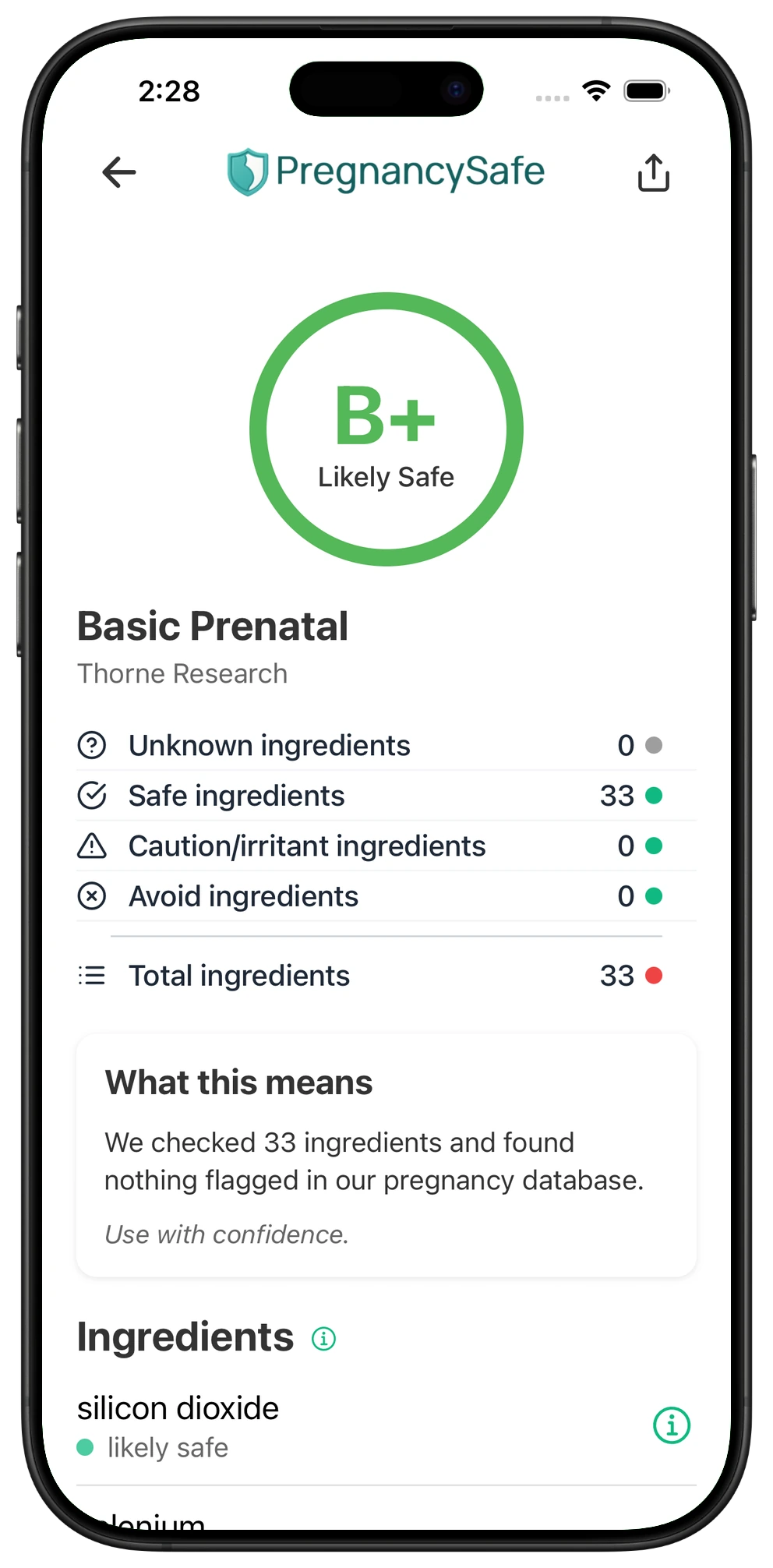
Stressless Pregnancy
Check your exact product with selenium in the app

What Is Selenium?
Selenium is an essential trace mineral involved in antioxidant protection and thyroid function. It occurs in seafood, meat, eggs, grains, dairy, and Brazil nuts, and is included in some prenatals and dietary supplements. Supplement sources include selenium yeast, selenomethionine, sodium selenate, and sodium selenite; products also come as drops and solutions.
What Other Ingredients Should You Look Out for in Products With Selenium?
A product's full ingredient list determines whether it's pregnancy-safe or not. These ingredients also appear in some of the selenium products we analyzed and may deserve a closer look.
Alcohol
AvoidLook for “ethanol” in oral supplements and check whether it remains in the finished product, rather than appearing only as an extraction solvent. Pregnancy guidance recommends avoiding alcohol containing oral supplements because no safe amount or timing of prenatal alcohol exposure has been established.
Flagged in 1 product (0.4%) in this analysis.
Cobalt
CautionIf a supplement lists “cobalt,” check whether it is added separately rather than present as part of vitamin B12. Standalone cobalt supplementation warrants clinician review because pregnancy data are limited and high exposures can be toxic; ordinary dietary cobalt and prenatal B12 are not the concern.
Flagged in 3 products (1.3%) in this analysis.
Hydrogenated Oils
CautionIf the label lists “hydrogenated vegetable oil,” check whether it is partially or fully hydrogenated. Partially hydrogenated oils raise artificial trans fat concerns; fully hydrogenated oils are mainly a saturated fat consideration, not the same trans fat warning.
Flagged in 1 product (0.4%) in this analysis.
Ubiquinone
CautionLook for “coenzyme q10” in combination supplements and review its use with your prenatal clinician. Concentrated oral CoQ10 has limited first trimester and long term fetal safety data, so findings from later pregnancy research do not establish safety throughout pregnancy.
Flagged in 1 product (0.4%) in this analysis.
Does the Form or Amount of Selenium Matter During Pregnancy?
The 60 mcg daily pregnancy requirement and 400 mcg daily upper limit refer to total selenium intake, not just a supplement dose. Normal dietary or prenatal amounts differ from taking extra selenium routinely. Pregnancy trials and thyroid in pregnancy guidance do not support routine high dose supplementation, while documented deficiency or special medical situations may justify clinician directed use.
What Products Contain Selenium?
Pregnancy Safe has looked at 5,896 products that have selenium as an ingredient. The category and grade breakdowns below use 231 products whose names mention Selenium or another name for it.
What Types of Products Contain Selenium?
Products You May Have That Contain Selenium
| Grade | Product | Brand | Type |
|---|---|---|---|
| B+ | Selenium 200 Mcg | 21St Century | Dietary Supplement |
| B+ | Selenium Forte | Ab American Biologics | Dietary Supplement |
| B+ | Selenium High Dose Drops 100 Mcg | Allergy Research Group | Dietary Supplement |
| B+ | Selenium Solution | Allergy Research Group | Dietary Supplement |
| B+ | Ionic Selenium | Am Angstrom Minerals | Dietary Supplement |
| B+ | Selenium 200 Mcg | An Amazing Nutrition Amazing Formulas | Dietary Supplement |
| B+ | Selenium 50 Mcg | An Amazing Nutrition Amazing Formulas | Dietary Supplement |
| B+ | Natural Selenium 50 Mcg | Basic Vitamins | Vitamin |
How Do Products Containing Selenium Score?
It can be helpful to see how products containing selenium generally score during pregnancy. This does not tell you whether your exact product is safe, but it gives you a general idea of what we found. In this breakdown of 231 products, 97% receive a B grade. A B grade means the complete formula is likely safe, with minimal identified risk.
Frequently Asked Questions About Selenium During Pregnancy
How much selenium do I need each day during pregnancy?
The pregnancy recommended daily allowance is 60 mcg from all sources. The daily upper limit is 400 mcg, not a target to aim for.
Is a 200 mcg selenium supplement too much?
A 200 mcg supplement alone is below the 400 mcg daily upper limit, but you also need to count selenium from food, your prenatal, and other supplements. Being below the limit does not establish a need for extra selenium; routine high dose supplementation is not supported.
Should I take extra selenium for thyroid health?
Selenium supports thyroid function, but thyroid in pregnancy guidance does not support routine high dose supplementation. Your clinician may recommend it for documented deficiency or a special medical situation.
Do Brazil nuts count toward my selenium intake?
Yes. Brazil nuts contribute selenium, and eating them frequently can lead to excess intake, especially alongside selenium containing supplements.
What symptoms can too much selenium cause?
Excess selenium can cause selenosis, with hair and nail changes, gastrointestinal symptoms, garlic breath or a metallic taste, and neurologic problems. These symptoms alone do not establish selenium toxicity; discuss suspected excess intake with your clinician.
Does selenium in a prenatal mean the whole product is pregnancy safe?
No. Selenium at normal prenatal amounts is generally compatible with pregnancy when total intake stays below the upper limit, but that does not establish the safety of every other ingredient or dose in the formula.
How Do We Score Products for Pregnancy Safety?
We analyze each product's ingredients and category to flag known risks and provide cautionary notices for general category safety concerns.
A - Safe
Excellent choice! All ingredients are considered safe during pregnancy.
What to do: Use with confidence.
B - Likely Safe
Pretty much safe with very minimal risk. Some ingredients may have limited pregnancy studies, but no significant safety concerns have been identified.
What to do: Use with confidence.
C - Limit
Contains ingredients with some pregnancy considerations. Research shows these ingredients may have limited safety data, potential for minor hormonal effects, or require caution based on animal studies.
What to do: Use sparingly and consider safer alternatives when available.
D - Caution
Similar to C grade but contains multiple cautionary ingredients. The combination increases overall concern.
What to do: Try to avoid if that makes you feel better. If you've already used it, no need to panic.
F - Avoid
Contains an ingredient Pregnancy Safe recommends avoiding during pregnancy. This may reflect an established risk or a precaution based on limited evidence; check the ingredient guidance and exposure context.
What to do: Do not use during pregnancy. If you've already used it, don't worry - contact your OBGYN if concerned.
Sources
- https://journals.sagepub.com/doi/10.1089/thy.2016.0457
- https://ods.od.nih.gov/factsheets/Pregnancy-HealthProfessional/
- https://ods.od.nih.gov/factsheets/Selenium-Consumer/
- https://ods.od.nih.gov/factsheets/Selenium-HealthProfessional/
- https://pubmed.ncbi.nlm.nih.gov/37716440/
- https://www.ncbi.nlm.nih.gov/books/NBK225470/
- https://www.ncbi.nlm.nih.gov/books/NBK582563/
- https://www.ncbi.nlm.nih.gov/books/NBK582743/
- https://www.cdc.gov/alcohol-pregnancy/about/index.html
- https://www.fda.gov/food/dietary-supplements-guidance-documents-regulatory-information/dietary-supplement-labeling-guide-chapter-iv-nutrition-labeling
- https://pubmed.ncbi.nlm.nih.gov/28775124/
- https://www.iberogast.com/healthcare-professionals/instructions-resources
- https://www.herbalist-alchemist.com/shop-products-cyp-cyperus-extract
- https://www.ncbi.nlm.nih.gov/books/NBK609977/
- https://www.atsdr.cdc.gov/toxguides/toxguide-33.pdf
- https://ods.od.nih.gov/factsheets/VitaminB12-HealthProfessional/
- https://pubmed.ncbi.nlm.nih.gov/33872739/
- https://pubmed.ncbi.nlm.nih.gov/32770943/
- https://pubmed.ncbi.nlm.nih.gov/35081493/
- https://pubmed.ncbi.nlm.nih.gov/41558207/
- https://www.fda.gov/food/food-additives-petitions/trans-fat
- https://www.fda.gov/food/hfp-constituent-updates/fda-completes-final-administrative-actions-partially-hydrogenated-oils-foods
- https://www.federalregister.gov/documents/2013/11/08/2013-26854/tentative-determination-regarding-partially-hydrogenated-oils-request-for-comments-and-for
- https://www.who.int/news-room/fact-sheets/detail/trans-fat
- https://cdn.realfood.gov/DGA.pdf
- https://www.fda.gov/food/people-risk-foodborne-illness/dietary-advice-and-during-pregnancy
- https://www.rcpi.ie/Portals/0/Document%20Repository/Institute%20of%20Obstetricians%20and%20Gynaecologists/National%20Clinical%20Guidelines/IOG_National%20Clinical%20Guidelines_Nutrition%20in%20pregnancy%20Guideline_2019.pdf
- https://pmc.ncbi.nlm.nih.gov/articles/PMC8027310/
- https://pmc.ncbi.nlm.nih.gov/articles/PMC3192475/
- https://webprod.hc-sc.gc.ca/nhpid-bdipsn/dbImages/mono_coenzyme-q10_english.pdf
- https://www.bfr.bund.de/cm/349/coenzyme-q10-what-is-known-about-the-health-risks-and-what-is-not.pdf
- https://pubmed.ncbi.nlm.nih.gov/19154996/
- https://lpi.oregonstate.edu/mic/dietary-factors/coenzyme-Q10
- https://www.ncbi.nlm.nih.gov/books/NBK531491/
- https://www.ncbi.nlm.nih.gov/books/NBK501788/
- https://www.nccih.nih.gov/health/coenzyme-q10
- https://pubmed.ncbi.nlm.nih.gov/19096117/