Is Witch Hazel Safe During Pregnancy? (Updated 2026 Guide)
Updated September 9, 2026
The Answer
For witch hazel during pregnancy, distinguish label directed external use from oral extracts: follow topical product directions, and do not swallow witch hazel or use it as an oral pregnancy remedy. Our catalog contains 18 A graded records among 30 products, but these mixed form ingredient scores do not establish pregnancy safety.
Topical witch hazel pads and astringents need different consideration from oral herbal tinctures, including alcohol free extracts. Alcohol containing topical forms can sting or dry your skin; evidence about drinking alcohol does not establish fetal harm from ordinary external application. Check the exact formulation and intended application site, and discuss use on damaged skin or persistent hemorrhoid or skin symptoms with your clinician.
Pregnancy Safe is 100% independent and research driven. No companies pay to promote or sponsor products.
Stress Less This Pregnancy
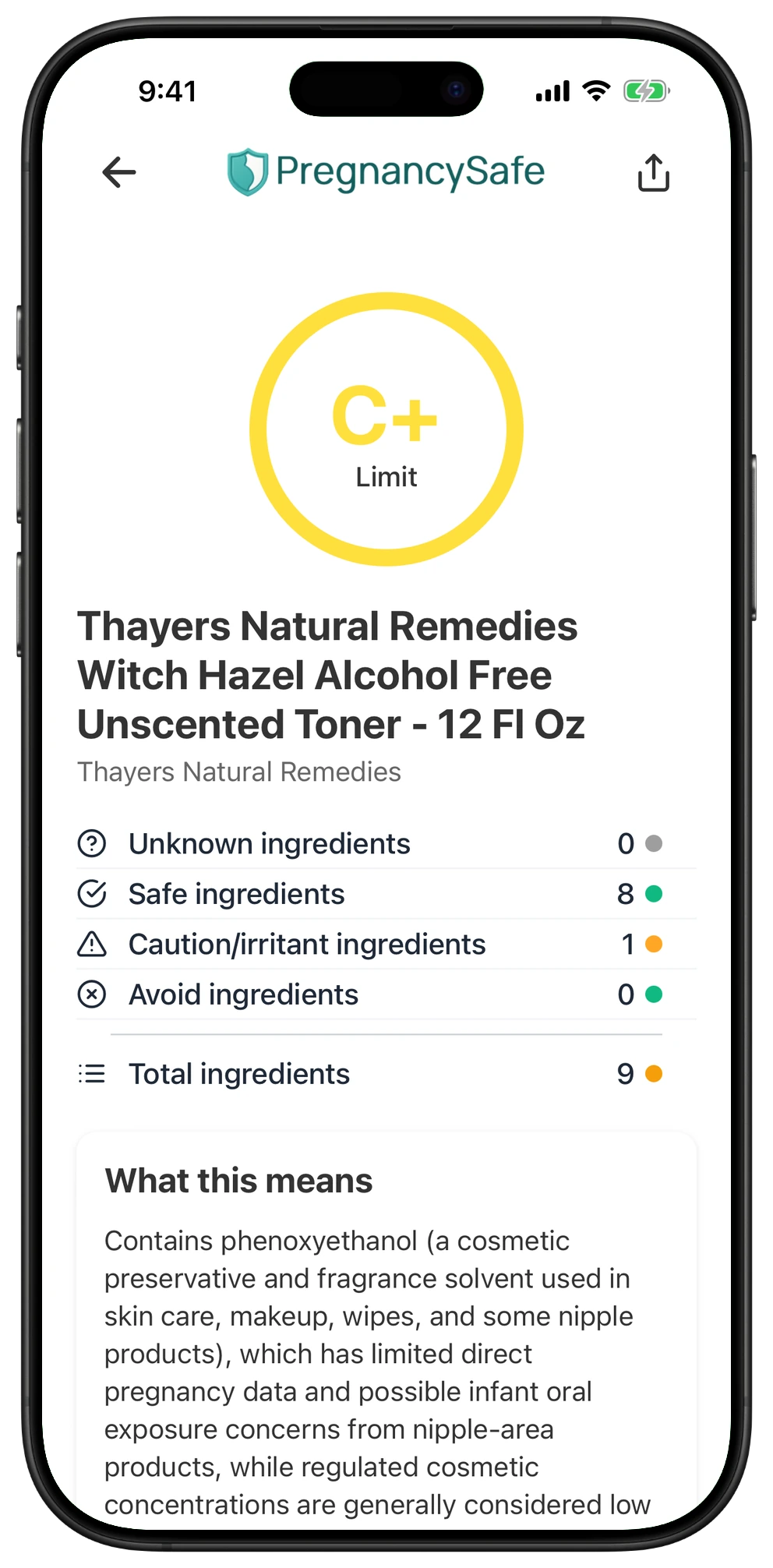
Check your exact witch hazel in the app

✓ What's Safe
- • Choose a product explicitly labeled for external use rather than an oral tincture or supplement.
- • Match the labeled purpose and application site to your needs; a facial astringent is not automatically a hemorrhoid preparation.
- • Read the full ingredient list and any active ingredient panel on the exact version you buy.
- • Consider an alcohol free topical formulation if alcohol containing products sting or dry your skin.
- • Follow the label's amount, frequency and duration instructions rather than applying more for stronger relief.
✗ What to Avoid
- • Do not swallow witch hazel or use oral extracts to treat pregnancy symptoms.
- • Do not assume an alcohol free or sugar free herbal extract is intended for skin use or established safe to ingest.
- • Avoid using a topical preparation internally or on an application site not covered by its directions.
- • Avoid increasing the amount or frequency beyond label directions, or applying to damaged skin without professional advice.
- • Stop using a preparation that causes irritation rather than repeatedly applying it.
- • Do not choose solely by an A grade, a short ingredient list, or natural and clean claims.
Most Common Ingredients in Witch Hazel Products
We analyzed 30 witch hazel products. Here are the most common ingredients, ranked by how often they appear:
Ingredients to Watch Out For in Witch Hazel
These are the most common flagged ingredients across 30 witch hazel products we analyzed.
alcohol
Caution
Alcohol is a volatile, colorless liquid commonly used as a solvent, disinfectant, or intoxicating beverage.
No amount of Alcohol is considered safe. Avoid alcohol beverages entirely. Be extremely careful when using in cooking or even with small percentages.
Flagged in 7 of 30 products (23%)
ethanol
Avoid
Ethanol is a clear, volatile, and flammable alcohol commonly used as a solvent, disinfectant, and in alcoholic beverages.
Has no established safe amount in pregnancy and is linked to fetal alcohol spectrum disorders and other adverse pregnancy outcomes.
Flagged in 2 of 30 products (7%)
ethyl alcohol
Avoid
Ethyl alcohol is a colorless, volatile, and flammable organic compound commonly used as a solvent, disinfectant, and in alcoholic beverages.
Has no established safe amount in pregnancy and is linked to fetal alcohol spectrum disorders and other adverse pregnancy outcomes.
Flagged in 2 of 30 products (7%)
Witch Hazel Products We've Analyzed
Our catalog contains ratings for 30 witch hazel products. These are database grades, not independent safety certifications.
Catalog ingredient scores are not clinical pregnancy verdicts or independent current-label/contaminant checks. Unreviewed, mixed-route or incompletely sourced records can affect counts. Follow exact product form, active ingredients, exposure and directions rather than choosing solely by grade.
Pregnancy Safe Witch Hazel Products
Popular options from our catalog, prioritizing A and B ingredient grades, with C grade options used to fill remaining places. Within each group, products are ordered by searches in Pregnancy Safe, not retail sales. Read the cautions and guidance above; grades do not verify a complete current label or guarantee pregnancy safety.
| Grade | Product | Brand |
|---|---|---|
| B+ | Organic Tea Tree Witch Hazel | Sky Organics |
| A | Witch Hazel | Terravita |
| A | Witch Hazel Strawberry Flavor | Terravita |
| A | Witch Hazel Chocolate Flavor | Terravita |
| A | Witch Hazel Vanilla Flavor | Terravita |
Your Questions Answered
Is witch hazel safe to use on skin while pregnant?
Ordinary external use needs to be considered separately from swallowing witch hazel, but it is not a blanket pregnancy safety guarantee. Choose a preparation labeled for your intended skin use and follow its amount and frequency instructions. Ask your clinician about use on damaged skin, and stop if it causes irritation.
Is witch hazel safe in pregnancy?
The answer depends on the form and how you use it, not simply the ingredient name. Topical pads and astringents are different exposures from oral tinctures and supplements. Follow external use directions, and do not swallow witch hazel or use an oral supplement to treat pregnancy conditions.
Can I use witch hazel pads for hemorrhoids during pregnancy?
Check that the exact pads are labeled for external hemorrhoid use rather than general facial or skin care. Review all active ingredients and follow the application and duration instructions. Ask your clinician or pharmacist about the formulation during pregnancy, and discuss persistent symptoms instead of continuing self treatment indefinitely.
Does alcohol in topical witch hazel pose the same risk as drinking alcohol?
No: ordinary external application and drinking alcohol are different exposure situations. Alcohol in a topical preparation can sting or dry skin, but drinking alcohol evidence does not establish fetal harm from that ordinary external use. Ethanol and ethyl alcohol are names for the same substance, not separate hazards. An alcohol free topical version may help with tolerability, but that label does not certify pregnancy safety.
Can I take alcohol free witch hazel drops while pregnant?
Do not treat alcohol free witch hazel drops as a pregnancy safe oral remedy. Removing alcohol does not establish the safety of swallowing the herbal extract or its supplemental dose. Check the intended route carefully, because a dropper bottle or alcohol free claim does not make an oral extract interchangeable with a topical preparation.
Does an A grade mean a witch hazel product is safe during pregnancy?
No. Our catalog contains 30 products, including 18 with an A grade, but ingredient scores are not clinical pregnancy verdicts or independent current label and contaminant checks. Many records are oral supplement extracts and should not be treated as topical recommendations. A low grade or incomplete record likewise does not, by itself, prove that a product is harmful; check its exact form, ingredients and directions.
How to Interpret These Ratings
Our ingredient and category rules generate letter grades from the information recorded in the catalog. Missing ingredients and broad category assignments can affect the result. These grades do not measure your dose, confirm a complete current label, or test a product for contamination.
A high grade is not a guarantee of pregnancy safety. A low grade is not, by itself, proof of harm from every use. Follow the product-specific guidance above, check the actual package, and ask your prenatal clinician about supplements, treatment decisions or uncertain exposures.
References
- https://www.fda.gov/cosmetics/resources-consumers-cosmetics/cosmetics-pregnancy
- https://www.aad.org/public/everyday-care/skin-care-secrets/routine/pregnancy-skin-care
- https://www.cdc.gov/alcohol-pregnancy/about/index.html
- https://www.cdc.gov/fasd/about/index.html
- https://www.acog.org/womens-health/infographics/alcohol-and-pregnancy
- https://www.niaaa.nih.gov/publications/brochures-and-fact-sheets/alcohol-and-your-pregnancy
- https://mothertobaby.org/fact-sheets/alcohol-pregnancy/
- https://pubmed.ncbi.nlm.nih.gov/26482673/
- https://pmc.ncbi.nlm.nih.gov/articles/PMC9543418/