Is Wine Safe During Pregnancy? (Updated 2026 Guide)
Updated September 9, 2026
The Answer
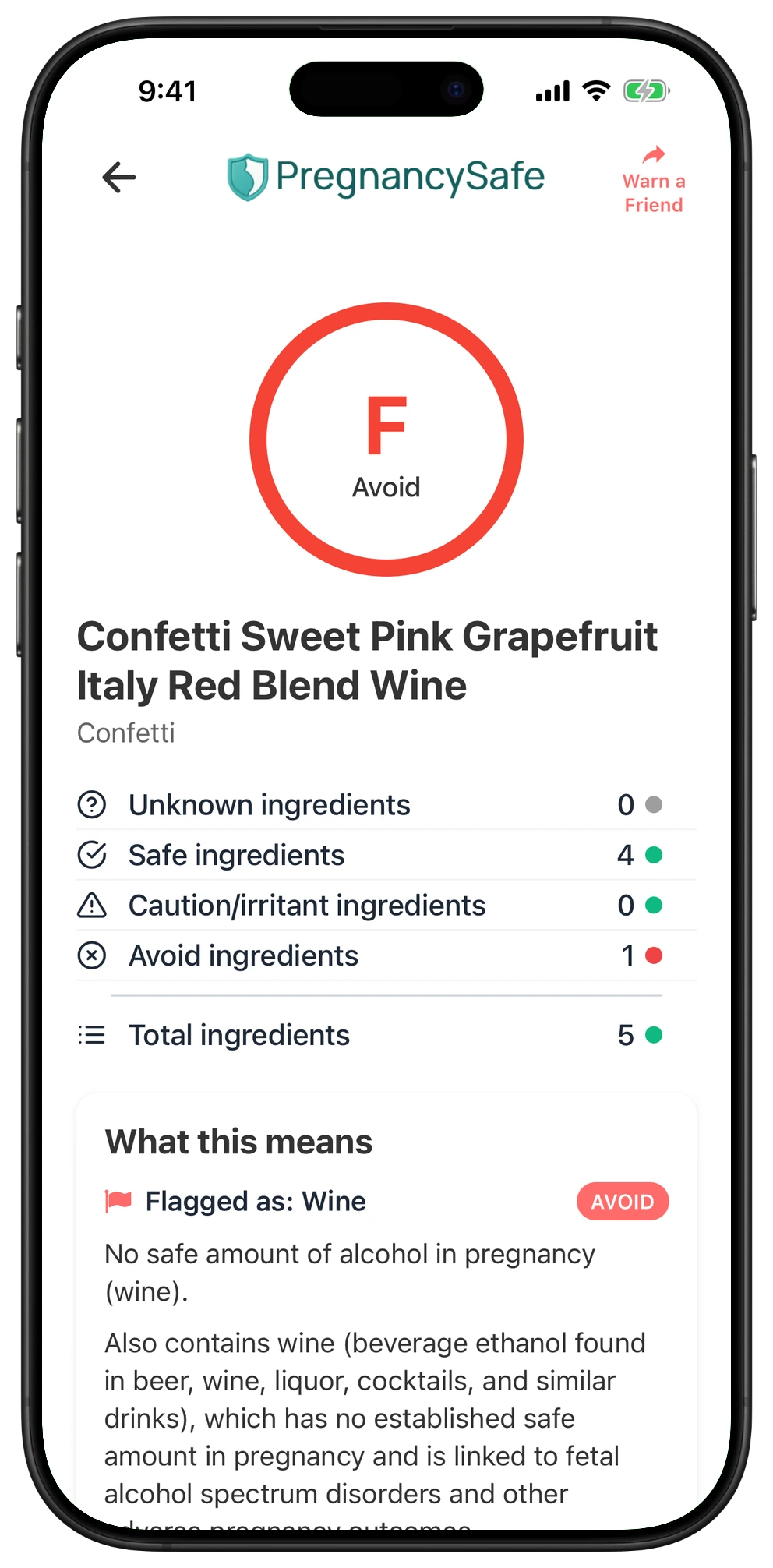
Avoid drinking alcoholic wine during pregnancy: no safe amount, timing, or type of beverage alcohol has been established. Cooking with wine is a separate exposure, but cooking does not automatically remove all alcohol.
The main concern is swallowed ethanol in alcoholic wine, which can affect fetal development and is linked to fetal alcohol spectrum disorders and other adverse pregnancy outcomes. Wine used in food requires attention to preparation and the amount consumed rather than treating it as equivalent to drinking a glass. Non alcoholic labels and catalog grades do not verify alcohol content; choose ordinary nonfermented alternatives when you want to avoid uncertainty.
Pregnancy Safe is 100% independent and research driven. No companies pay to promote or sponsor products.
Stress Less This Pregnancy
Check your exact wine in the app
✓ What's Safe
- • Choose ordinary nonfermented drinks, such as sparkling water, instead of alcoholic wine.
- • Check the exact bottle’s alcohol by volume (ABV), rather than relying on words such as zero or non alcoholic.
- • Choose recipes made without wine when you want to avoid uncertainty about residual alcohol.
- • Ask restaurant staff whether wine is used in sauces or desserts and whether a version without it is available.
- • Check serving sizes and added sugars when choosing a sweet wine alternative, especially if you have individualized carbohydrate guidance.
✗ What to Avoid
- • Avoid drinking alcoholic red wine, white wine, sparkling wine, or fortified wine during pregnancy.
- • Do not treat one small glass or a later trimester as an established safe exception.
- • Do not assume simmering, baking, or other cooking removes every trace of alcohol.
- • Do not assume non alcoholic, alcohol removed, and alcohol free mean the same thing in every market.
- • Do not use an A grade or a product name as proof that a drink contains no alcohol.
- • Avoid choosing wine for claimed resveratrol or other health benefits; those claims do not override pregnancy alcohol guidance.
Most Common Ingredients in Wine Products
We analyzed 352 wine products. Here are the most common ingredients, ranked by how often they appear:
Ingredients to Watch Out For in Wine
These are the most common flagged ingredients across 352 wine products we analyzed.
wine
Caution / Avoid (depends on product type)
Wine is a fermented beverage made from crushed grapes or other fruits, often enjoyed for its rich flavors and cultural significance.
Cooking Wine (CAUTION): Avoid wine beverages entirely. Be extremely careful when using in cooking or even with small percentages.
Wine (AVOID): Has no established safe amount in pregnancy and is linked to fetal alcohol spectrum disorders and other adverse pregnancy outcomes.
Flagged in 67 of 352 products (19%)
neutral spirits
Avoid
Neutral spirits are high proof, flavorless distilled alcohol used as a base for cocktails and infusions.
Has no established safe amount in pregnancy and is linked to fetal alcohol spectrum disorders and other adverse pregnancy outcomes.
Flagged in 11 of 352 products (3%)
red wine
Avoid
Red wine is a rich, fermented beverage made from dark colored grape varieties, often enjoyed for its complex flavors and cultural significance.
Has no established safe amount in pregnancy and is linked to fetal alcohol spectrum disorders and other adverse pregnancy outcomes.
Flagged in 11 of 352 products (3%)
white wine
Avoid
White wine is a crisp, pale yellow alcoholic beverage made from fermented white grapes, often used to enhance the flavor of dishes or enjoyed on its own.
Has no established safe amount in pregnancy and is linked to fetal alcohol spectrum disorders and other adverse pregnancy outcomes.
Flagged in 8 of 352 products (2%)
marsala wine
Avoid
Marsala wine is a rich, fortified Italian wine with a sweet or dry flavor profile, often used in cooking and desserts.
Has no established safe amount in pregnancy and is linked to fetal alcohol spectrum disorders and other adverse pregnancy outcomes.
Flagged in 6 of 352 products (2%)
alcohol
Caution
Alcohol is a volatile, colorless liquid commonly used as a solvent, disinfectant, or intoxicating beverage.
No amount of Alcohol is considered safe. Avoid alcohol beverages entirely. Be extremely careful when using in cooking or even with small percentages.
Flagged in 5 of 352 products (1%)
high fructose corn syrup
Caution
High fructose corn syrup is a sweet, liquid sweetener made from corn starch, commonly used in processed foods and beverages.
Is not a known teratogen at occasional food amounts, but high added sugar intake can displace nutrients and raise gestational diabetes and metabolic concerns.
Flagged in 5 of 352 products (1%)
sherry wine
Avoid
Sherry wine is a fortified Spanish wine known for its rich, nutty flavor and versatility in cooking and sipping.
Has no established safe amount in pregnancy and is linked to fetal alcohol spectrum disorders and other adverse pregnancy outcomes.
Flagged in 5 of 352 products (1%)
Types of Wine
Wine Products We've Analyzed
Our catalog contains ratings for 352 wine products. These are database grades, not independent safety certifications.
Grades do not establish a safe alcohol dose or verify every product’s alcohol content. The wider wine category can include non-alcoholic records; an A grade is not permission to drink alcohol.
Your Questions Answered
Can I have one glass of wine while pregnant?
The recommendation is to avoid alcoholic wine, including an occasional glass. No safe amount or safe time during pregnancy has been established. If you already had a glass, that does not establish that harm occurred; discuss the amount and timing with your pregnancy clinician.
Is a glass of wine safe for a pregnant woman?
A glass of alcoholic wine cannot be described as safe during pregnancy. General claims about wine and adult heart health do not establish pregnancy safety, and red wine is not an exception. Choose a nonfermented drink instead of drinking wine for its supposed health benefits.
Is cooking with wine while pregnant safe?
Cooking with wine is different from drinking it, but cooking does not automatically remove all alcohol. Your exposure depends on how much wine is used, how the dish is prepared, and how much you eat. A recipe made without wine avoids that uncertainty. If you already ate a wine containing dish, do not assume harm occurred; discuss concerns with your pregnancy clinician.
Can I drink non alcoholic wine during pregnancy?
Do not rely on the category name alone to decide. Non alcoholic, alcohol free, and alcohol removed labels are not interchangeable in every market, so check the exact bottle’s ABV and manufacturer information. An ordinary nonfermented alternative avoids uncertainty about residual alcohol. A catalog grade is not a substitute for checking the alcohol content.
What if I drank wine before I knew I was pregnant?
Past drinking does not mean that harm definitely occurred. Avoid further alcoholic drinks and tell your pregnancy clinician about the amount, frequency, and timing so they can advise you individually. If stopping feels difficult, ask for support rather than trying to manage it alone.
Why do some wines have an A grade?
Our catalog contains 352 products in this broad category, including 20 with an A grade, and the category includes non alcoholic records. Those grades do not establish a safe alcohol dose or verify every bottle’s alcohol content. An A grade is not permission to drink alcoholic wine, and a low grade alone does not prove a particular product is harmful. Check the exact product’s label rather than treating the grade as a clinical verdict.
How to Interpret These Ratings
Our ingredient and category rules generate letter grades from the information recorded in the catalog. Missing ingredients and broad category assignments can affect the result. These grades do not measure your dose, confirm a complete current label, or test a product for contamination.
A high grade is not a guarantee of pregnancy safety. A low grade is not, by itself, proof of harm from every use. Follow the product-specific guidance above, check the actual package, and ask your prenatal clinician about supplements, treatment decisions or uncertain exposures.
People Also Checked
References
- https://www.cdc.gov/alcohol-pregnancy/about/index.html
- https://www.cdc.gov/fasd/about/index.html
- https://www.acog.org/womens-health/infographics/alcohol-and-pregnancy
- https://www.niaaa.nih.gov/publications/brochures-and-fact-sheets/alcohol-and-your-pregnancy
- https://mothertobaby.org/fact-sheets/alcohol-pregnancy/
- https://pubmed.ncbi.nlm.nih.gov/26482673/
- https://pmc.ncbi.nlm.nih.gov/articles/PMC9543418/
- https://cdn.realfood.gov/DGA.pdf
- https://www.dietaryguidelines.gov/sites/default/files/2021-12/DGA_Pregnancy_FactSheet-508c.pdf
- https://www.acog.org/womens-health/faqs/healthy-eating-during-pregnancy
- https://www.cdc.gov/nutrition/php/data-research/added-sugars.html
- https://www.cdc.gov/diabetes/about/gestational-diabetes.html
- https://www.who.int/publications/i/item/9789241549028
- https://nesr.usda.gov/2025-dietary-guidelines-advisory-committee-systematic-reviews/dietary-patterns_gestational-diabetes
- https://health.ec.europa.eu/system/files/2021-08/sccs_o_195_0.pdf
- https://ec.europa.eu/growth/tools-databases/cosing/details/28157
- https://journals.sagepub.com/doi/10.3109/10915819009078737
- https://link.springer.com/article/10.1007/s00204-024-03938-5
- https://www.sfda.gov.sa/en/warnings/1156
- https://www.industrialchemicals.gov.au/sites/default/files/Ethanol%2C%202-phenoxy-_Human%20health%20tier%20II%20assessment.pdf
- https://hero.epa.gov/reference/2857875
- https://books.publisso.de/sites/default/files/documents/series/mak/dam/Vol2019/Iss1/Alt006/mb12299kske6319_w.pdf
- https://www.nccih.nih.gov/health/bitter-orange
- https://www.ncbi.nlm.nih.gov/books/NBK501892/
- https://pubmed.ncbi.nlm.nih.gov/21594979/
- https://pubmed.ncbi.nlm.nih.gov/28058460/
- https://www.bfr.bund.de/cm/349/health-assessment-of-sports-and-weight-loss-products-containing-synephrine-and-caffeine.pdf
- https://www.rivm.nl/bibliotheek/rapporten/2017-0069.pdf
- https://www.canada.ca/en/health-canada/services/drugs-health-products/natural-non-prescription/legislation-guidelines/guidance-documents/notice-use-synephrine.html