Is Mushroom Safe During Pregnancy? (Updated 2026 Guide)
Updated September 9, 2026
The Answer
Yes ordinary edible mushrooms can fit your pregnancy diet when properly cleaned, stored and prepared. Avoid unwashed mushrooms, cook enoki thoroughly, and do not treat wild mushrooms or concentrated supplements as equivalent to food mushrooms.
The main concern is food handling, especially contamination on unwashed produce: rinse fresh mushrooms under running water without soap and refrigerate cut mushrooms promptly. Commercially canned mushrooms are a different preparation; follow their package instructions for storage and use after opening. In prepared mushroom dishes, consider added ingredients separately pasteurized feta requires safe handling, while ordinary seasoning amounts of sage are not equivalent to medicinal extracts.
Pregnancy Safe is 100% independent and research driven. No companies pay to promote or sponsor products.
Stress Less This Pregnancy
Check your exact mushroom in the app
✓ What's Safe
- • Choose clearly identified edible mushrooms sold as food through a reliable commercial source.
- • Rinse fresh mushrooms under running water before preparation; follow any specific package instructions.
- • Cook enoki thoroughly rather than serving it raw or using it as an uncooked garnish.
- • Follow the exact storage and preparation instructions for fresh, canned or prepared mushrooms, including after opening.
- • Choose pasteurized dairy in stuffed mushrooms or creamy dishes and keep perishable ingredients refrigerated.
✗ What to Avoid
- • Eating unwashed fresh mushrooms or washing them with soap or detergent.
- • Eating raw or undercooked enoki mushrooms.
- • Eating unidentified wild mushrooms or relying on an app to identify whether a foraged mushroom is edible.
- • Using a food mushroom's ingredient grade as clearance for concentrated mushroom supplements or medicinal extracts.
- • Leaving cut mushrooms unrefrigerated instead of refrigerating them promptly.
- • Using unpasteurized or unlabeled feta in mushroom dishes, or eating recalled ingredients.
Most Common Ingredients in Mushroom Products
We analyzed 542 mushroom products. Here are the most common ingredients, ranked by how often they appear:
Ingredients to Watch Out For in Mushroom
These are the most common flagged ingredients across 542 mushroom products we analyzed.
feta cheese crumbles pasteurized cow's milk
Caution
May carry Listeria risk if made from raw or unpasteurized milk or contaminated after pasteurization, while pasteurized feta kept cold or cooked until steaming hot is generally the safer pregnancy choice.
Flagged in 5 of 542 products (1%)
high fructose corn syrup
Caution
High fructose corn syrup is a sweet, liquid sweetener made from corn starch, commonly used in processed foods and beverages.
Is not a known teratogen at occasional food amounts, but high added sugar intake can displace nutrients and raise gestational diabetes and metabolic concerns.
Flagged in 2 of 542 products (0%)
white wine
Avoid
White wine is a crisp, pale yellow alcoholic beverage made from fermented white grapes, often used to enhance the flavor of dishes or enjoyed on its own.
Has no established safe amount in pregnancy and is linked to fetal alcohol spectrum disorders and other adverse pregnancy outcomes.
Flagged in 2 of 542 products (0%)
alcohol
Caution
Alcohol is a volatile, colorless liquid commonly used as a solvent, disinfectant, or intoxicating beverage.
No amount of Alcohol is considered safe. Avoid alcohol beverages entirely. Be extremely careful when using in cooking or even with small percentages.
Flagged in 1 of 542 products (0%)
feta cheese pasteurized milk cheese cultur
Caution
Feta cheese is a tangy, crumbly, pasteurized milk cheese made with traditional cultures, known for its creamy texture and salty flavor.
May carry Listeria risk if made from raw or unpasteurized milk or contaminated after pasteurization, while pasteurized feta kept cold or cooked until steaming hot is generally the safer pregnancy choice.
Flagged in 1 of 542 products (0%)
partially hydrogenated cottonseed oil
Caution
Partially hydrogenated cottonseed oil is a processed vegetable oil used to improve texture and shelf life in baked goods and snacks, but it contains trans fats that may impact health.
Mainly raise concern when partially hydrogenated and high in artificial trans fat; fully hydrogenated oils are mostly a saturated fat limit rather than the same trans fat issue.
Flagged in 1 of 542 products (0%)
sage
Caution
Sage is a fragrant, gray green herb known for its earthy, slightly peppery flavor and aromatic leaves, often used to enhance savory dishes and herbal remedies.
Is generally low concern at normal culinary amounts but medicinal teas, extracts, supplements, and essential oil should be avoided or clinician reviewed in pregnancy due to limited data and thujone exposure concerns.
Flagged in 1 of 542 products (0%)
seaweed seasoning
Caution
Seaweed seasoning is a savory, umami rich condiment made from dried and ground seaweed, adding a salty, oceanic flavor to dishes.
Can contain highly variable iodine, with high dose brown seaweed or kelp products and hijiki arsenic exposure requiring caution in pregnancy.
Flagged in 1 of 542 products (0%)
Mushroom Products We've Analyzed
Our catalog contains ratings for 542 mushroom products. These are database grades, not independent safety certifications.
Catalog ingredient grades do not measure current-label completeness, pathogens, preparation, caffeine or clinical pregnancy suitability. These counts include unreviewed records and are not a percentage of independently verified safe products.
Pregnancy Safe Mushroom Products
Popular options from our catalog, prioritizing A and B ingredient grades, with C grade options used to fill remaining places. Within each group, products are ordered by searches in Pregnancy Safe, not retail sales. Read the cautions and guidance above; grades do not verify a complete current label or guarantee pregnancy safety.
| Grade | Product | Brand |
|---|---|---|
| A | H-E-B Organics Texas Roots Sliced Baby Bella Mushrooms | H-E-B |
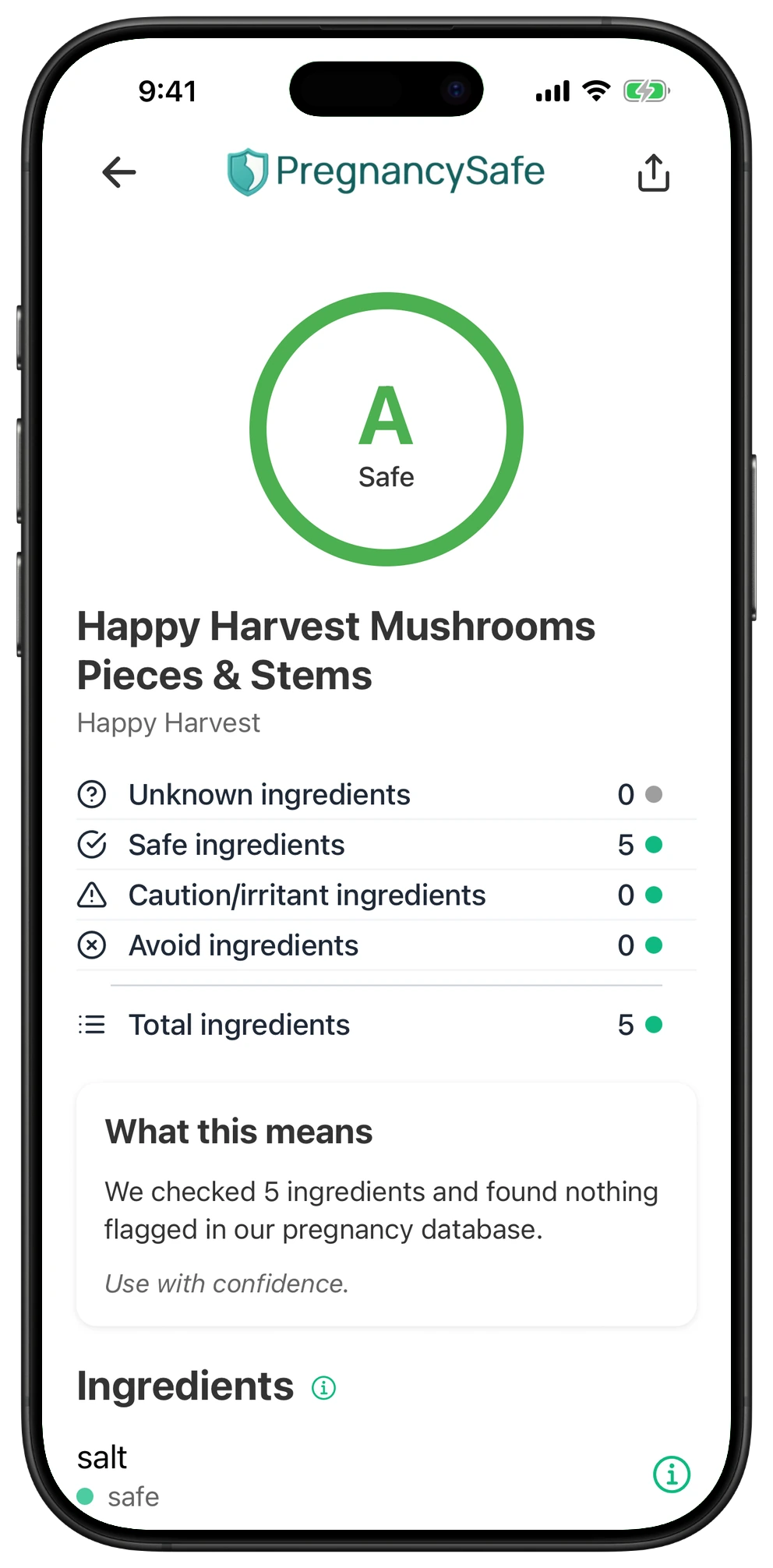
| A | Happy Harvest Mushrooms Pieces & Stems | Happy Harvest |
| A | Sliced Mushrooms | Sainsbury’S |
| A | Pieces & Stems Mushrooms | Essential Everyday |
| A | Organic White Mushrooms | Trader Joe'S |
Your Questions Answered
Can I eat mushrooms in early pregnancy?
Yes ordinary edible food mushrooms can fit your diet in early pregnancy when handled and prepared safely. Rinse fresh mushrooms under running water, refrigerate cut mushrooms promptly and cook enoki thoroughly. This does not establish the safety of wild mushrooms, medicinal extracts or concentrated supplements.
How should I wash mushrooms during pregnancy?
Rinse fresh mushrooms under running water before preparing them. Do not use soap or detergent. Refrigerate cut mushrooms promptly and follow the package's storage instructions. Washing does not replace the need to cook enoki thoroughly.
Can I eat canned mushrooms while pregnant?
Commercially canned edible mushrooms can be an option during pregnancy. Read the actual package and follow its preparation, storage and after opening instructions. A catalog listing does not verify today's package or guarantee pregnancy safety. Canned food mushrooms should not be confused with wild mushrooms or medicinal mushroom products.
Are raw mushrooms and enoki safe during pregnancy?
Avoid unwashed mushrooms, and do not eat enoki raw or undercooked. Cook enoki thoroughly rather than adding it uncooked to a finished dish. For other commercially sold edible mushrooms, rinse them and follow their preparation instructions. Cleaning and cooking cannot establish whether an unidentified wild mushroom is edible.
Are mushroom supplements as safe as mushrooms in food?
You should not assume they are equivalent. Concentrated supplements and medicinal extracts can involve different ingredients and doses from an ordinary serving of edible mushrooms. A food ingredient grade does not establish pregnancy safety for these products. Ask your pregnancy care team to review the exact formulation and dose before using one.
What should I check in stuffed or seasoned mushroom dishes?
Check the full recipe or package, not just the mushrooms. Pasteurized feta is generally acceptable when handled safely; avoid raw milk or unlabeled feta and recalled cheese. If you want to avoid uncertainty about white wine or alcohol in a sauce, choose a recipe without added alcohol; an ingredient listing alone does not establish the amount you would consume. Ordinary culinary sage and occasional added sugar should not be treated as proof of fetal harm.
Does an A grade guarantee that a mushroom product is safe during pregnancy?
No our catalog contains 542 products, including 519 with an A ingredient grade, but these are not 519 independently verified safe products. Grades do not measure pathogens, preparation or current label completeness, and the catalog includes unreviewed records. Check the actual product's food or supplement form, label and handling instructions. A lower grade or incomplete record also does not by itself prove that a product is harmful.
How to Interpret These Ratings
Our ingredient and category rules generate letter grades from the information recorded in the catalog. Missing ingredients and broad category assignments can affect the result. These grades do not measure your dose, confirm a complete current label, or test a product for contamination.
A high grade is not a guarantee of pregnancy safety. A low grade is not, by itself, proof of harm from every use. Follow the product-specific guidance above, check the actual package, and ask your prenatal clinician about supplements, treatment decisions or uncertain exposures.
References
- https://www.fda.gov/food/buy-store-serve-safe-food/selecting-and-serving-produce-safely
- https://www.fda.gov/media/77178/download
- https://www.nhs.uk/pregnancy/keeping-well/foods-to-avoid/
- https://www.fda.gov/food/people-risk-foodborne-illness/cooking-food-safety-moms-be
- https://www.cdc.gov/food-safety/foods/pregnant-women.html
- https://www.cdc.gov/listeria/causes/dairy.html
- https://www.fda.gov/food/health-educators/listeria-food-safety-moms-be
- https://www.foodsafety.gov/people-at-risk/pregnant-women
- https://www.acog.org/clinical/clinical-guidance/committee-opinion/articles/2014/12/management-of-pregnant-women-with-presumptive-exposure-to-listeria-monocytogenes
- https://www.ncbi.nlm.nih.gov/books/NBK582795/
- https://pubmed.ncbi.nlm.nih.gov/29774843/
- https://cdn.realfood.gov/DGA.pdf
- https://www.dietaryguidelines.gov/sites/default/files/2021-12/DGA_Pregnancy_FactSheet-508c.pdf
- https://www.acog.org/womens-health/faqs/healthy-eating-during-pregnancy
- https://www.cdc.gov/nutrition/php/data-research/added-sugars.html
- https://www.cdc.gov/diabetes/about/gestational-diabetes.html
- https://www.who.int/publications/i/item/9789241549028
- https://nesr.usda.gov/2025-dietary-guidelines-advisory-committee-systematic-reviews/dietary-patterns_gestational-diabetes
- https://www.cdc.gov/alcohol-pregnancy/about/index.html
- https://www.cdc.gov/fasd/about/index.html
- https://www.acog.org/womens-health/infographics/alcohol-and-pregnancy
- https://www.niaaa.nih.gov/publications/brochures-and-fact-sheets/alcohol-and-your-pregnancy
- https://mothertobaby.org/fact-sheets/alcohol-pregnancy/
- https://pubmed.ncbi.nlm.nih.gov/26482673/
- https://pmc.ncbi.nlm.nih.gov/articles/PMC9543418/
- https://www.fda.gov/food/food-additives-petitions/trans-fat
- https://www.fda.gov/food/hfp-constituent-updates/fda-completes-final-administrative-actions-partially-hydrogenated-oils-foods
- https://www.federalregister.gov/documents/2013/11/08/2013-26854/tentative-determination-regarding-partially-hydrogenated-oils-request-for-comments-and-for
- https://www.who.int/news-room/fact-sheets/detail/trans-fat
- https://www.fda.gov/food/people-risk-foodborne-illness/dietary-advice-and-during-pregnancy
- https://www.rcpi.ie/Portals/0/Document%20Repository/Institute%20of%20Obstetricians%20and%20Gynaecologists/National%20Clinical%20Guidelines/IOG_National%20Clinical%20Guidelines_Nutrition%20in%20pregnancy%20Guideline_2019.pdf
- https://pmc.ncbi.nlm.nih.gov/articles/PMC8027310/
- https://pmc.ncbi.nlm.nih.gov/articles/PMC3192475/
- https://www.nccih.nih.gov/health/sage
- https://www.ema.europa.eu/en/documents/herbal-monograph/final-european-union-herbal-monograph-salvia-officinalis-l-folium-revision-1_en.pdf
- https://www.ema.europa.eu/en/documents/public-statement/public-statement-salvia-officinalis-l-aetheroleum_en.pdf
- https://www.ema.europa.eu/en/documents/scientific-guideline/public-statement-use-herbal-medicinal-products-containing-thujone-revision-1_en.pdf
- https://webprod.hc-sc.gc.ca/nhpid-bdipsn/dbImages/mono_Sage_Oral_EN.pdf
- https://pubmed.ncbi.nlm.nih.gov/23933314/
- https://pmc.ncbi.nlm.nih.gov/articles/PMC7956842/
- https://journals.sagepub.com/doi/10.1177/10507256261445624
- https://ods.od.nih.gov/factsheets/Iodine-HealthProfessional/
- https://www.foodstandards.gov.au/consumer/nutrition/pregnancy/iodine-and-pregnancy
- https://www.foodstandards.gov.au/consumer/prevention-of-foodborne-illness/arseniciodine
- https://inspection.canada.ca/en/food-safety-consumers/fact-sheets/specific-products-and-risks/chemical-hazards/inorganic-arsenic
- https://pubmed.ncbi.nlm.nih.gov/35947162/
- https://pubmed.ncbi.nlm.nih.gov/20919974/
- https://pubmed.ncbi.nlm.nih.gov/30632947/
- https://pmc.ncbi.nlm.nih.gov/articles/PMC8077470/