Best Pregnancy Safe Leave In Conditioner (Updated 2026 Guide)
Updated September 9, 2026
The Answer
For pregnancy, choose a leave in conditioner with a clear current label, avoid butylphenyl methylpropional, and follow the intended hair use directions without inhaling spray. Our catalog contains mostly C range scores, but ingredient grades do not establish whether a finished product is safe or unsafe in pregnancy.
Leave in conditioner remains on your hair longer than rinse off conditioner, but ordinary hair application is not equivalent to ingestion, supplement dosing, or occupational exposure. Fragrance can cause irritation or allergy, while pregnancy evidence for common preservatives is limited or mixed rather than proof of fetal harm at regulated cosmetic concentrations. Butylphenyl methylpropional warrants avoidance because of regulatory reproductive toxicity concerns; damaged skin, scalp disease, and medicated treatments need separate advice.
Pregnancy Safe is 100% independent and research driven. No companies pay to promote or sponsor products.
Stress Less This Pregnancy
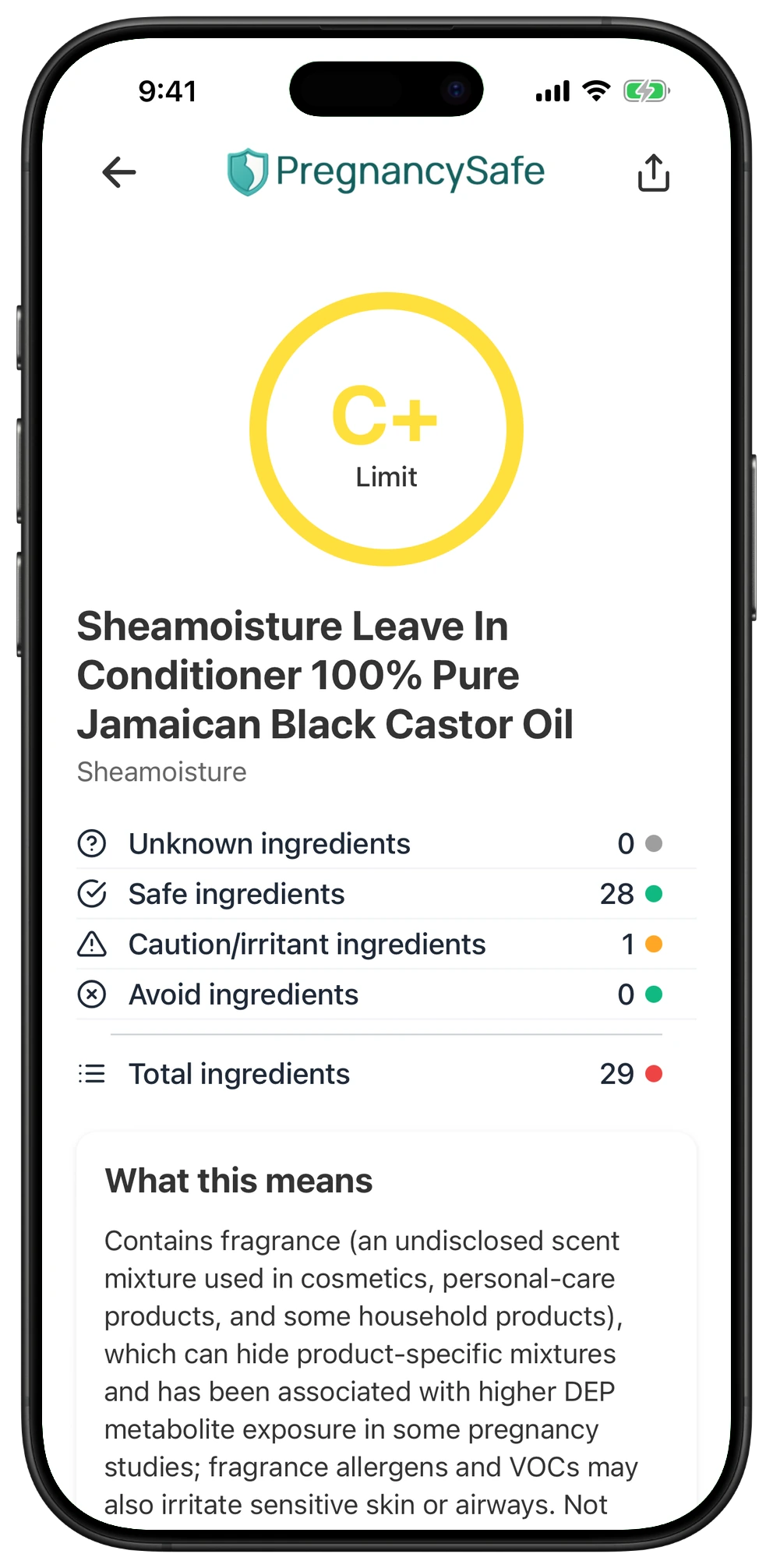
Check your exact leave in conditioner in the app

✓ What's Safe
- • Check the complete ingredient list on your exact bottle against the current manufacturer label, including the fragrance free or fragranced version.
- • Choose a fragrance free formulation if you want to reduce scent mixture exposure or have fragrance sensitivity; it cannot guarantee freedom from reactions.
- • Consider a cream or lotion rather than a mist if you want to avoid breathing airborne conditioner.
- • Look for clear leave in directions specifying the amount and whether the product belongs on hair lengths, the scalp, or both.
- • Choose by the full formulation and intended use, not just an A grade, a short ingredient list, or a clean or natural claim.
✗ What to Avoid
- • Avoid formulas listing butylphenyl methylpropional, also called Lilial, BMHCA, or lysmeral.
- • Avoid fragrance or parfum if it triggers skin or airway symptoms; parfum fragrance and fragrance parfum are alternative label wording, not separate hazards.
- • Avoid benzyl salicylate if you have a known allergy to it; its presence alone does not make normal hair use equivalent to taking oral salicylates.
- • Avoid assuming phenoxyethanol, methylparaben, propylparaben, or ethylparaben automatically makes a conditioner unsafe; evaluate regulated cosmetic use rather than treating caution flags as bans.
- • Avoid inhaling conditioner mist, applying more than directed, or using an ordinary conditioner on broken or inflamed scalp skin without advice.
- • Avoid buying on pregnancy safe marketing alone when the exact formula or application directions are missing.
Most Common Ingredients in Leave In Conditioner Products
We analyzed 275 leave in conditioner products. Here are the most common ingredients, ranked by how often they appear:
Ingredients to Watch Out For in Leave In Conditioner
These are the most common flagged ingredients across 275 leave in conditioner products we analyzed.
Caution
Phenoxyethanol is a preservative commonly used in cosmetics and skincare products to prevent microbial growth and extend shelf life.
Has limited direct pregnancy data and possible infant oral exposure concerns from nipple area products, while regulated cosmetic concentrations are generally considered low systemic risk.
This preservative helps protect leave in conditioner against microbial growth. Direct pregnancy data are limited, but regulated cosmetic concentrations are considered low systemic concern; high dose animal findings and infant ingestion from nipple products do not establish harm from ordinary hair use.
Flagged in 183 of 275 products (67%)
fragrance
Caution
A fragrant substance used to add a pleasant aroma to products or environments.
Can hide product specific mixtures and has been associated with higher DEP metabolite exposure in some pregnancy studies; fragrance allergens and VOCs may also irritate sensitive skin or airways.
In leave in conditioner, fragrance describes a scent mixture that may not disclose every component. Fragrance free options can reduce scent exposure and allergy triggers, but typical use is not proven to harm pregnancy and not every mixture contains phthalates.
Flagged in 135 of 275 products (49%)
benzyl salicylate
Caution
Benzyl salicylate is a fragrant compound commonly used as a UV filter and scent ingredient in perfumes and cosmetics.
Has limited pregnancy specific human data and weak endocrine mode signals, but regulated low dose cosmetic use has wide safety margins compared with high dose oral salicylates.
This fragrance allergen and light stabilizer may appear in scented leave ins. Pregnancy specific human data are limited, but modeled exposure from regulated topical cosmetics is far below medication like oral salicylate exposure; watch for allergy rather than equating it with an oral drug.
Flagged in 51 of 275 products (19%)
parfum
Caution
Parfum is a fragrant mixture of essential oils, aroma compounds, and solvents used to impart a pleasant scent.
Can hide product specific mixtures and has been associated with higher DEP metabolite exposure in some pregnancy studies; fragrance allergens and VOCs may also irritate sensitive skin or airways.
Parfum is another label term for fragrance, not a separate ingredient class with a different pregnancy risk. In a leave in, its practical concerns are undisclosed mixture details and possible skin or airway sensitivity, rather than established fetal harm from typical use.
Flagged in 46 of 275 products (17%)
parfum fragrance
Caution
A parfum fragrance is a concentrated aromatic blend designed to impart a pleasing and lasting scent when applied to the skin or clothing.
Can hide product specific mixtures and has been associated with higher DEP metabolite exposure in some pregnancy studies; fragrance allergens and VOCs may also irritate sensitive skin or airways.
This combined label wording refers to fragrance, not two distinct hazardous ingredients. Because a leave in remains on your hair, choosing a fragrance free version can reduce ongoing scent exposure; this wording alone does not establish phthalate content or pregnancy harm.
Flagged in 38 of 275 products (14%)
fragrance parfum
Caution
A fragrant, concentrated scent used to enhance personal aroma and add a touch of elegance.
Can hide product specific mixtures and has been associated with higher DEP metabolite exposure in some pregnancy studies; fragrance allergens and VOCs may also irritate sensitive skin or airways.
This is alternative combined wording for a fragrance mixture in a conditioner. It does not identify a unique chemical or a stronger hazard than fragrance alone; consider a fragrance free leave in if scent causes irritation or you prefer less mixture uncertainty.
Flagged in 28 of 275 products (10%)
methylparaben
Caution
Methylparaben is a synthetic preservative commonly used in cosmetics and personal care products to inhibit microbial growth and extend shelf life.
Has mixed human pregnancy biomonitoring signals and weak endocrine activity, while regulated cosmetic levels are generally considered low concern.
Methylparaben is a short chain preservative that protects conditioner from microbial growth. Pregnancy biomonitoring findings are mixed and its endocrine activity is weak; regulated topical use is considered low concern, not a proven pregnancy toxin.
Flagged in 22 of 275 products (8%)
butylphenyl methylpropional
Avoid
Butylphenyl methylpropional is a synthetic fragrance compound commonly used to impart floral and fresh scent notes in perfumes and personal care products.
Has regulatory reproductive toxicity concerns, with animal developmental effects and EU cosmetic prohibition supporting avoidance during pregnancy.
Also called Lilial or BMHCA, this fragrance ingredient warrants avoiding in leave in conditioner. Regulatory reproductive toxicity concerns and the EU cosmetic prohibition support that choice, although the evidence relies largely on animal studies rather than demonstrated harm from an individual hair application.
Flagged in 20 of 275 products (7%)
How Do Leave In Conditioner Products Stack Up?
Our catalog contains ratings for 275 leave in conditioner products. These are database grades, not independent safety certifications.
Catalog ingredient scores are not clinical pregnancy verdicts or independent current-label/contaminant checks. Unreviewed, mixed-route or incompletely sourced records can affect counts. Follow exact product form, active ingredients, exposure and directions rather than choosing solely by grade.
Best Pregnancy Safe Leave In Conditioner
Popular options from our catalog, prioritizing A and B ingredient grades, with C grade options used to fill remaining places. Within each group, products are ordered by searches in Pregnancy Safe, not retail sales. Read the cautions and guidance above; grades do not verify a complete current label or guarantee pregnancy safety.
| Grade | Product | Brand |
|---|---|---|
| B+ | Frizz Free Shea Butter Moisturizing Leave-In | Maui Moisture |
| A | Being Frenshe Leave In Conditioner Cashmere Vanilla | Being Frenshe |
| A | Honey Milk Active Repair Leave-In Conditioner Mist | Gisou |
| B+ | 3-In-1 Leave-In Conditioner Contains caffeine; the ingredient grade does not establish the amount. | Divi |
| A | Tropic Isle Living Jamaican Strong Roots Red Pimento Edge Leave-In Conditioner | Tropic Isle Living |
Your Questions Answered
Can I use leave in conditioner during pregnancy?
Choose according to the exact formula and intended use rather than assuming all leave ins are either safe or unsafe. Check for butylphenyl methylpropional, follow the labeled amount, and avoid breathing spray. Ordinary topical hair use is different from swallowing an ingredient or taking it as a supplement. If you have scalp disease or use a medicated hair treatment, ask your clinician about that specific product.
Can you use hair products with fragrance when pregnant?
Typical fragranced hair product use is not established as harmful to pregnancy. Fragrance mixtures are not always fully disclosed, and some personal care exposure studies report associations that do not establish harm from a particular conditioner. Fragrance can also trigger allergy, irritation, or airway symptoms, which are different concerns from reproductive harm. Choosing fragrance free is a reasonable way to reduce exposure, but it does not guarantee you will have no reaction.
Is phenoxyethanol in leave in conditioner a reason to stop using it?
Its presence alone is not a reason to treat a conditioner as unsafe. Phenoxyethanol prevents microbial growth, and cosmetic safety assessments support its use at regulated concentrations, although direct pregnancy outcome data are limited. Findings from much higher systemic animal exposures do not establish harm from normal hair application. Warnings involving infant ingestion from nipple products concern a different route and situation.
Are leave in conditioner sprays different from creams?
Sprays can add inhalation exposure, whereas creams can be applied without creating a mist. Avoid spraying toward your face or breathing the cloud, and follow the application directions. A cream is a practical alternative if mist bothers your airways. Neither format provides a pregnancy safety guarantee; the ingredients and amount used still matter.
Do natural ingredients such as rosemary or moringa make a leave in conditioner safer?
Natural labeling does not establish pregnancy safety. Evidence about swallowing rosemary or moringa preparations cannot be directly applied to a trace extract used for hair conditioning. The extract, concentration, formulation, and exposure route matter. Check the whole label rather than rejecting or endorsing a conditioner because it contains one botanical.
Does an A grade mean a leave in conditioner is verified safe for pregnancy?
No. Our catalog contains 275 leave in conditioners, including 3 with A grades, but those are ingredient scores rather than counts of independently verified pregnancy safe products. Scores do not establish current label accuracy, contaminant testing, or clinical pregnancy outcomes, and incomplete records are not evidence of harm. A listed product helps you match a specific formula; it is not a clinical endorsement or a pregnancy safety guarantee.
How to Interpret These Ratings
Our ingredient and category rules generate letter grades from the information recorded in the catalog. Missing ingredients and broad category assignments can affect the result. These grades do not measure your dose, confirm a complete current label, or test a product for contamination.
A high grade is not a guarantee of pregnancy safety. A low grade is not, by itself, proof of harm from every use. Follow the product-specific guidance above, check the actual package, and ask your prenatal clinician about supplements, treatment decisions or uncertain exposures.
People Also Checked
See our full guide to conditioner during pregnancy.
References
- https://www.fda.gov/cosmetics/resources-consumers-cosmetics/cosmetics-pregnancy
- https://www.aad.org/public/everyday-care/skin-care-secrets/routine/pregnancy-skin-care
- https://health.ec.europa.eu/system/files/2021-08/sccs_o_195_0.pdf
- https://ec.europa.eu/growth/tools-databases/cosing/details/28157
- https://journals.sagepub.com/doi/10.3109/10915819009078737
- https://link.springer.com/article/10.1007/s00204-024-03938-5
- https://www.sfda.gov.sa/en/warnings/1156
- https://www.industrialchemicals.gov.au/sites/default/files/Ethanol%2C%202-phenoxy-_Human%20health%20tier%20II%20assessment.pdf
- https://hero.epa.gov/reference/2857875
- https://books.publisso.de/sites/default/files/documents/series/mak/dam/Vol2019/Iss1/Alt006/mb12299kske6319_w.pdf
- https://www.fda.gov/cosmetics/cosmetic-ingredients/fragrances-cosmetics
- https://www.fda.gov/cosmetics/cosmetic-ingredients/phthalates-cosmetics
- https://www.fda.gov/cosmetics/cosmetic-ingredients/allergens-cosmetics
- https://pmc.ncbi.nlm.nih.gov/articles/PMC3110684/
- https://pmc.ncbi.nlm.nih.gov/articles/PMC4016195/
- https://pmc.ncbi.nlm.nih.gov/articles/PMC4097177/
- https://pmc.ncbi.nlm.nih.gov/articles/PMC8453372/
- https://pmc.ncbi.nlm.nih.gov/articles/PMC10999525/
- https://www.epa.gov/indoor-air-quality-iaq/volatile-organic-compounds-impact-indoor-air-quality
- https://health.ec.europa.eu/system/files/2023-11/sccs_o_277.pdf
- https://eur-lex.europa.eu/legal-content/EN/TXT/HTML/?uri=OJ%3AL_202600909
- https://pmc.ncbi.nlm.nih.gov/articles/PMC10955127/
- https://pubmed.ncbi.nlm.nih.gov/29410076/
- https://www.cir-safety.org/sites/default/files/bensal042019FR.pdf
- https://health.ec.europa.eu/system/files/2023-06/sccs_o_268.pdf
- https://www.fda.gov/cosmetics/cosmetic-ingredients/parabens-cosmetics
- https://health.ec.europa.eu/system/files/2023-12/sccs_o_276_final.pdf
- https://pubmed.ncbi.nlm.nih.gov/19101832/
- https://pubmed.ncbi.nlm.nih.gov/32283359/
- https://pubmed.ncbi.nlm.nih.gov/33477047/
- https://pubmed.ncbi.nlm.nih.gov/36709902/
- https://pubmed.ncbi.nlm.nih.gov/40117576/
- https://pubmed.ncbi.nlm.nih.gov/27156397/
- https://www.canada.ca/en/health-canada/services/chemicals-product-safety/lilial.html
- https://www.canada.ca/en/environment-climate-change/services/evaluating-existing-substances/draft-assessment-phenylpropanoids-aldehydes-group.html
- https://health.ec.europa.eu/publications/safety-butylphenyl-methylpropional-p-bmhca-cosmetic-products-submission-ii_en
- https://eur-lex.europa.eu/legal-content/EN/TXT/PDF/?uri=CELEX%3A32021R1902
- https://chem.echa.europa.eu/100.001.173/harmonised/113759
- https://chem.echa.europa.eu/obligation-lists/candidateList
- https://pubmed.ncbi.nlm.nih.gov/32461162/
- https://health.ec.europa.eu/publications/propylparaben_en
- https://journals.sagepub.com/doi/10.1177/1091581820925001
- https://pubmed.ncbi.nlm.nih.gov/32279061/
- https://pubmed.ncbi.nlm.nih.gov/30412856/
- https://pubmed.ncbi.nlm.nih.gov/32521303/
- https://pubmed.ncbi.nlm.nih.gov/35487354/
- https://pubmed.ncbi.nlm.nih.gov/16097138/
- https://ec.europa.eu/health/scientific_committees/consumer_safety/docs/sccs_o_132.pdf
- https://pubmed.ncbi.nlm.nih.gov/34474324/
- https://pubmed.ncbi.nlm.nih.gov/29596967/