Is Frozen Yogurt Safe During Pregnancy? (Updated 2026 Guide)
Updated September 9, 2026
The Answer
Yes, frozen yogurt can be a pregnancy option when made with pasteurized dairy and handled properly; avoid versions made with raw milk. Keep packaged frozen yogurt frozen, and check pasteurization and equipment cleaning practices before choosing machine served soft serve.
The main pregnancy consideration is foodborne illness: pasteurization matters, but pasteurized frozen yogurt is not sterile, and freezing does not kill all pathogens. Packaged products need proper frozen storage, while soft serve also depends on properly cleaned equipment. Added sugars, including high fructose corn syrup, are mainly an amount and frequency consideration, not evidence that an occasional serving causes fetal harm.
Pregnancy Safe is 100% independent and research driven. No companies pay to promote or sponsor products.
Stress Less This Pregnancy
Check your exact frozen yogurt in the app

✓ What's Safe
- • Confirm that the milk and other dairy ingredients are pasteurized; check the package or ask the manufacturer or shop.
- • Choose packaged frozen yogurt that has been kept frozen, and follow its storage and use instructions.
- • For machine served frozen yogurt, ask about equipment cleaning and safe handling rather than relying on appearance alone.
- • Compare added sugar at the portion size you actually plan to eat, including toppings.
- • Read the exact flavor and version's current label; an archived label or ingredient grade cannot confirm today's formulation or handling.
✗ What to Avoid
- • Avoid frozen yogurt made with raw or unpasteurized milk.
- • Skip products when you cannot confirm pasteurization or proper storage.
- • Avoid machine served frozen yogurt when equipment cleanliness or handling is questionable.
- • Do not assume freezing or refreezing makes improperly handled frozen yogurt safe.
- • Limit frequent large servings with high fructose corn syrup or other added sugars rather than treating frozen yogurt as an unrestricted health food.
- • Avoid intentionally alcohol containing desserts; an ethyl alcohol label entry alone does not establish the amount or make trace flavoring exposure equivalent to drinking alcohol.
Most Common Ingredients in Frozen Yogurt Products
We analyzed 287 frozen yogurt products. Here are the most common ingredients, ranked by how often they appear:
Ingredients to Watch Out For in Frozen Yogurt
These are the most common flagged ingredients across 287 frozen yogurt products we analyzed.
high fructose corn syrup
Caution
High fructose corn syrup is a sweet, liquid sweetener made from corn starch, commonly used in processed foods and beverages.
Is not a known teratogen at occasional food amounts, but high added sugar intake can displace nutrients and raise gestational diabetes and metabolic concerns.
Flagged in 42 of 287 products (15%)
Caution
Red 40 is a synthetic food dye commonly used to add vibrant red color to candies, beverages, and processed foods.
Has limited human pregnancy data and is allowed at regulated food additive levels, but child neurobehavior concerns and high dose animal findings make frequent high dye intake worth limiting.
Flagged in 18 of 287 products (6%)
blue 1
Caution
Blue 1 is a synthetic blue dye commonly used to add vibrant color to foods, beverages, and cosmetics.
Has limited human pregnancy data; regulated food use is not shown to cause fetal harm, but high dose animal neurobehavior findings and child sensitivity concerns support minimizing frequent exposure.
Flagged in 13 of 287 products (5%)
ethyl alcohol
Avoid
Ethyl alcohol is a colorless, volatile, and flammable organic compound commonly used as a solvent, disinfectant, and in alcoholic beverages.
Has no established safe amount in pregnancy and is linked to fetal alcohol spectrum disorders and other adverse pregnancy outcomes.
Flagged in 5 of 287 products (2%)
partially hydrogenated soybean oil
Caution
Partially hydrogenated soybean oil is a processed fat commonly used in foods to improve texture and shelf life, but it contains trans fats linked to health risks.
Mainly raise concern when partially hydrogenated and high in artificial trans fat; fully hydrogenated oils are mostly a saturated fat limit rather than the same trans fat issue.
Flagged in 5 of 287 products (2%)
artificial color
Caution
Artificial color is a synthetic dye added to foods and products to enhance or alter their visual appearance.
Has limited pregnancy specific outcome data; regulated incidental exposure is generally low concern but some dyes have child behavior allergy or regulatory caveats.
Flagged in 2 of 287 products (1%)
artificial colors red 40
Caution
Red 40 is a synthetic artificial colorant commonly used to add a vibrant red hue to foods and beverages.
Has limited human pregnancy data and is allowed at regulated food additive levels, but child neurobehavior concerns and high dose animal findings make frequent high dye intake worth limiting.
Flagged in 2 of 287 products (1%)
probiotic culture bacillus coagulans gbi 30 6086
Caution
Has strain specific safety with limited pregnancy specific data and includes species that can cause foodborne illness or carry toxin genes.
Flagged in 2 of 287 products (1%)
Frozen Yogurt Products We've Analyzed
Our catalog contains ratings for 287 frozen yogurt products. These are database grades, not independent safety certifications.
Catalog ingredient grades do not measure current-label completeness, pathogens, preparation, caffeine or clinical pregnancy suitability. These counts include unreviewed records and are not a percentage of independently verified safe products.
Pregnancy Safe Frozen Yogurt Products
Popular options from our catalog, prioritizing A and B ingredient grades, with C grade options used to fill remaining places. Within each group, products are ordered by searches in Pregnancy Safe, not retail sales. Read the cautions and guidance above; grades do not verify a complete current label or guarantee pregnancy safety.
| Grade | Product | Brand |
|---|---|---|
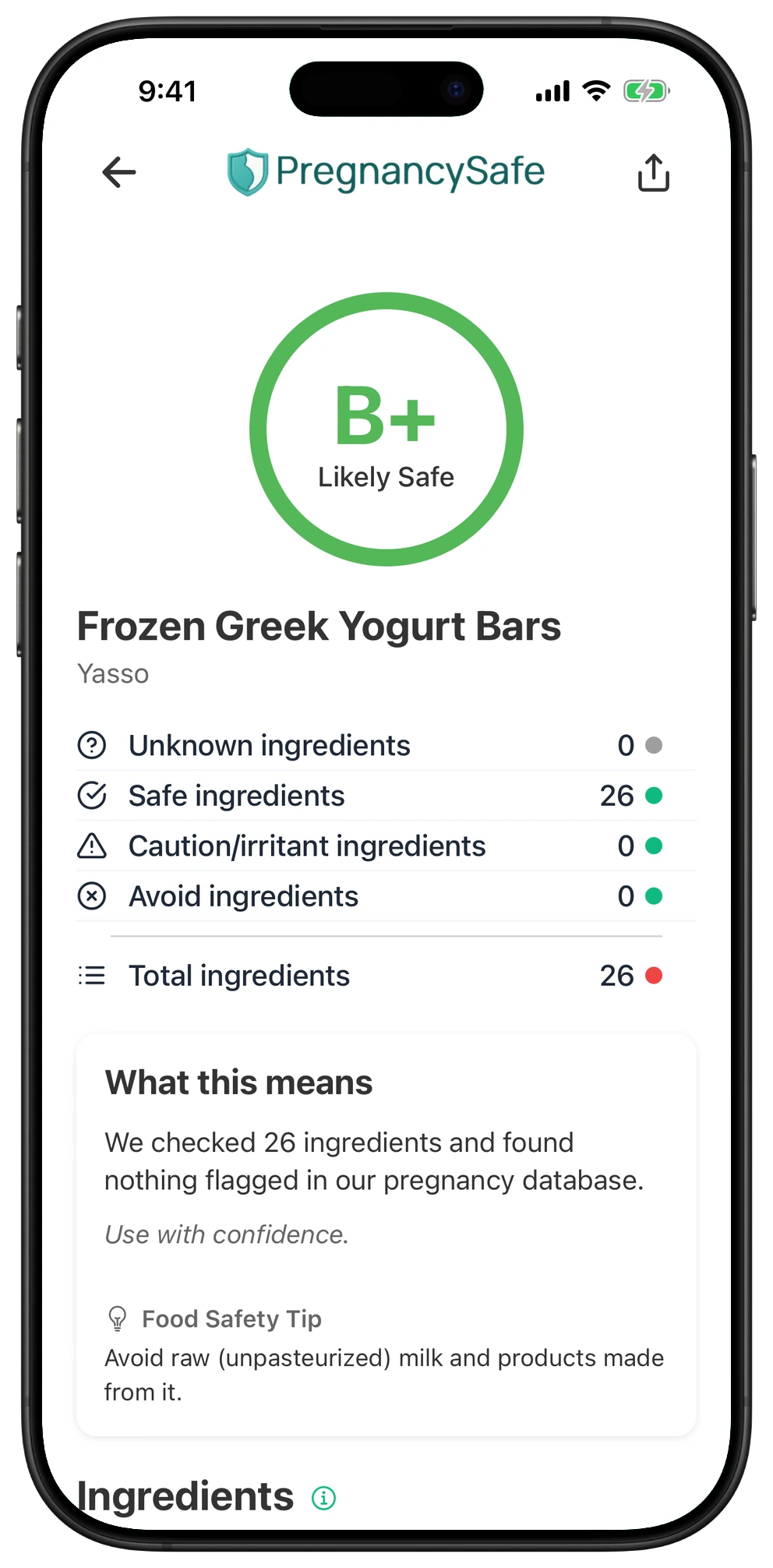
| B+ | Frozen Greek Yogurt Bars | Yasso |
| B+ | Kemps Low Fat Vanilla Bean Frozen Yogurt | Kemps |
| A | Cookies 'N Cream Frozen Greek Yogurt | Yasso |
| A | Yasso Frozen Greek Yogurt Indulgent Vanilla Chocolate Crunch | Yasso |
| B+ | Vanilla Nonfat Frozen Yogurt | Umpqua |
Your Questions Answered
What yogurts should I avoid while pregnant?
Avoid yogurt and frozen yogurt made with raw, unpasteurized milk. Also skip products whose storage or handling you cannot trust, even if the dairy was pasteurized. Fruit flavoring alone is not a reason to avoid yogurt during pregnancy; check pasteurization, handling and added sugar instead.
Is frozen yogurt made with pasteurized milk?
Check the exact product rather than assuming all frozen yogurt uses pasteurized milk. Look for confirmation on the package, or ask the manufacturer or shop about its dairy ingredients. Pasteurization does not remove the need for proper storage and clean serving equipment.
Can I eat soft serve frozen yogurt during pregnancy?
For soft serve, both pasteurized ingredients and properly cleaned equipment matter. Ask the shop about its mix and cleaning practices; if these cannot be confirmed, choose a packaged option with confirmed pasteurization and proper frozen storage instead. Machine served and packaged frozen yogurt have different handling considerations, but neither is guaranteed free of pathogens.
Does freezing frozen yogurt kill Listeria?
No, freezing does not reliably eliminate Listeria or all other pathogens. It is not a substitute for pasteurization and hygienic preparation. Keep packaged frozen yogurt frozen as instructed, but do not use refreezing to rescue a product that has been improperly handled.
How much frozen yogurt can I eat while pregnant?
There is no single pregnancy specific serving amount that fits everyone. Check the serving size and added sugar, and consider how often you eat it alongside other sweet foods. High fructose corn syrup is an added sugar, not a known teratogen at occasional food amounts. If you have gestational diabetes, use your care team's individualized carbohydrate guidance.
Are live cultures in frozen yogurt a pregnancy concern?
Live cultures are not the same as raw milk, and their presence alone does not mean the dairy is unpasteurized. They also do not establish pregnancy specific probiotic benefits. For added Bacillus coagulans GBI 30 6086, pregnancy specific evidence is limited; this named food strain should not be equated with food poisoning species or high dose probiotic supplements.
Does an A grade mean frozen yogurt is guaranteed safe during pregnancy?
No. Our catalog contains 287 frozen yogurt products, including 69 with an A ingredient grade, but those counts include unreviewed records and are not independently verified safe product counts. Ingredient grades do not measure pathogens, preparation or current label completeness, and a low grade alone does not prove a product is harmful. Check the actual package, pasteurization and storage regardless of grade.
How to Interpret These Ratings
Our ingredient and category rules generate letter grades from the information recorded in the catalog. Missing ingredients and broad category assignments can affect the result. These grades do not measure your dose, confirm a complete current label, or test a product for contamination.
A high grade is not a guarantee of pregnancy safety. A low grade is not, by itself, proof of harm from every use. Follow the product-specific guidance above, check the actual package, and ask your prenatal clinician about supplements, treatment decisions or uncertain exposures.
People Also Checked
See our full guide to yogurt during pregnancy.
References
- https://www.cdc.gov/foodsafety/rawmilk/index.html
- https://www.cdc.gov/listeria/prevention/index.html
- https://www.nhs.uk/pregnancy/keeping-well/foods-to-avoid/
- https://cdn.realfood.gov/DGA.pdf
- https://www.dietaryguidelines.gov/sites/default/files/2021-12/DGA_Pregnancy_FactSheet-508c.pdf
- https://www.acog.org/womens-health/faqs/healthy-eating-during-pregnancy
- https://www.cdc.gov/nutrition/php/data-research/added-sugars.html
- https://www.cdc.gov/diabetes/about/gestational-diabetes.html
- https://www.who.int/publications/i/item/9789241549028
- https://nesr.usda.gov/2025-dietary-guidelines-advisory-committee-systematic-reviews/dietary-patterns_gestational-diabetes
- https://www.hfpappexternal.fda.gov/scripts/fdcc/index.cfm?id=FDCRed40&set=ColorAdditives
- https://www.ecfr.gov/current/title-21/chapter-I/subchapter-A/part-74/subpart-A/section-74.340
- https://www.fda.gov/food/color-additives-information-consumers/tracking-food-industry-pledges-remove-petroleum-based-food-dyes
- https://www.efsa.europa.eu/en/efsajournal/pub/1327
- https://www.efsa.europa.eu/en/efsajournal/pub/4007
- https://apps.who.int/food-additives-contaminants-jecfa-database/Home/Chemical/2361
- https://oehha.ca.gov/risk-assessment/report/health-effects-assessment-potential-neurobehavioral-effects-synthetic-food-dyes-children
- https://pubmed.ncbi.nlm.nih.gov/6636206/
- https://pubmed.ncbi.nlm.nih.gov/2613118/
- https://pubmed.ncbi.nlm.nih.gov/7940558/
- https://www.hfpappexternal.fda.gov/scripts/fdcc/index.cfm?id=FDCBlue1&set=ColorAdditives
- https://www.ecfr.gov/current/title-21/chapter-I/subchapter-A/part-74
- https://efsa.onlinelibrary.wiley.com/doi/10.2903/j.efsa.2010.1853
- https://apps.who.int/food-additives-contaminants-jecfa-database/Home/Chemical/3309
- https://pubmed.ncbi.nlm.nih.gov/23208798/
- https://pubmed.ncbi.nlm.nih.gov/24257113/
- https://www.cdc.gov/alcohol-pregnancy/about/index.html
- https://www.cdc.gov/fasd/about/index.html
- https://www.acog.org/womens-health/infographics/alcohol-and-pregnancy
- https://www.niaaa.nih.gov/publications/brochures-and-fact-sheets/alcohol-and-your-pregnancy
- https://mothertobaby.org/fact-sheets/alcohol-pregnancy/
- https://pubmed.ncbi.nlm.nih.gov/26482673/
- https://pmc.ncbi.nlm.nih.gov/articles/PMC9543418/
- https://www.fda.gov/food/food-additives-petitions/trans-fat
- https://www.fda.gov/food/hfp-constituent-updates/fda-completes-final-administrative-actions-partially-hydrogenated-oils-foods
- https://www.federalregister.gov/documents/2013/11/08/2013-26854/tentative-determination-regarding-partially-hydrogenated-oils-request-for-comments-and-for
- https://www.who.int/news-room/fact-sheets/detail/trans-fat
- https://www.fda.gov/food/people-risk-foodborne-illness/dietary-advice-and-during-pregnancy
- https://www.rcpi.ie/Portals/0/Document%20Repository/Institute%20of%20Obstetricians%20and%20Gynaecologists/National%20Clinical%20Guidelines/IOG_National%20Clinical%20Guidelines_Nutrition%20in%20pregnancy%20Guideline_2019.pdf
- https://pmc.ncbi.nlm.nih.gov/articles/PMC8027310/
- https://pmc.ncbi.nlm.nih.gov/articles/PMC3192475/
- https://www.fda.gov/food/color-additives-information-consumers/color-additives-questions-and-answers-consumers
- https://www.fda.gov/food/food-ingredients-packaging/color-additives-information-consumers
- https://www.fda.gov/cosmetics/cosmetic-ingredient-names/color-additives-permitted-use-cosmetics
- https://www.fda.gov/industry/color-additives/fdc-red-no-3
- https://pubmed.ncbi.nlm.nih.gov/35233072/
- https://pubmed.ncbi.nlm.nih.gov/35484553/
- https://pubmed.ncbi.nlm.nih.gov/35106984/
- https://pmc.ncbi.nlm.nih.gov/articles/PMC8308823/
- https://pmc.ncbi.nlm.nih.gov/articles/PMC5759212/
- https://pmc.ncbi.nlm.nih.gov/articles/PMC6811671/
- https://www.efsa.europa.eu/en/topics/topic/qualified-presumption-safety-qps
- https://www.fda.gov/files/food/published/GRAS-Notice-000660---Bacillus-coagulans-GBI-30--6086.pdf
- https://www.bccdc.ca/health-info/diseases-conditions/bacillus-cereus
- https://www.fda.gov/food/people-risk-foodborne-illness/food-safety-booklet-pregnant-women-their-unborn-babies-and-children-under-five