Best Pregnancy Safe Energy Drink (Updated 2026 Guide)
Updated September 9, 2026
The Answer
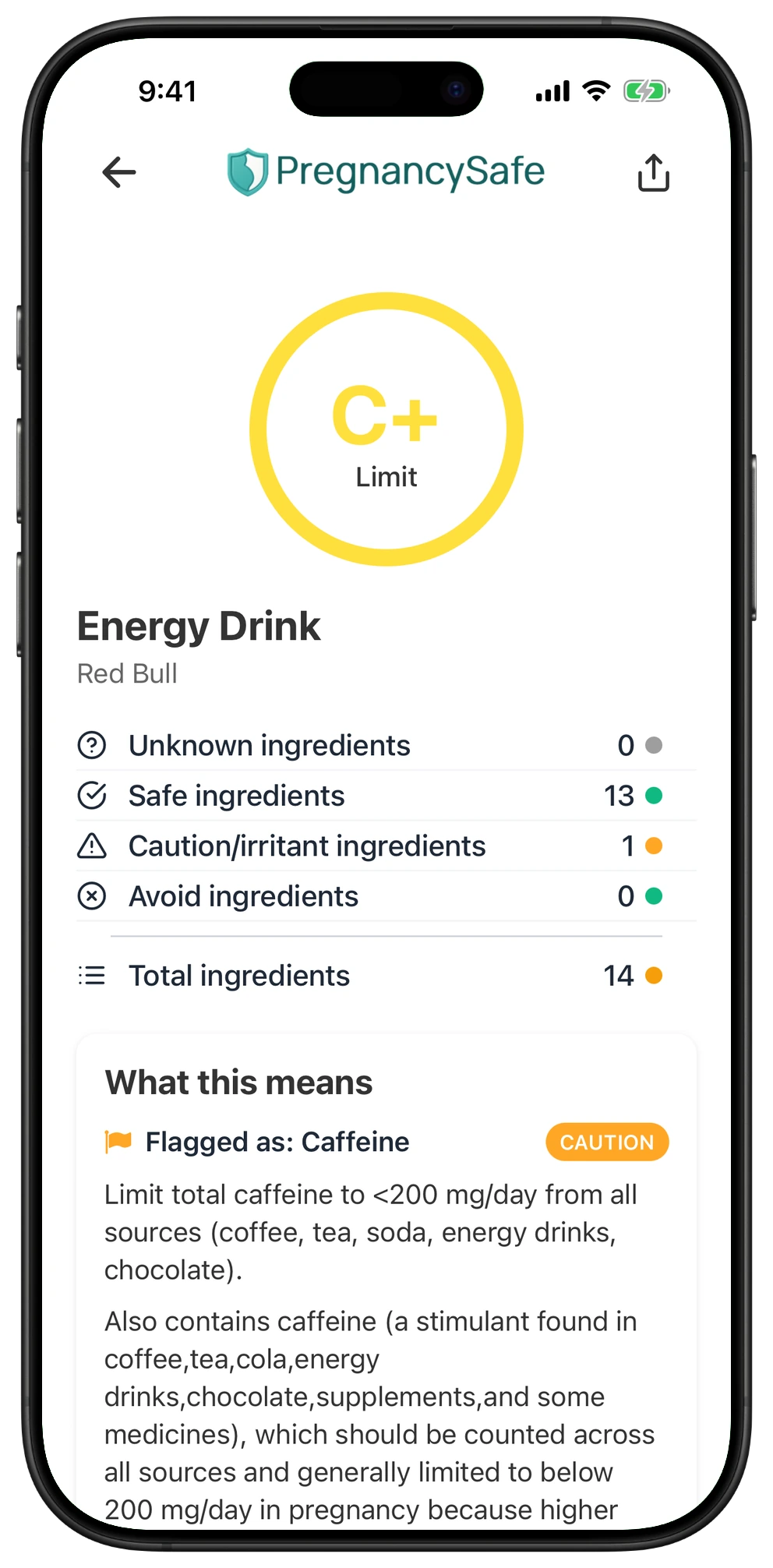
Avoid energy drinks as a routine pregnancy beverage; choose ordinary hydration instead. Keep total caffeine below 200 mg per day from all sources, but remember that staying below this limit does not establish the safety of other stimulants or botanical blends.
Energy drinks can contain high or variable amounts of caffeine, including caffeine from guarana, so check the amount in the entire container rather than just one serving. Oral botanical extracts such as panax ginseng have limited pregnancy safety evidence, and concentrated l citrulline requires separate consideration from ordinary food exposure. Sugar free labels and high catalog grades do not establish pregnancy safety or measure your total stimulant exposure.
Pregnancy Safe is 100% independent and research driven. No companies pay to promote or sponsor products.
Stress Less This Pregnancy
Check your exact energy drink in the app

✓ What's Safe
- • Choose ordinary hydration, such as plain water, rather than a drink marketed for stimulation or energy.
- • Check caffeine in milligrams per serving and the number of servings in the container; calculate the amount you would actually drink.
- • Read the full ingredient list for caffeine sources, including guarana, rather than relying on the front label.
- • Prefer beverages without added stimulant or botanical blends; caffeine free alone does not settle the safety of other ingredients.
- • Check added sugars and follow your care team's carbohydrate guidance if you have gestational diabetes.
✗ What to Avoid
- • Avoid using drinks containing caffeine, caffeine anhydrous, or natural caffeine as routine pregnancy beverages; all contribute to the same daily caffeine total.
- • Avoid energy drinks containing panax ginseng root extract or panax ginseng extract because pregnancy evidence for oral use is inadequate.
- • Avoid self selecting concentrated l citrulline drinks for performance or blood pressure benefits during pregnancy; discuss supplemental doses with your clinician.
- • Limit frequent heavily dyed drinks containing red 40, fd c red 40, or blue 1, without treating occasional food level exposure as proven fetal harm.
- • Limit frequent high sugar drinks containing high fructose corn syrup; removing sugar does not remove stimulant concerns.
- • Avoid treating an unclear caffeine amount, a sugar free claim, or an A grade as permission to drink an energy blend.
Most Common Ingredients in Energy Drink Products
We analyzed 2,932 energy drink products. Here are the most common ingredients, ranked by how often they appear:
Ingredients to Watch Out For in Energy Drink
These are the most common flagged ingredients across 2,932 energy drink products we analyzed.
caffeine
Caution
Caffeine is a natural stimulant found in coffee, tea, and various plants that temporarily boosts alertness and reduces fatigue.
Should be counted across all sources and generally limited to below 200 mg/day in pregnancy because higher intake has observational links to miscarriage and fetal growth outcomes.
In energy drinks, caffeine contributes to your total oral caffeine exposure; keep the daily total below 200 mg across all sources. Check the amount in the entire container. Higher intake has observational links to adverse pregnancy outcomes, but these findings do not prove that a single exposure caused harm.
Flagged in 1415 of 2,932 products (48%)
caffeine anhydrous
Caution
Caffeine anhydrous is a dehydrated, powdered form of caffeine commonly used as a stimulant to increase alertness and energy.
Should be counted across all sources and generally limited to below 200 mg/day in pregnancy because higher intake has observational links to miscarriage and fetal growth outcomes.
Caffeine anhydrous is dehydrated caffeine, not a separate stimulant with a separate allowance. Count its caffeine dose toward the same below-200-mg daily total. Its name alone does not tell you how much caffeine an energy drink contains.
Flagged in 301 of 2,932 products (10%)
panax ginseng root extract
Avoid
Panax ginseng root extract is a traditional herbal ingredient known for its energizing, adaptogenic, and immune boosting properties.
Is not recommended as an oral supplement in pregnancy because human data are limited and animal or embryo culture ginsenoside studies raise developmental concerns.
This Asian ginseng root extract is an oral botanical addition to some energy drinks. Avoid it during pregnancy because human safety data are inadequate. Developmental findings from isolated ginsenosides in rodent embryo cultures do not establish harm from a particular beverage dose.
Flagged in 244 of 2,932 products (8%)
Caution
Red 40 is a synthetic food dye commonly used to add vibrant red color to candies, beverages, and processed foods.
Has limited human pregnancy data and is allowed at regulated food additive levels, but child neurobehavior concerns and high dose animal findings make frequent high dye intake worth limiting.
Red 40 colors some energy drinks and is also called Allura Red AC. Occasional regulated food level exposure is unlikely to be a major pregnancy hazard; human pregnancy data are limited. Limiting frequent heavily dyed drinks is a precaution, not a conclusion that this dye causes fetal harm.
Flagged in 219 of 2,932 products (7%)
blue 1
Caution
Blue 1 is a synthetic blue dye commonly used to add vibrant color to foods, beverages, and cosmetics.
Has limited human pregnancy data; regulated food use is not shown to cause fetal harm, but high dose animal neurobehavior findings and child sensitivity concerns support minimizing frequent exposure.
Blue 1, also called Brilliant Blue FCF, is a color additive in some energy drinks. Ordinary regulated food use has not been shown to cause fetal harm, although pregnancy specific data are very limited. Child sensitivity concerns and high dose animal findings are indirect evidence, not proof of harm from a beverage serving.
Flagged in 188 of 2,932 products (6%)
natural caffeine
Caution
Natural caffeine is a plant derived stimulant found in sources like coffee beans, tea leaves, and guarana that provides a boost of energy and alertness.
Should be counted across all sources and generally limited to below 200 mg/day in pregnancy because higher intake has observational links to miscarriage and fetal growth outcomes.
Natural caffeine is plant derived caffeine and has the same pregnancy counting rule as other caffeine. Include its dose in your below-200-mg daily total rather than treating natural sourcing as a safety advantage. An energy drink's other ingredients still need separate consideration.
Flagged in 171 of 2,932 products (6%)
l citrulline
Caution
Is low concern from foods but concentrated supplements have limited pregnancy data and may affect blood pressure or vascular therapies.
L citrulline is an amino acid that may be added to performance oriented energy drinks. Normal food exposure, such as watermelon, is low concern, but concentrated supplemental doses have limited pregnancy data and may affect blood pressure. Do not assume an added beverage dose is equivalent to food exposure; discuss concentrated use with your clinician.
Flagged in 167 of 2,932 products (6%)
panax ginseng extract
Avoid
Panax ginseng extract is a natural herbal supplement known for its energizing, adaptogenic, and immune boosting properties.
Is not recommended as an oral supplement in pregnancy because human data are limited and animal or embryo culture ginsenoside studies raise developmental concerns.
Panax ginseng extract is an Asian ginseng preparation, not a distinct pregnancy safe alternative to panax ginseng root extract. Oral use is not recommended during pregnancy because adequate human safety evidence is lacking. The amount and composition in an energy drink may differ from experimental exposures, so animal findings cannot quantify that drink's risk.
Flagged in 149 of 2,932 products (5%)
How Do Energy Drink Products Stack Up?
Our catalog contains ratings for 2,932 energy drink products. These are database grades, not independent safety certifications.
Scores do not measure total stimulant exposure or verify every label. Do not select an A-grade energy drink as a pregnancy-safe substitute.
Your Questions Answered
What drink can a pregnant woman take for energy?
Choose ordinary hydration rather than relying on an energy drink for stimulation. If you choose ordinary tea or coffee, account for the caffeine in your actual serving and keep your daily total below 200 mg from all sources. A measured ordinary beverage differs from an energy drink containing multiple stimulants or botanical extracts. Discuss persistent fatigue with your prenatal care team rather than managing it with increasingly strong drinks.
What happens if I drank energy drinks before I knew I was pregnant?
A past sip or drink does not mean you harmed your pregnancy. Check the exact label and note how much you drank, when you drank it, and any other caffeine you consumed. Avoid routine energy drink use going forward and keep total caffeine below 200 mg per day. Seek individualized medical advice if the exposure was substantial or you have symptoms.
Can I drink an energy drink if it contains less than 200 mg of caffeine?
Being below 200 mg does not automatically make an energy drink an appropriate pregnancy choice. The limit applies to your total daily caffeine from drinks, foods, supplements, and some medicines not to each container separately. Guarana and natural caffeine also contribute to that total. Other stimulants and botanical blends need separate consideration, so avoid routine energy drink use even when the caffeine appears to fit.
Are sugar free or natural energy drinks safer during pregnancy?
Sugar free does not mean stimulant free, and natural caffeine is still caffeine. Removing added sugar does not resolve concerns about caffeine dose or botanical extracts. Check the full label rather than relying on natural, zero sugar, or similar claims. Ordinary hydration remains the better default.
Does an A grade mean an energy drink is pregnancy safe?
No. Our catalog contains 2,932 products in this category, including 238 with an A grade, but those grades do not verify every label or measure total stimulant exposure. They are not a count of independently verified pregnancy safe drinks. Likewise, a low grade or an incomplete record does not by itself establish that a product will cause harm.
Are energy drinks the same as sports drinks or oral rehydration solutions?
No energy drinks, ordinary sports drinks, and oral rehydration solutions are different categories. Do not assume that a drink marketed for energy is suitable for rehydration simply because it contains electrolytes. Read the exact version's label for caffeine and other stimulants. If you need an oral rehydration solution, ask your care team which formulation fits your situation rather than substituting an energy drink.
How to Interpret These Ratings
Our ingredient and category rules generate letter grades from the information recorded in the catalog. Missing ingredients and broad category assignments can affect the result. These grades do not measure your dose, confirm a complete current label, or test a product for contamination.
A high grade is not a guarantee of pregnancy safety. A low grade is not, by itself, proof of harm from every use. Follow the product-specific guidance above, check the actual package, and ask your prenatal clinician about supplements, treatment decisions or uncertain exposures.
People Also Checked
References
- https://www.acog.org/womens-health/experts-and-stories/ask-acog/how-much-coffee-can-i-drink-while-pregnant
- https://www.acog.org/clinical/clinical-guidance/committee-opinion/articles/2010/08/moderate-caffeine-consumption-during-pregnancy
- https://www.nccih.nih.gov/health/energy-drinks
- https://ods.od.nih.gov/factsheets/Pregnancy-HealthProfessional/
- https://www.ncbi.nlm.nih.gov/books/NBK582613/
- https://www.who.int/tools/elena/interventions/caffeine-pregnancy
- https://www.fda.gov/consumers/consumer-updates/spilling-beans-how-much-caffeine-too-much
- https://pubmed.ncbi.nlm.nih.gov/25179792/
- https://pubmed.ncbi.nlm.nih.gov/25238871/
- https://www.nccih.nih.gov/health/asian-ginseng
- https://www.ema.europa.eu/en/documents/herbal-report/draft-assessment-report-panax-ginseng-camey-radix-revision-1_en.pdf
- https://pubmed.ncbi.nlm.nih.gov/18204104/
- https://pubmed.ncbi.nlm.nih.gov/14507839/
- https://pubmed.ncbi.nlm.nih.gov/15834894/
- https://pubmed.ncbi.nlm.nih.gov/15336721/
- https://pubmed.ncbi.nlm.nih.gov/20091796/
- https://www.hfpappexternal.fda.gov/scripts/fdcc/index.cfm?id=FDCRed40&set=ColorAdditives
- https://www.ecfr.gov/current/title-21/chapter-I/subchapter-A/part-74/subpart-A/section-74.340
- https://www.fda.gov/food/color-additives-information-consumers/tracking-food-industry-pledges-remove-petroleum-based-food-dyes
- https://www.efsa.europa.eu/en/efsajournal/pub/1327
- https://www.efsa.europa.eu/en/efsajournal/pub/4007
- https://apps.who.int/food-additives-contaminants-jecfa-database/Home/Chemical/2361
- https://oehha.ca.gov/risk-assessment/report/health-effects-assessment-potential-neurobehavioral-effects-synthetic-food-dyes-children
- https://pubmed.ncbi.nlm.nih.gov/6636206/
- https://pubmed.ncbi.nlm.nih.gov/2613118/
- https://pubmed.ncbi.nlm.nih.gov/7940558/
- https://www.hfpappexternal.fda.gov/scripts/fdcc/index.cfm?id=FDCBlue1&set=ColorAdditives
- https://www.ecfr.gov/current/title-21/chapter-I/subchapter-A/part-74
- https://efsa.onlinelibrary.wiley.com/doi/10.2903/j.efsa.2010.1853
- https://apps.who.int/food-additives-contaminants-jecfa-database/Home/Chemical/3309
- https://pubmed.ncbi.nlm.nih.gov/23208798/
- https://pubmed.ncbi.nlm.nih.gov/24257113/
- https://pmc.ncbi.nlm.nih.gov/articles/PMC6743852/
- https://pmc.ncbi.nlm.nih.gov/articles/PMC10827856/
- https://pubmed.ncbi.nlm.nih.gov/39638148/
- https://pmc.ncbi.nlm.nih.gov/articles/PMC9318495/
- https://pubmed.ncbi.nlm.nih.gov/37789125/
- https://cdn.realfood.gov/DGA.pdf
- https://www.dietaryguidelines.gov/sites/default/files/2021-12/DGA_Pregnancy_FactSheet-508c.pdf
- https://www.acog.org/womens-health/faqs/healthy-eating-during-pregnancy
- https://www.cdc.gov/nutrition/php/data-research/added-sugars.html
- https://www.cdc.gov/diabetes/about/gestational-diabetes.html
- https://www.who.int/publications/i/item/9789241549028
- https://nesr.usda.gov/2025-dietary-guidelines-advisory-committee-systematic-reviews/dietary-patterns_gestational-diabetes