Is Chia Seeds Safe During Pregnancy? (Updated 2026 Guide)
Updated September 9, 2026
The Answer
Yes plain chia seeds can be eaten during pregnancy unless you are allergic or have been advised otherwise by your clinician. Mix them into food or hydrate them adequately rather than swallowing a spoonful of dry seeds.
Preparation and your individual allergy history matter more than an ingredient grade; there is no established pregnancy specific chia dose. Plain seeds are different from sweetened blends, concentrated oils, and supplements, which need separate consideration. For blends, check for added alcohol or partially hydrogenated oils; a trans fat entry in a nutrition panel alone does not establish that those oils were added.
Pregnancy Safe is 100% independent and research driven. No companies pay to promote or sponsor products.
Stress Less This Pregnancy
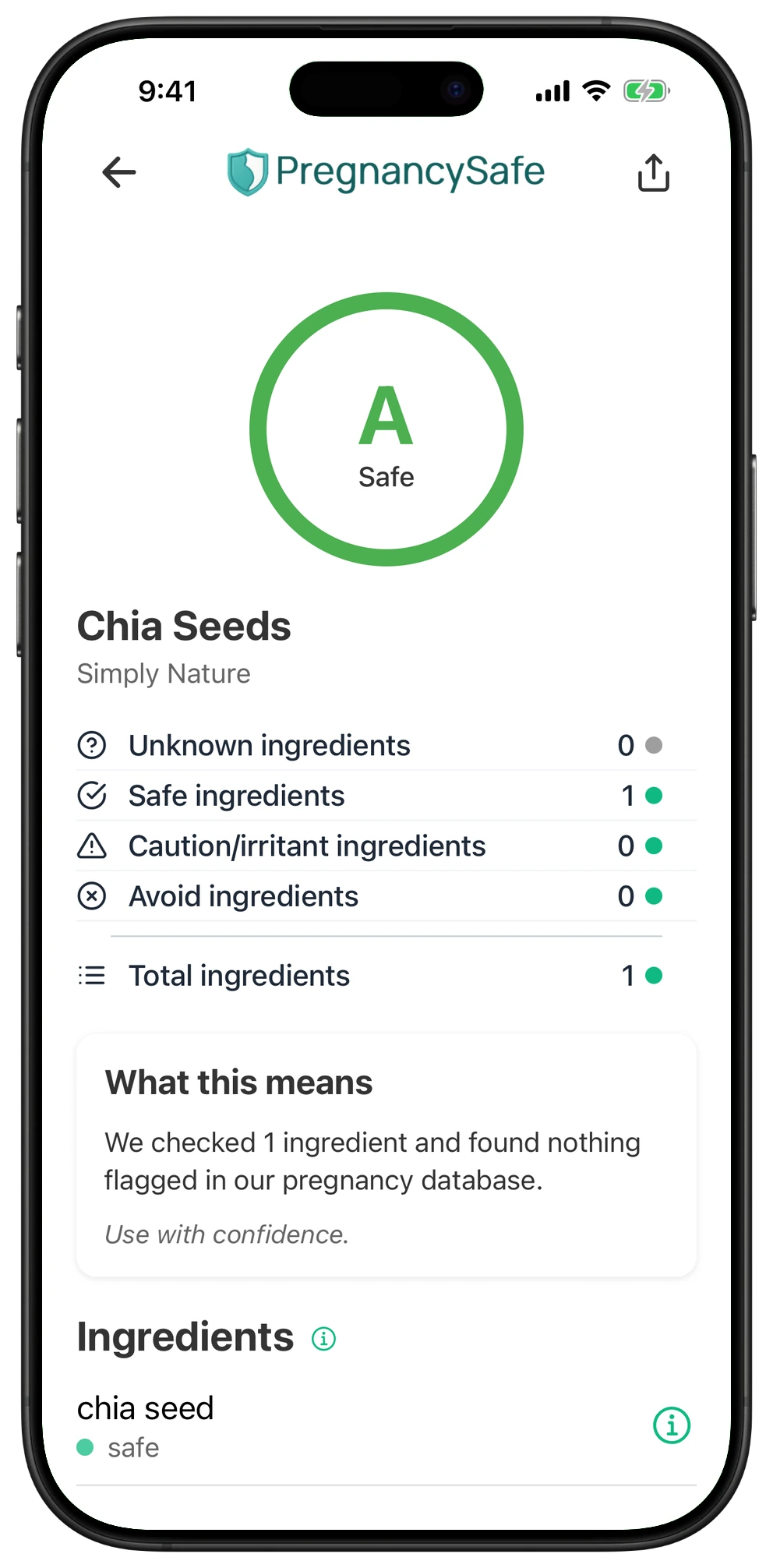
Check your exact chia seeds in the app
✓ What's Safe
- • Choose plain chia seeds when you want to avoid extra ingredients in sweetened or fortified blends.
- • Mix chia into food or hydrate it adequately, following the package preparation directions.
- • Use the package serving size as a food portion guide, not as a proven pregnancy dose.
- • Read the current package’s full ingredient list and allergy information, even if you have bought it before.
- • Follow storage instructions for both the dry seeds and the food you prepare with them.
✗ What to Avoid
- • Do not swallow a spoonful of dry chia seeds on its own.
- • Avoid chia if you have a known chia allergy or have been individually advised not to eat it.
- • Avoid chia drinks or recipes made with alcoholic beverages during pregnancy.
- • Avoid partially hydrogenated oils in chia containing processed foods; do not mistake a nutrition panel heading for an added ingredient.
- • Do not treat concentrated chia oils, supplements, or large amounts as equivalent to ordinary food servings.
- • Avoid relying on claims that chia replaces fish omega-3s, guarantees fetal development, induces labor, or treats disease.
Most Common Ingredients in Chia Seeds Products
We analyzed 238 chia seeds products. Here are the most common ingredients, ranked by how often they appear:
Ingredients to Watch Out For in Chia Seeds
These are the most common flagged ingredients across 238 chia seeds products we analyzed.
trans fat
Caution
Trans fat is a type of unsaturated fat artificially created through hydrogenation, known to increase bad cholesterol levels and raise the risk of heart disease.
Mainly raise concern when partially hydrogenated and high in artificial trans fat; fully hydrogenated oils are mostly a saturated fat limit rather than the same trans fat issue.
Flagged in 9 of 238 products (4%)
alcohol
Caution
Alcohol is a volatile, colorless liquid commonly used as a solvent, disinfectant, or intoxicating beverage.
No amount of Alcohol is considered safe. Avoid alcohol beverages entirely. Be extremely careful when using in cooking or even with small percentages.
Flagged in 2 of 238 products (1%)
bacillus coagulans gbi 30 6086
Caution
Has strain specific safety with limited pregnancy specific data and includes species that can cause foodborne illness or carry toxin genes.
Flagged in 1 of 238 products (0%)
Chia Seeds Products We've Analyzed
Our catalog contains ratings for 238 chia seeds products. These are database grades, not independent safety certifications.
Catalog ingredient grades do not measure current-label completeness, pathogens, preparation, caffeine or clinical pregnancy suitability. These counts include unreviewed records and are not a percentage of independently verified safe products.
Pregnancy Safe Chia Seeds Products
Popular options from our catalog, prioritizing A and B ingredient grades, with C grade options used to fill remaining places. Within each group, products are ordered by searches in Pregnancy Safe, not retail sales. Read the cautions and guidance above; grades do not verify a complete current label or guarantee pregnancy safety.
| Grade | Product | Brand |
|---|---|---|
| A | Chia Seeds | Simply Nature |
| A | Bob'S Red Mill Organic Chia Seeds | Bob'S Red Mill Natural Foods, Inc. |
| A | Chia Seeds | O Organics |
| A | Chia Seeds | Mayorga Organics |
| A | Organic Chia Seed | Trader Joe'S |
Your Questions Answered
Are chia seeds safe during pregnancy?
Plain chia seeds can be part of your pregnancy diet unless you are allergic or have been advised otherwise. Eat them mixed into food or adequately hydrated rather than swallowing dry spoonfuls. This guidance concerns ordinary food use, not concentrated chia supplements or oils.
How much chia can I eat while pregnant?
There is no established pregnancy specific chia dose. Use the package serving size as a practical food portion guide, not a medical target or proven safety limit. If you need individualized portions because of a medical condition or dietary restriction, ask your prenatal clinician or dietitian.
Do I need to soak chia seeds before eating them?
Use chia mixed into food or adequately hydrated rather than swallowing a spoonful of dry seeds. Follow the preparation directions for the particular recipe or package. There is no single pregnancy specific soaking time established here, so do not rely on an arbitrary number of minutes as a safety guarantee.
Can chia seeds replace fish or an omega-3 supplement during pregnancy?
Do not assume chia provides omega-3 benefits equivalent to fish. No pregnancy specific equivalence is established, and ordinary seeds are not interchangeable with a recommended supplement. If you do not eat fish or have been advised to take omega-3s, discuss suitable options with your prenatal clinician.
Should I avoid chia seeds to prevent allergies in my baby?
There is no routine need to avoid ordinary nuts or seeds during pregnancy to prevent allergy in your baby. Your own known allergy is a separate reason to avoid a food. Check package allergy information and follow any individualized advice you have received.
What is the golden rule for every pregnant woman when choosing foods like chia?
No single food or rule guarantees a healthy pregnancy. For chia, focus on ordinary food portions, appropriate preparation, storage instructions, and your own allergy history. Avoid alcoholic preparations, and do not use chia as a substitute for prenatal care or recommended treatment.
Does an A grade mean a chia product is verified safe for pregnancy?
No our catalog contains 238 products: 224 graded A, 12 graded C+, and 2 graded B+. These ingredient grades do not establish current label completeness, pathogen safety, preparation safety, or individual pregnancy suitability, and the counts include unreviewed records. Read your actual package rather than treating a grade as a guarantee. A lower grade or incomplete record is not, by itself, proof that a product is harmful.
How to Interpret These Ratings
Our ingredient and category rules generate letter grades from the information recorded in the catalog. Missing ingredients and broad category assignments can affect the result. These grades do not measure your dose, confirm a complete current label, or test a product for contamination.
A high grade is not a guarantee of pregnancy safety. A low grade is not, by itself, proof of harm from every use. Follow the product-specific guidance above, check the actual package, and ask your prenatal clinician about supplements, treatment decisions or uncertain exposures.
References
- https://www.nhs.uk/pregnancy/keeping-well/foods-to-avoid/
- https://ods.od.nih.gov/factsheets/Pregnancy-HealthProfessional/
- https://www.fda.gov/food/food-additives-petitions/trans-fat
- https://www.fda.gov/food/hfp-constituent-updates/fda-completes-final-administrative-actions-partially-hydrogenated-oils-foods
- https://www.federalregister.gov/documents/2013/11/08/2013-26854/tentative-determination-regarding-partially-hydrogenated-oils-request-for-comments-and-for
- https://www.who.int/news-room/fact-sheets/detail/trans-fat
- https://cdn.realfood.gov/DGA.pdf
- https://www.fda.gov/food/people-risk-foodborne-illness/dietary-advice-and-during-pregnancy
- https://www.rcpi.ie/Portals/0/Document%20Repository/Institute%20of%20Obstetricians%20and%20Gynaecologists/National%20Clinical%20Guidelines/IOG_National%20Clinical%20Guidelines_Nutrition%20in%20pregnancy%20Guideline_2019.pdf
- https://pmc.ncbi.nlm.nih.gov/articles/PMC8027310/
- https://pmc.ncbi.nlm.nih.gov/articles/PMC3192475/
- https://pmc.ncbi.nlm.nih.gov/articles/PMC8308823/
- https://pmc.ncbi.nlm.nih.gov/articles/PMC5759212/
- https://pmc.ncbi.nlm.nih.gov/articles/PMC6811671/
- https://www.efsa.europa.eu/en/topics/topic/qualified-presumption-safety-qps
- https://www.fda.gov/files/food/published/GRAS-Notice-000660---Bacillus-coagulans-GBI-30--6086.pdf
- https://www.bccdc.ca/health-info/diseases-conditions/bacillus-cereus
- https://www.fda.gov/food/people-risk-foodborne-illness/food-safety-booklet-pregnant-women-their-unborn-babies-and-children-under-five