Best Pregnancy Safe Bb Cream (Updated 2026 Guide)
Updated September 9, 2026
The Answer
Choose BB cream by its complete formula: check skincare actives, consider fragrance free options, and preserve broad spectrum sun protection. Our catalog contains 46 products with grades from B+ to F and no A grades, but those scores do not establish whether a formula is safe or unsafe during pregnancy.
BB cream can combine makeup, skincare, sunscreen and acne actives, so check both active and inactive ingredients for your exact shade and market. Retinoids and hydroquinone require pregnancy precautions, while arbutin warrants clinician discussion; ordinary preservatives, silicones and pigments should not be treated as established fetal toxins. Several ingredient concerns involve oral or high dose experimental exposure rather than ordinary facial application, and irritation is distinct from reproductive harm.
Pregnancy Safe is 100% independent and research driven. No companies pay to promote or sponsor products.
Stress Less This Pregnancy
Check your exact bb cream in the app

✓ What's Safe
- • Read the complete active and inactive ingredient lists for the exact shade, country and version you plan to buy.
- • Choose a formula without retinoids or hydroquinone, and discuss arbutin containing brightening formulas with your clinician.
- • Look for fragrance free formulations if scents irritate your skin or you want to reduce exposure to undisclosed scent mixtures.
- • Consider zinc oxide or titanium dioxide sunscreen actives when practical, but assess the whole formula rather than one mineral ingredient.
- • Check broad spectrum protection and application directions; use separate sunscreen if your makeup application cannot provide the labeled coverage.
✗ What to Avoid
- • Avoid retinoid- or hydroquinone containing BB creams during pregnancy rather than assuming makeup needs no skincare precautions.
- • Avoid fragrance, parfum or parfum fragrance if they trigger irritation; these are related scent label terms, not evidence of three separate reproductive hazards.
- • Avoid choosing octinoxate solely for its SPF contribution without considering mineral alternatives; measurable absorption does not itself establish pregnancy harm.
- • Avoid applying formulas containing butyloctyl salicylate to broken skin or over larger areas than directed, where exposure can differ from ordinary facial use.
- • Avoid assuming panax ginseng root extract is pregnancy proven because it is botanical; oral and embryo culture concerns do not establish harm from BB cream.
- • Avoid rejecting a formula solely because it contains phenoxyethanol or aluminum hydroxide: regulated preservative use and topical makeup exposure need different interpretation from infant ingestion or oral antacid dosing.
Most Common Ingredients in Bb Cream Products
We analyzed 46 bb cream products. Here are the most common ingredients, ranked by how often they appear:
Ingredients to Watch Out For in Bb Cream
These are the most common flagged ingredients across 46 bb cream products we analyzed.
Caution
Phenoxyethanol is a preservative commonly used in cosmetics and skincare products to prevent microbial growth and extend shelf life.
Has limited direct pregnancy data and possible infant oral exposure concerns from nipple area products, while regulated cosmetic concentrations are generally considered low systemic risk.
This preservative protects BB cream against microbial growth. Direct pregnancy studies are limited, but regulated cosmetic concentrations are considered acceptable in cosmetic safety reviews; infant oral exposure from nipple products is a different situation from facial use.
Flagged in 31 of 46 products (67%)
aluminum hydroxide
Caution
Aluminum hydroxide is a compound commonly used as an antacid to neutralize stomach acid and as an adjuvant in vaccines.
Is generally low concern for short term labeled antacid use but needs caution with chronic high dose use, kidney disease, constipation, or medication and iron interactions.
The concerns described for aluminum hydroxide mainly involve oral antacid dosing, including prolonged high dose use and medication interactions. Those findings do not establish a pregnancy risk from aluminum hydroxide in a topical BB cream, and its presence alone is not a reason to avoid the formula.
Flagged in 15 of 46 products (33%)
fragrance
Caution
A fragrant substance used to add a pleasant aroma to products or environments.
Can hide product specific mixtures and has been associated with higher DEP metabolite exposure in some pregnancy studies; fragrance allergens and VOCs may also irritate sensitive skin or airways.
Fragrance identifies a scent mixture whose individual components may not be disclosed. In BB cream, irritation or allergy is a practical concern; exposure associations do not prove every mixture contains phthalates or harms pregnancy. Fragrance free is an optional exposure reduction choice.
Flagged in 8 of 46 products (17%)
glycyrrhiza glabra root extract
Caution
Glycyrrhiza glabra root extract is a natural compound derived from licorice root, commonly used for its soothing, anti inflammatory, and sweetening properties in skincare and herbal remedies.
Is low concern in typical topical cosmetics but warrants caution because oral licorice or glycyrrhizin exposure in pregnancy is linked to blood pressure effects, shorter gestation, preterm birth, and child neurodevelopment signals.
This licorice root extract is used for soothing and brightening in skincare. Typical topical concentrations are lower concern than heavy oral licorice intake, which underlies the main pregnancy signals; direct pregnancy data for BB cream use remain limited.
Flagged in 8 of 46 products (17%)
butyloctyl salicylate
Caution
Butyloctyl salicylate is a lightweight, skin friendly ester used in cosmetics and sunscreens to enhance SPF protection and improve product spreadability.
Has limited pregnancy specific data and salicylate exposure may matter with high dose or large area topical use, although routine cosmetic use appears low concern.
This salicylic acid ester works as an emollient and solvent in cosmetic formulas. Direct human pregnancy studies are lacking, while cosmetic reviews support current uses formulated to avoid irritation. Ordinary facial application is not equivalent to oral salicylate dosing; avoid broken skin or unusually extensive application.
Flagged in 7 of 46 products (15%)
octinoxate
Caution
Has measurable dermal absorption and endocrine active signals, with limited direct pregnancy outcome data, so mineral or lower absorption sunscreen filters are preferred when practical.
Octinoxate, also called ethylhexyl methoxycinnamate, is a UVB sunscreen filter. Skin absorption has been measured, but this does not itself prove harm, and direct pregnancy outcome evidence is sparse. Mineral sunscreen actives are a cautious alternative when practical without abandoning sun protection.
Flagged in 7 of 46 products (15%)
bht
Caution
BHT (butylated hydroxytoluene) is a synthetic antioxidant commonly used as a preservative to prevent the oxidation of fats and oils in food products.
Has limited human pregnancy data, with low concern at reviewed cosmetic levels but reproductive and thyroid related findings in high dose oral animal studies.
BHT is an antioxidant that helps stabilize BB cream. Reviewed cosmetic concentrations are considered low concern, although direct human pregnancy data are limited. High dose oral animal findings do not establish reproductive harm from ordinary topical makeup use.
Flagged in 6 of 46 products (13%)
panax ginseng root extract
Avoid
Panax ginseng root extract is a traditional herbal ingredient known for its energizing, adaptogenic, and immune boosting properties.
Is not recommended as an oral supplement in pregnancy because human data are limited and animal or embryo culture ginsenoside studies raise developmental concerns.
This ginseng botanical has limited pregnancy specific evidence for topical BB cream use. Oral supplement recommendations and rodent embryo culture findings do not establish harm from facial application. Choosing a formula without it is an uncertainty reduction option, not a response to proven topical pregnancy harm.
Flagged in 6 of 46 products (13%)
How Do Bb Cream Products Stack Up?
Our catalog contains ratings for 46 bb cream products. These are database grades, not independent safety certifications.
Catalog ingredient scores are not clinical pregnancy verdicts or independent current-label/contaminant checks. Unreviewed, mixed-route or incompletely sourced records can affect counts. Follow exact product form, active ingredients, exposure and directions rather than choosing solely by grade.
Best Pregnancy Safe Bb Cream
Popular options from our catalog, prioritizing A and B ingredient grades, with C grade options used to fill remaining places. Within each group, products are ordered by searches in Pregnancy Safe, not retail sales. Read the cautions and guidance above; grades do not verify a complete current label or guarantee pregnancy safety.
| Grade | Product | Brand |
|---|---|---|
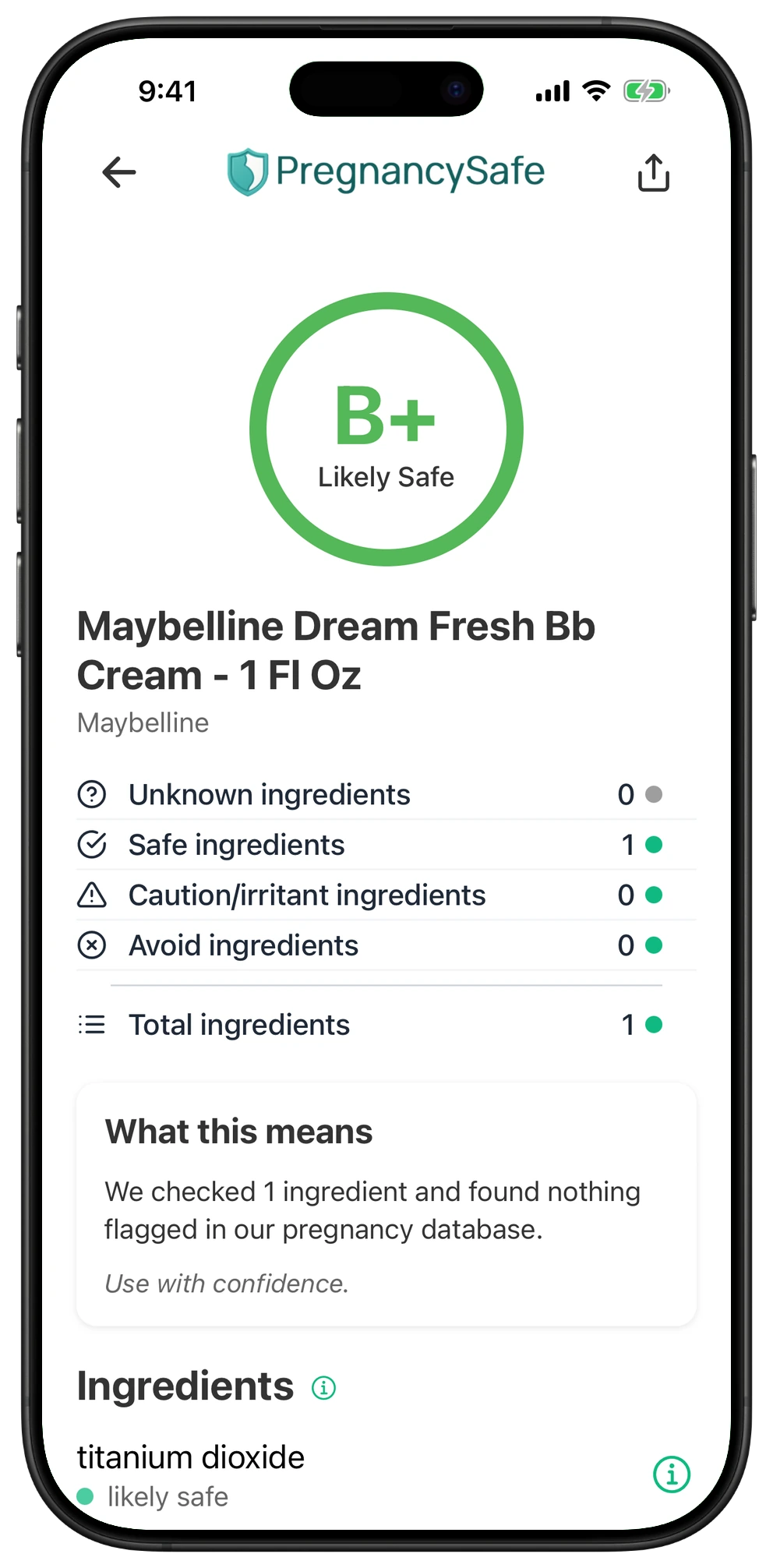
| B+ | Maybelline Dream Fresh Bb Cream | Maybelline |
| C | Dream Fresh Bb Cream 110 Light Medium Catalog caution flags: chamomilla recutita flower extract, phenoxyethanol. Read the category guidance above. | Maybelline |
| C | Dream Fresh Bb Cream 120 Medium Catalog caution flags: chamomilla recutita matricaria flower extract, phenoxyethanol. Read the category guidance above. | Maybelline |
| C- | Dream Pure Bb Cream Skin Clearing Perfector Catalog caution flags: aluminum hydroxide, phenoxyethanol, salicylic acid. Read the category guidance above. | Maybelline |
| C | Dream Fresh Bb Cream 130 Medium/Deep Catalog caution flags: chamomilla recutita flower extract, phenoxyethanol. Read the category guidance above. | Maybelline |
Your Questions Answered
What BB is safe in pregnancy?
Look for a complete formula without retinoids or hydroquinone, and check any brightening or acne treatment ingredients separately. Fragrance free options and mineral sunscreen actives are practical preferences, not pregnancy safety guarantees. The listed products are catalog comparison options, not independent confirmation of every complete current formula. Check your exact shade and market rather than relying on a brand name or grade.
What creams should be avoided during pregnancy?
Avoid creams containing retinoids or hydroquinone during pregnancy. Discuss arbutin containing brightening formulas with your clinician before use. These precautions also apply when the ingredients appear in a BB cream marketed primarily as makeup. A preservative, silicone or pigment on the label is not by itself evidence of fetal harm.
Is the SPF in BB cream enough?
A thin makeup layer may not deliver the SPF printed on the package. Check whether the product provides broad spectrum protection and follow its application and reapplication directions. If you cannot use the BB cream as directed for sunscreen protection, use a separate broad spectrum sunscreen. Titanium dioxide appearing somewhere in the ingredient list does not establish the finished product's protection.
Should I avoid phenoxyethanol in BB cream?
Phenoxyethanol helps prevent microbial growth in cosmetics. Direct pregnancy outcome data are limited, but cosmetic safety reviews consider it acceptable at regulated concentrations. Concerns about infant ingestion from nipple area products are not evidence that ordinary facial application during pregnancy is harmful. Its presence alone is not a reason to discard an otherwise suitable formula.
Are licorice and ginseng extracts unsafe in BB cream?
Glycyrrhiza glabra root extract is licorice extract, and typical topical cosmetic use is lower concern than heavy oral licorice exposure, although pregnancy specific skin use data are limited. Panax ginseng root extract has limited pregnancy evidence, with concerns drawn mainly from oral herbal use and experimental ginsenoside studies. Neither evidence base establishes fetal harm from ordinary BB cream application. You can choose a formula without these optional botanicals if you prefer to reduce uncertainty.
Does a low BB cream grade mean I should stop using it?
Not automatically: ingredient scores are not clinical pregnancy verdicts. Our catalog contains 46 BB creams, including 10 graded F and none graded A, but those counts are not an independent assessment of every current label or product batch. Incomplete records and evidence from different exposure routes can affect scores without proving a product harmful. Check your actual formula and ask your clinician about any pregnancy restricted skincare actives.
How to Interpret These Ratings
Our ingredient and category rules generate letter grades from the information recorded in the catalog. Missing ingredients and broad category assignments can affect the result. These grades do not measure your dose, confirm a complete current label, or test a product for contamination.
A high grade is not a guarantee of pregnancy safety. A low grade is not, by itself, proof of harm from every use. Follow the product-specific guidance above, check the actual package, and ask your prenatal clinician about supplements, treatment decisions or uncertain exposures.
People Also Checked
References
- https://www.aad.org/public/everyday-care/skin-care-secrets/routine/pregnancy-skin-care
- https://www.fda.gov/cosmetics/resources-consumers-cosmetics/cosmetics-pregnancy
- https://health.ec.europa.eu/system/files/2021-08/sccs_o_195_0.pdf
- https://ec.europa.eu/growth/tools-databases/cosing/details/28157
- https://journals.sagepub.com/doi/10.3109/10915819009078737
- https://link.springer.com/article/10.1007/s00204-024-03938-5
- https://www.sfda.gov.sa/en/warnings/1156
- https://www.industrialchemicals.gov.au/sites/default/files/Ethanol%2C%202-phenoxy-_Human%20health%20tier%20II%20assessment.pdf
- https://hero.epa.gov/reference/2857875
- https://books.publisso.de/sites/default/files/documents/series/mak/dam/Vol2019/Iss1/Alt006/mb12299kske6319_w.pdf
- https://www.ncbi.nlm.nih.gov/books/NBK573943/
- https://pmc.ncbi.nlm.nih.gov/articles/PMC9439837/
- https://pmc.ncbi.nlm.nih.gov/articles/PMC2821234/
- https://dailymed.nlm.nih.gov/dailymed/drugInfo.cfm?setid=27848ae0-3b2f-4bfe-8856-4b8de419091e
- https://pubmed.ncbi.nlm.nih.gov/39249590/
- https://pubmed.ncbi.nlm.nih.gov/7565498/
- https://www.ncbi.nlm.nih.gov/books/NBK526049/
- https://www.fda.gov/cosmetics/cosmetic-ingredients/fragrances-cosmetics
- https://www.fda.gov/cosmetics/cosmetic-ingredients/phthalates-cosmetics
- https://www.fda.gov/cosmetics/cosmetic-ingredients/allergens-cosmetics
- https://pmc.ncbi.nlm.nih.gov/articles/PMC3110684/
- https://pmc.ncbi.nlm.nih.gov/articles/PMC4016195/
- https://pmc.ncbi.nlm.nih.gov/articles/PMC4097177/
- https://pmc.ncbi.nlm.nih.gov/articles/PMC8453372/
- https://pmc.ncbi.nlm.nih.gov/articles/PMC10999525/
- https://www.epa.gov/indoor-air-quality-iaq/volatile-organic-compounds-impact-indoor-air-quality
- https://www.nccih.nih.gov/health/licorice-root
- https://cosmileeurope.eu/inci/detail/6154/glycyrrhiza-glabra-root-extract/
- https://pubmed.ncbi.nlm.nih.gov/11390327/
- https://pubmed.ncbi.nlm.nih.gov/12396997/
- https://pubmed.ncbi.nlm.nih.gov/28158597/
- https://pubmed.ncbi.nlm.nih.gov/28833680/
- https://pubmed.ncbi.nlm.nih.gov/16884839/
- https://www.cir-safety.org/sites/default/files/S-breakout-092020.pdf
- https://vkm.no/download/18.948158f1633d1b9fb95930/1525764185285/Hazard%20assessment%20of%20glycyrrhizic%20acid%20from%20liquorice.pdf
- https://www.cir-safety.org/sites/default/files/salicy042019FAR.pdf
- https://pubmed.ncbi.nlm.nih.gov/41243163/
- https://pubmed.ncbi.nlm.nih.gov/38539266/
- https://health.ec.europa.eu/system/files/2023-06/sccs_o_268.pdf
- https://www.ncbi.nlm.nih.gov/books/NBK582985/
- https://www.fda.gov/drugs/drug-safety-and-availability/fda-recommends-avoiding-use-nsaids-pregnancy-20-weeks-or-later-because-they-can-result-low-amniotic
- https://webprod.hc-sc.gc.ca/nhpid-bdipsn/ingredReq?id=11175
- https://health.ec.europa.eu/document/download/3166a978-06de-4526-b25e-8d5a66943a2e_en?filename=sccs_o_294.pdf
- https://www.tga.gov.au/sites/default/files/2025-04/safety-review-seven-active-sunscreen-ingredients.pdf
- https://www.fda.gov/drugs/understanding-over-counter-medicines/questions-and-answers-fda-posts-deemed-final-order-and-proposed-order-over-counter-sunscreen
- https://pubmed.ncbi.nlm.nih.gov/31961417/
- https://pubmed.ncbi.nlm.nih.gov/15191542/
- https://www.ncbi.nlm.nih.gov/books/NBK581587/
- https://pubmed.ncbi.nlm.nih.gov/32108942/
- https://pubmed.ncbi.nlm.nih.gov/40212279/
- https://health.ec.europa.eu/publications/sccs-opinion-ethylhexyl-methoxycinnamate-ehmc-cas-no-5466-77-383834-59-7-ec-no-226-775-7629-661-9_en
- https://www.federalregister.gov/documents/2019/02/26/2019-03019/sunscreen-drug-products-for-over-the-counter-human-use
- https://pubmed.ncbi.nlm.nih.gov/26151237/
- https://pubmed.ncbi.nlm.nih.gov/31195281/
- https://pubmed.ncbi.nlm.nih.gov/35767664/
- https://pubmed.ncbi.nlm.nih.gov/15833384/
- https://pubmed.ncbi.nlm.nih.gov/21059369/
- https://health.ec.europa.eu/system/files/2022-08/sccs_o_257.pdf
- https://pubmed.ncbi.nlm.nih.gov/37751543/
- https://pubmed.ncbi.nlm.nih.gov/12396675/
- https://pmc.ncbi.nlm.nih.gov/articles/PMC13151845/
- https://www.ecfr.gov/current/title-21/chapter-I/subchapter-B/part-172/subpart-B/section-172.115
- https://www.ecfr.gov/current/title-21/chapter-I/subchapter-B/part-182/subpart-D/section-182.3173
- https://www.fda.gov/news-events/press-announcements/fda-finalizes-food-chemical-safety-post-market-assessment-program-launches-reassessment-bht-ada
- https://www.nccih.nih.gov/health/asian-ginseng
- https://www.ema.europa.eu/en/documents/herbal-report/draft-assessment-report-panax-ginseng-camey-radix-revision-1_en.pdf
- https://pubmed.ncbi.nlm.nih.gov/18204104/
- https://pubmed.ncbi.nlm.nih.gov/14507839/
- https://pubmed.ncbi.nlm.nih.gov/15834894/
- https://pubmed.ncbi.nlm.nih.gov/15336721/
- https://pubmed.ncbi.nlm.nih.gov/20091796/